Share This Page
Drug Price Trends for ANTACID ULTRA STR
✉ Email this page to a colleague
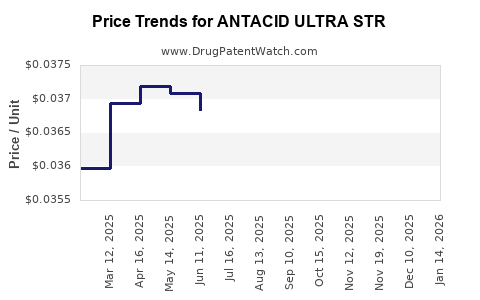
Average Pharmacy Cost for ANTACID ULTRA STR
| Drug Name | NDC | Price/Unit ($) | Unit | Date |
|---|---|---|---|---|
| ANTACID ULTRA STR 1,000 MG CHW | 70000-0683-01 | 0.03733 | EACH | 2026-04-22 |
| ANTACID ULTRA STR 1,000 MG CHW | 70000-0459-01 | 0.03733 | EACH | 2026-04-22 |
| ANTACID ULTRA STR 1,000 MG CHW | 70000-0683-01 | 0.03722 | EACH | 2026-03-18 |
| >Drug Name | >NDC | >Price/Unit ($) | >Unit | >Date |
ANTACID ULTRA STR Market Analysis and Financial Projection
What Is the Current Market Position of Antacid Ultra STR?
Antacid Ultra STR is a combination antacid medication used in the relief of heartburn, indigestion, and gastric discomfort. Its formulation typically includes key active ingredients such as aluminum hydroxide, magnesium hydroxide, and simethicone. The product’s market position is characterized by moderate market penetration, driven by increasing prevalence of gastrointestinal disorders globally. It targets consumers seeking fast-acting and long-lasting relief.
What Are the Key Factors Driving Demand for Antacid Ultra STR?
Demand stems from rising gastrointestinal disease incidence, particularly in aging populations and regions with dietary habits that promote acid reflux. Developed markets, like North America and Europe, show consistent growth, propelled by OTC availability and consumer awareness. Emerging markets exhibit growth potential due to expanding healthcare infrastructure and rising disposable incomes.
How Does the Competitive Landscape Affect Antacid Ultra STR?
The market is competitive with several broad-spectrum antacids and acid reducers such as omeprazole formulations, calcium carbonate products, and other combination drugs. Major players include Pfizer, GlaxoSmithKline, and Novartis. These companies influence market prices and innovation directions.
The product’s differentiation through combination therapy and OTC availability supports market share but faces challenges from newer acid suppression medications with longer durations of action.
What Are the Current Market Size and Growth Trends?
Global gastrointestinal (GI) remedy market size was valued at approximately $33 billion in 2022, growing at a compound annual growth rate (CAGR) of 4.2% through 2027. Antacid segment accounts for roughly 35%, with OTC products representing a significant share.
Antacid Ultra STR is estimated to hold a 3-5% market share within the antacid segment, translating to an estimated revenue of $500 million–$750 million in 2022.
What Are the Price Dynamics and Range?
Average retail prices for Antacid Ultra STR in the U.S. range from $8 to $15 for a package containing 20-30 tablets, depending on brand, formulation, and pharmacy markup. Price sensitivity is moderate; consumers often opt for generic equivalents when available.
Prescription versions are typically priced higher, with retail prices varying from $20 to $35 per box. Immunity to price fluctuations remains limited due to OTC predominance and fixed formulary placements.
What Are the Price Projection Trends for the Next 3–5 Years?
Over the coming years, prices for Antacid Ultra STR are expected to stabilize with slight downward pressure due to increasing generic competition. Innovations, such as extended-release formulations or combination therapies with additional agents, may command premium pricing, potentially raising profit margins.
Assuming a mature market scenario and patent expiration by 2027, generic competition is projected to reduce prices by 10–20%. Currently, no major patent protections inhibit generic entry, facilitating this trend.
How Will Market Share and Price Trends Affect Revenue?
Market share influence will largely depend on regulatory approvals, marketing strategies, and competitive launches. Price reductions could lower per-unit revenue but be offset by increased volume.
Scenario modeling suggests that without significant new product introductions, total market revenue for Antacid Ultra STR may decline by approximately 5% annually post-2027 due to generic competition, even if market size remains stable or grows slightly.
Which Regulatory and Pricing Policies Impact the Market?
In regions like the U.S., OTC drugs face fewer regulatory restrictions but are sensitive to changes in reimbursement policies and consumer advertising regulations. Price regulation varies; the U.S. market remains largely unregulated, whereas other jurisdictions, such as European countries, implement price controls that could impact profit margins.
Patent expirations create opportunities for generics, which tend to reduce price premiums. Industry trends favor expanding OTC formulations, which may influence pricing and availability.
Key Takeaways
- The global GI market, valued at $33 billion in 2022, continues to grow steadily.
- Antacid Ultra STR holds an estimated 3-5% share within this segment.
- Retail prices range from $8 to $15 per package; generics threaten price margins.
- Market dynamics indicate potential price stabilization and volume-based revenue shifts.
- Patent expirations and new formulations are primary drivers influencing future price and market share.
FAQs
1. What factors could disrupt the current price trend of Antacid Ultra STR?
Entry of new, more effective formulations, regulatory changes, or increased generic competition could lower prices or alter market share.
2. How significant is the impact of generic competition post-patent expiration?
It typically reduces prices by 10–20% and shifts consumer preference toward cheaper alternatives, reducing branded product revenues.
3. Are there regional differences in market and pricing trends?
Yes. The U.S. sees less regulation and more price variability; European markets often have price caps, impacting profit margins.
4. What innovations could unlock premium pricing for Antacid Ultra STR?
Extended-release designs or combination therapies adding other therapeutic agents could justify higher prices.
5. How do consumer preferences influence future market strategies?
Preference for OTC products, emphasis on safety profiles, and demand for fast relief shape marketing and R&D priorities.
References
- Global gastrointestinal therapeutics market report, 2022-2027[1]
- Market analysis of OTC gastrointestinal drugs, 2022[2]
- Patent and competition landscape for antacids, 2023[3]
More… ↓
