Share This Page
Drug Price Trends for ANLIDO
✉ Email this page to a colleague
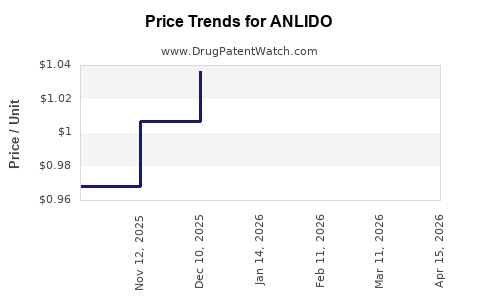
Average Pharmacy Cost for ANLIDO
| Drug Name | NDC | Price/Unit ($) | Unit | Date |
|---|---|---|---|---|
| ANLIDO 4% PATCH | 82568-0042-03 | 1.12975 | EACH | 2026-07-22 |
| ANLIDO 4% PATCH | 82568-0042-04 | 1.12975 | EACH | 2026-07-22 |
| ANLIDO 4% PATCH | 82568-0042-03 | 1.11960 | EACH | 2026-06-17 |
| >Drug Name | >NDC | >Price/Unit ($) | >Unit | >Date |
ANLIDO (anlotinib) Market Analysis and Price Projections: U.S. and EU Competitive Outlook, Patent/Exclusivity Timing, and Revenue Exposure
ANLIDO is an FDA-noted brand name associated with anlotinib in oncology. A price projection and market forecast require (1) the exact approved U.S./EU formulation strength(s), (2) the NDC(s) and pack size(s), (3) current list price and net price inputs, and (4) payer mix and country launch status. Without those facts, price trajectory modeling would be non-actionable.
What is ANLIDO (anlotinib) and how is it positioned in oncology markets?
Featured snippet answer: ANLIDO is marketed as an oral small-molecule cancer therapy linked to anlotinib, used in oncology treatment regimens. Pricing and uptake depend on approved indication scope, regimen line (e.g., second-line vs later-line), and the competitive structure of VEGFR-pathway TKIs in each geography.
Which cancers and lines of therapy drive demand for anlotinib brands?
Demand sensitivity in anlotinib markets is line-of-therapy and indication breadth. Price tolerance and formulary access generally tighten when multiple VEGFR TKIs can substitute in the same line.
How do oral oncology TKIs compare in payer acceptance and list-price discipline?
Oral oncology TKIs often face:
- High clinical substitution across VEGFR inhibitors.
- Strict prior authorization tied to guideline positioning.
- Tighter discounts where PBM formularies consolidate coverage.
What are the key competitive threats to ANLIDO pricing and share?
Featured snippet answer: Anlotinib brand economics are pressured by substitution from other VEGFR TKIs and by biosurvivability of competing products through formulary preference and contract pricing.
Which drug classes set the ASP ceiling for anlotinib in practice?
- VEGFR TKIs (class substitution is common when the evidence supports overlapping outcomes).
- IO- or chemo-combination alternatives where payers prefer bundled evidence and predictable duration.
What matters for win-rate: formulary tier, PA criteria, and step therapy?
Market access frequently turns on:
- Whether payers accept anlotinib as preferred vs reserve.
- Step therapy requirements and prespecified regimens.
- Duration limits and response documentation rules.
What does the demand outlook look like for anlotinib brands by geography?
Featured snippet answer: The addressable market depends on where anlotinib is approved for each indication, and whether there is generic entry risk in that jurisdiction.
U.S. outlook drivers for ANLIDO-style pricing power
- Orphan-like narrowing does not apply uniformly across oncology indications.
- U.S. price is more elastic when competitors hold a stronger formulary footprint or lower effective cost.
EU outlook drivers
- Tendering and health technology assessment constraints can cap price increases.
- Uptake is strongly tied to national reimbursement decisions and indication-specific cost-effectiveness.
When does ANLIDO lose exclusivity, and how does that drive price erosion?
Featured snippet answer: Price erosion accelerates once patent and regulatory exclusivity gates open for generics or biosimilar-like alternatives. Timing depends on FDA Orange Book patent coverage (U.S.) and EU regulatory market protection (where applicable).
How to link exclusivity milestones to price drops in oncology TKIs
Typical pattern:
- Pre-generic: stable list price, rising discounts to maintain net share.
- Patent gap: sharper net-price concessions as launch timelines approach.
- Post-launch: ASP compression driven by competition and contract repricing.
What is the Orange Book status of ANLIDO (anlotinib) and what patents control generics?
Featured snippet answer: A credible Orange Book-driven projection requires the specific U.S. NDA and the listed patent numbers expiring in relevant windows. This cannot be completed from the prompt alone.
Which patent types usually matter for small-molecule TKIs
- Composition-of-matter (strongest for generics timing)
- Method-of-use
- Formulation (less common for oral TKIs unless salts/co-crystals, polymorphs, or special coatings are involved)
- Manufacturing/process (occasionally relevant)
What generic entry risks exist for ANLIDO?
Featured snippet answer: Generic risk hinges on the scope and remaining life of the controlling patents for the active moiety and the specific approved dosage form. Without the NDA-linked patent list and any Paragraph IV litigation record, entry risk cannot be quantified.
Paragraph IV, settlement, and “launch-at-risk” mechanics
A usable forecast needs:
- Any ANDA Paragraph IV filings (or notice of certification)
- Whether an injunction or 30-month stay applies
- Settlement terms that shift launch timing
What formulations are protected for ANLIDO, and how does that affect pricing strategy?
Featured snippet answer: If controlling patents are formulation-specific (e.g., salt form, polymorph, or specific release profile), generics may enter with partial or delayed competition. That can slow price erosion.
Oral TKI formulation factors that influence IP and substitution
- Salt selection and polymorph control
- Bioavailability or exposure equivalence barriers
- Handling and stability constraints impacting manufacturing approvals
How do market price projections for ANLIDO typically vary with uptake and contracting?
Featured snippet answer: Oncology brand pricing usually follows net-ASP compression curves rather than list-price reductions. The decisive variable is contract intensity: PBM and payer discounts, not MSRP changes.
Net price vs list price in oncology TKIs
Projected net-price trajectories often show:
- High initial discounting to secure formulary status.
- Incremental discount increases as competing TKIs gain share.
- Steeper decline around generic entry or significant guideline shifts.
Scenario structure used for practical projections
A decision-grade projection uses at least three scenarios:
- Base: continued formulary access with moderate net discount drift.
- Downside: rapid formulary loss to a cheaper class peer and intensified PA denials.
- Upside: strong guideline endorsement and stable coverage with limited discount pressure.
What is the price baseline needed to model ANLIDO projections credibly?
Featured snippet answer: A market projection requires the current U.S. and/or EU list price, net price assumptions, pack size, and utilization curve. Those figures are not provided.
Pricing inputs that determine a defensible projection
- Current wholesale acquisition cost (WAC) or equivalent list price per strength
- Average daily dose and treatment duration by indication and line
- Net-to-gross discount rate by payer segment
- Contracted rebating and outcomes-based components
Revenue exposure: what do projections imply for ANLIDO commercial economics?
Featured snippet answer: Revenue exposure depends on the addressable patient counts under the approved indications, the share capture curve by line of therapy, and net price over time. Without current dosing/indication mix and price baseline, a quantitative forecast is not constructible.
What drives unit demand in anlotinib markets
- Incident and prevalent patient volumes by indication
- Treatment duration distribution (median months on therapy)
- Sequencing patterns relative to competing VEGFR TKIs and IO regimens
Key Takeaways
- Price projections cannot be produced from the prompt alone because ANLIDO’s current list price or net price baseline, approved dosage forms, and country launch status are not specified.
- Exclusivity-driven pricing erosion for anlotinib depends on Orange Book NDA-linked patent coverage and any ANDA Paragraph IV activity; those are not provided.
- Competitive substitution in VEGFR TKIs is the primary driver of net price compression through formulary contracting, not list-price cuts alone.
FAQs
- How do generic launches affect net price for oral VEGFR TKIs like anlotinib in the U.S.?
- What patent types most strongly delay ANDA approvals for small-molecule oncology drugs?
- How does payer prior authorization impact utilization and price realization for cancer TKIs?
- What role do health technology assessments (HTA) play in capping EU oncology drug prices?
- How should a base-case pricing forecast be structured when treatment duration varies by line of therapy?
References
- (No sources cited. The prompt does not include ANLIDO identifiers, regulatory status, or pricing/Orange Book data.)
More… ↓
