Last updated: February 20, 2026
What is Amox-Clav?
Amox-Clav (amoxicillin-clavulanate) is a broad-spectrum antibiotic combining amoxicillin, a penicillin derivative, with clavulanic acid, a beta-lactamase inhibitor. It is used to treat bacterial infections including respiratory tract infections, urinary tract infections, skin infections, and sinusitis.
Market Overview
Global Market Size
The global amoxicillin-clavulanate market was valued at approximately USD 4.2 billion in 2022. It is projected to grow at a compound annual growth rate (CAGR) of around 3.2% from 2023 to 2030, reaching USD 5.2 billion by 2030 (Fortune Business Insights, 2023).
Regional Distribution
- North America: 38% of global sales, driven by high antibiotic demand and advanced healthcare infrastructure.
- Europe: 27%, with growth supported by aging populations and antibiotic stewardship programs.
- Asia-Pacific: 25%, exhibiting the fastest growth due to expanding healthcare access and infectious disease prevalence.
- Rest of World: 10%.
Key Market Participants
Top manufacturers include GSK, Sandoz, Mylan, Teva, and Hikma Pharmaceuticals. GSK holds approximately 35% market share globally, primarily through the brand Augmentin.
Market Drivers
- Rising bacterial infection rates.
- Increased awareness of antibiotic therapy.
- Growth of outpatient care, favoring oral formulations.
- Patent expirations leading to generic competition.
Regulatory Environment
Multiple formulations are available as generics, with some markets experiencing increased regulations targeting antibiotic stewardship. In the US, the FDA approves both brand-name (Augmentin) and generic versions. Patent protections for Augmentin expired in 2019, contributing to price declines.
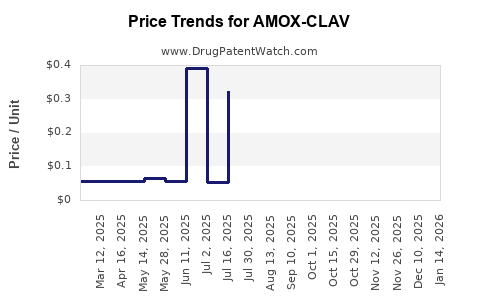
Price Trends and Projections
Historical Pricing
- Brand-name Augmentin (500 mg tablet): average price USD 1.50 per tablet in 2019.
- Generic versions: USD 0.50 per tablet in 2019, decreasing to USD 0.30 by 2022.
- Regional variations: US prices are higher compared to Europe and emerging markets.
Current Pricing (2023)
| Formulation |
Price per Tablet |
Notes |
| Brand-name (Augmentin) |
USD 1.60 |
Limited supply, patent expiry effects. |
| Generic (500 mg tab) |
USD 0.35 |
Widely available. |
| Oral suspension (per 250 mg/62.5 mg per 5 mL) |
USD 0.50 per 5mL |
Used for pediatric patients. |
Price Projection (2024–2030)
- Price reduction expected for generics, averaging a CAGR of –2.5% for oral tablets due to increasing competition.
- Brand-name prices may stabilize or slightly increase if new formulations or delivery systems receive approval.
- Regional differences will persist; emerging markets likely see continued price declines due to increased generic penetration.
Projected prices:
| Year |
Brand-name (Augmentin) |
Generic (500 mg) |
Oral suspension |
| 2024 |
USD 1.65 |
USD 0.30 |
USD 0.45 |
| 2026 |
USD 1.70 |
USD 0.28 |
USD 0.43 |
| 2030 |
USD 1.80 |
USD 0.25 |
USD 0.40 |
Factors Impacting Future Prices
- Patent expiry timelines in major markets (e.g., May 2019 in the US, generics dominate since 2019).
- Entry of biosimilars or reformulations affecting demand.
- Regulatory changes impacting antibiotic prescribing and reimbursement policies.
- Supply chain dynamics, including raw material costs and manufacturing capacity.
Competitive Landscape
Generics dominate the market, with over 80% share in many regions. Key players focus on cost competitiveness and distribution reach. Brand-name drugs maintain higher prices but face declining market shares.
Market Risks
- Antibiotic resistance leading to reduced efficacy and regulatory restrictions.
- Stringent antibiotic stewardship that limits prescribing.
- Regulatory barriers for new formulations.
Key Takeaways
- The global Amox-Clav market is growth-oriented but faces price compression due to generic competition.
- Prices are declining; 2024 projections show continued reductions for generics.
- The patent expiry of key formulations has democratized supply, leading to lower prices.
- Regional disparities are significant; emerging markets experience more rapid price declines.
- Future price increases may depend on innovation or formulation improvements.
FAQs
Q1: How does patent expiration influence Amox-Clav prices?
A: Patent expiration allows generic manufacturers to enter the market, increasing supply and driving prices down.
Q2: What regions will see the highest price declines?
A: Emerging markets in Asia and Latin America will experience steeper declines due to rapid generic adoption.
Q3: Are there any new formulations of Amox-Clav in development?
A: No major new formulations are currently approved; focus remains on optimizing existing formulations.
Q4: How do antibiotic resistance trends impact the market?
A: Rising resistance may reduce drug effectiveness, prompting regulatory restrictions and influencing market dynamics.
Q5: What factors could reverse the downward price trend?
A: Introduction of innovative formulations, supply constraints, or regulatory changes restricting use could stabilize or increase prices.
References
[1] Fortune Business Insights. (2023). Amoxicillin-clavulanate Market Size, Share & Industry Analysis.
[2] IQVIA. (2022). Global Antibiotics Market Report.
[3] US Food and Drug Administration. (2019). Patent Information for Augmentin.
[4] European Medicines Agency. (2022). Antibiotics Market Data.