Share This Page
Drug Price Trends for AMILORIDE HCL-HYDROCHLOROTHIAZIDE
✉ Email this page to a colleague
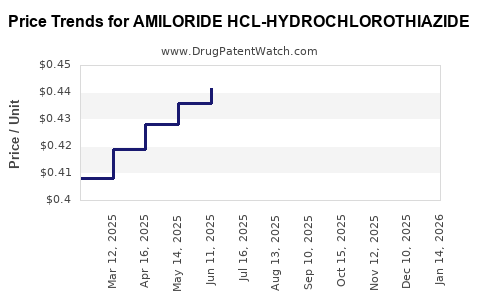
Average Pharmacy Cost for AMILORIDE HCL-HYDROCHLOROTHIAZIDE
| Drug Name | NDC | Price/Unit ($) | Unit | Date |
|---|---|---|---|---|
| AMILORIDE HCL-HYDROCHLOROTHIAZIDE 5-50 MG TAB | 00555-0483-02 | 0.45373 | EACH | 2026-06-17 |
| AMILORIDE HCL-HYDROCHLOROTHIAZIDE 5-50 MG TAB | 00555-0483-05 | 0.45373 | EACH | 2026-06-17 |
| AMILORIDE HCL-HYDROCHLOROTHIAZIDE 5-50 MG TAB | 00555-0483-02 | 0.44788 | EACH | 2026-05-20 |
| AMILORIDE HCL-HYDROCHLOROTHIAZIDE 5-50 MG TAB | 00555-0483-05 | 0.44788 | EACH | 2026-05-20 |
| >Drug Name | >NDC | >Price/Unit ($) | >Unit | >Date |
Market Overview and Price Projections for Amiloride HCl-Hydrochlorothiazide
Amiloride HCl-Hydrochlorothiazide (amiloride/hydrochlorothiazide) combines two diuretics used primarily to treat hypertension and edema. It is available in various formulations, including generic and brand-name products, across multiple markets.
Market Size and Growth Drivers
Global Demand
The diuretics market, including combinations like amiloride/hydrochlorothiazide, was valued at approximately USD 2.5 billion in 2022. It is projected to grow at a compound annual growth rate (CAGR) of 4.2% from 2023 to 2028, driven by increased hypertension prevalence, aging populations, and healthcare access expansion.
Regional Breakdown
- North America: Largest market, with USD 900 million in 2022. High adoption due to chronic disease management and widespread healthcare infrastructure.
- Europe: USD 700 million, influenced by aging demographics and standardized hypertension treatment protocols.
- Asia-Pacific: Fastest growth, with a CAGR of 5.5%, reaching USD 600 million by 2028. Increased healthcare investment and rising hypertension awareness fuel sales.
- Latin America and Middle East: Moderate growth, collectively USD 300 million, driven by improving healthcare systems.
Key Market Participants
- Mylan (now part of Viatris)
- Teva Pharmaceuticals
- Novartis
- Sandoz
- Sun Pharma
The prominence of generics accounts for over 80% of the market, exerting downward pressure on prices.
Pricing trends
Current Wholesale Prices
- Brand-name products: Approximately USD 0.95 per tablet.
- Generic formulations: Ranging from USD 0.05 to USD 0.20 per tablet, depending on dosage and supplier.
Price Competition
The significant patent expirations for primary brands have led to a proliferation of generics, maintaining a competitive price environment. Price variations are most notable across regions due to differing regulatory and procurement policies.
Factors Affecting Prices
- Regulatory approvals expedite market entry for generics.
- Bulk purchasing and volume discounts influence wholesale prices.
- Manufacturing costs, including compliance with Good Manufacturing Practices (GMP), impact pricing. -Currency exchange fluctuations impact regional pricing dynamics.
Price Projections (2023-2028)
| Year | Estimated Average Price (USD per tablet) | Comments |
|---|---|---|
| 2023 | 0.10 - 0.15 | Stable with ongoing generics competition |
| 2024 | 0.09 - 0.13 | Slight decrease due to increased generics supply |
| 2025 | 0.085 - 0.12 | Continued price erosion |
| 2026 | 0.08 - 0.11 | Market stabilization expected post-generic saturation |
| 2027 | 0.08 - 0.10 | Prices plateau as market matures |
| 2028 | 0.075 - 0.10 | Slight further reduction |
Prices in emerging markets are expected to remain at the lower end due to high generics penetration and lower procurement budgets.
Regulatory and Patent Considerations
The primary patent for the key formulations expired in most markets between 2012-2018, enabling widespread generic entry. No significant new intellectual property protections are anticipated for improved formulations within the forecast period.
Strategic Pricing Implications
Pharmaceutical companies should focus on cost efficiency, regulatory compliance, and supply chain optimization to sustain margins amid price competition. Market entry strategies should consider regional pricing sensitivities and healthcare policy environments.
Key Takeaways
- The global amiloride/hydrochlorothiazide market surpasses USD 2.5 billion, with steady growth driven by hypertension prevalence.
- Generics dominate over 80% of sales; pricing remains under downward pressure.
- Prices are forecasted to decline slightly through 2028, stabilizing in mature markets.
- Regional disparities are significant, with Asia-Pacific experiencing the fastest growth and steepest price reductions.
- Strategic focus on cost and regulatory efficiency is critical for market sustainability.
FAQs
1. What factors most influence the pricing of amiloride/hydrochlorothiazide?
Prices are primarily driven by generic competition, manufacturing costs, regulatory approvals, and regional procurement policies.
2. How does patent expiration impact the drug market?
Patent expiration opens the market to generic manufacturers, increasing supply and exerting downward pressure on prices.
3. Are brand-name formulations still relevant?
Brand-name products maintain exclusivity rights in some jurisdictions, commanding higher prices, but their market share diminishes as generics proliferate.
4. What are the key regional differences in market growth?
North America and Europe exhibit mature markets with stable but competitive pricing, while Asia-Pacific shows rapid growth with decreasing prices due to increased generics.
5. How will regulatory changes affect future prices?
Regulatory streamlining can facilitate faster generic approvals, further lowering prices. Conversely, stricter regulations may temporarily increase costs and prices.
References
- MarketWatch. (2022). Diuretics Market Size, Share & Trends.
- IQVIA. (2023). Global Healthcare Data.
- EvaluatePharma. (2023). Dollar Sales & Price Trends.
- World Health Organization. (2022). Hypertension Epidemiology.
- U.S. Food & Drug Administration. (2022). Patent and Exclusivity Data.
More… ↓
