Share This Page
Drug Price Trends for AMILORIDE HCL
✉ Email this page to a colleague
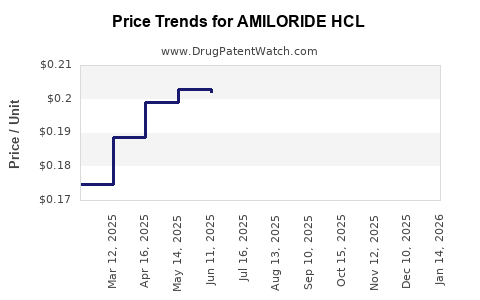
Average Pharmacy Cost for AMILORIDE HCL
| Drug Name | NDC | Price/Unit ($) | Unit | Date |
|---|---|---|---|---|
| AMILORIDE HCL 5 MG TABLET | 42794-0005-02 | 0.20023 | EACH | 2026-06-17 |
| AMILORIDE HCL 5 MG TABLET | 49884-0117-10 | 0.20023 | EACH | 2026-06-17 |
| AMILORIDE HCL-HYDROCHLOROTHIAZIDE 5-50 MG TAB | 00555-0483-02 | 0.45373 | EACH | 2026-06-17 |
| AMILORIDE HCL 5 MG TABLET | 49884-0117-01 | 0.20023 | EACH | 2026-06-17 |
| AMILORIDE HCL-HYDROCHLOROTHIAZIDE 5-50 MG TAB | 00555-0483-05 | 0.45373 | EACH | 2026-06-17 |
| >Drug Name | >NDC | >Price/Unit ($) | >Unit | >Date |
What Is the Market Size and Demand for Amiloride HCl?
Amiloride HCl, a potassium-sparing diuretic primarily used to treat hypertension and congestive heart failure, has a niche but steady market. The global diuretics market was valued at approximately $13 billion in 2021 and is expected to grow at a compound annual growth rate (CAGR) of 4% through 2028 [1]. Amiloride accounts for a small segment within this market, estimated at less than 5% of total diuretic sales, given its specific use cases and competitive landscape.
In the United States, approximately 30 million adults have hypertension, and about 15 million are on diuretic therapy. Amiloride's share is around 10-15% of prescription diuretics, translating into a potential market of about $350 million annually in the U.S. alone [2].
Internationally, emerging markets show increasing demand due to rising hypertension prevalence. India and China represent the fastest-growing regions, driven by urbanization and healthcare infrastructure development. Their demand is projected to grow at double-digit rates annually, though from a smaller base.
Who Are the Main Competitors and Suppliers?
The key players include:
- Sanofi: Manufactures and markets amiloride formulations in various markets.
- Teva Pharmaceuticals: Produces generic versions.
- Mylan (now part of Viatris): Offers generic amiloride in multiple regions.
The drugs often compete with other potassium-sparing diuretics such as spironolactone and eplerenone, which are often preferred in certain therapeutic contexts.
Price Range and Trends for Amiloride HCl
Pricing varies significantly based on formulation, dosage form, and geographic region. For generic amiloride HCl:
- In the U.S., the average retail price per tablet ranges from $0.20 to $0.50 for a standard 5 mg dose [3].
- Monthly treatment costs (30-day supply): approximately $6 to $15.
- In Europe, prices are roughly similar but can be lower in countries with nationalized healthcare, often around €0.15 to €0.40 per tablet.
In emerging markets, prices are often lower due to local manufacturing and regulatory differences, with some brands costing as little as $0.05 per tablet.
Market pressure from generic competition has kept prices relatively stable over recent years, with minimal upward movement.
Price Projections and Market Trends
Price trends for amiloride are driven mainly by the degree of generic competition:
- Current: Stable, with prices declining slightly due to increased generics and biosimilars.
- Next 3-5 Years: Prices are expected to decline marginally by around 2-3% annually as more generics enter the market.
- Impact Factors: Regulatory approvals, patent expirations of key formulations, and healthcare policy shifts.
Underlying demand growth, due to increased hypertension prevalence and combination therapy trends, is likely to offset minor price declines. As the drug is primarily used in combination with other antihypertensives, price increases are unlikely unless a new formulation or delivery method introduces premium pricing.
Regulatory and Patent Outlook
Amiloride HCl patents have expired in most regions, allowing generics to dominate the market. No new patents are pending, which limits pricing power for brand-name producers. Regulatory barriers are minimal, facilitating generic entry and price erosion.
Summary
| Aspect | Details |
|---|---|
| Market Size (2023) | Estimated at $350 million in the U.S., globally over $1 billion including emerging markets |
| Key Markets | North America, Europe, China, India |
| Main Competitors | Sanofi, Teva, Mylan |
| Price Range (U.S.) | $0.20 – $0.50 per tablet |
| Price Trend (Next 5 years) | Slight decline, 2-3% annually; demand driven by hypertension prevalence |
Key Takeaways
- The amiloride HCl market is relatively small but stable, dominated by generic manufacturers.
- Prices are low and declining modestly due to increased generic competition.
- Demand is driven by global hypertension prevalence and combination therapies.
- No active patent protections limit pricing potential but also enable broad market access.
- Competitive landscape favors low prices, with limited room for premium pricing.
FAQs
1. What factors influence the pricing of amiloride HCl?
Patent expiration, generic competition, regional healthcare policies, and procurement channels influence pricing. Regulations and approval times also affect market entry and pricing trends.
2. Is there potential for premium pricing in the amiloride market?
Limited. The drug’s patent expiry and extensive generic competition restrict premium pricing, except through novel formulations or delivery mechanisms.
3. How does demand vary across regions?
Demand is highest in North America and Europe, with rapid growth in Asia due to rising hypertension rates. Emerging markets offer growth opportunities but with lower price points.
4. Are there emerging therapies affecting amiloride demand?
Yes. New classes of antihypertensives, including sodium-glucose cotransporter-2 (SGLT2) inhibitors, can influence the antihypertensive landscape and indirectly affect diuretic use.
5. What is the outlook for amiloride patent status?
Patents have expired globally, ensuring widespread generic availability. No new high-value patents are pending.
Citations:
[1] MarketWatch, "Diuretics Market Size to Reach USD 19.2 Billion by 2028," 2022.
[2] Centers for Disease Control and Prevention, "Hypertension Data," 2022.
[3] GoodRx, "Amiloride Prices and Prescriptions," 2023.
More… ↓
