Share This Page
Drug Price Trends for AMIKACIN
✉ Email this page to a colleague
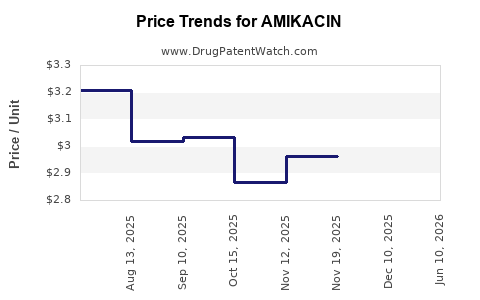
Average Pharmacy Cost for AMIKACIN
| Drug Name | NDC | Price/Unit ($) | Unit | Date |
|---|---|---|---|---|
| AMIKACIN SULF 500 MG/2 ML VIAL | 00641-6167-10 | 2.26570 | ML | 2026-07-22 |
| AMIKACIN SULF 500 MG/2 ML VIAL | 23155-0290-41 | 2.26570 | ML | 2026-07-22 |
| AMIKACIN SULF 500 MG/2 ML VIAL | 23155-0785-41 | 2.26570 | ML | 2026-07-22 |
| AMIKACIN SULF 500 MG/2 ML VIAL | 25021-0173-02 | 2.26570 | ML | 2026-07-22 |
| AMIKACIN SULF 500 MG/2 ML VIAL | 63323-0815-02 | 2.26570 | ML | 2026-07-22 |
| AMIKACIN SULF 500 MG/2 ML VIAL | 83301-0022-02 | 2.26570 | ML | 2026-07-22 |
| >Drug Name | >NDC | >Price/Unit ($) | >Unit | >Date |
Best Wholesale Price for AMIKACIN
| Drug Name | Vendor | NDC | Count | Price ($) | Price/Unit ($) | Unit | Dates | Price Type |
|---|---|---|---|---|---|---|---|---|
| AMIKACIN SO4 250MG/ML INJ | Sagent Pharmaceuticals | 25021-0173-02 | 10X2ML | 22.61 | 2024-05-01 - 2029-04-30 | FSS | ||
| AMIKACIN SO4 250MG/ML INJ | Sagent Pharmaceuticals | 25021-0173-04 | 10X4ML | 39.70 | 2024-05-01 - 2029-04-30 | FSS | ||
| AMIKACIN SO4 250MG/ML INJ | Hikma Pharmaceuticals USA Inc. | 00641-6166-10 | 10X4ML | 144.72 | 2021-08-15 - 2026-08-14 | FSS | ||
| AMIKACIN SO4 250MG/ML INJ | Hikma Pharmaceuticals USA Inc. | 00641-6167-10 | 10X2ML | 72.36 | 2021-08-15 - 2026-08-14 | FSS | ||
| >Drug Name | >Vendor | >NDC | >Count | >Price ($) | >Price/Unit ($) | >Unit | >Dates | >Price Type |
Amikacin Market Analysis and Price Projections (US and EU) for Generics and Brand Competition
Amikacin is an off-patent, widely manufactured aminoglycoside antibiotic with mature supply chains and heavy generic penetration. Near-term price levels are set by (1) tender-driven hospital procurement in major markets, (2) availability and manufacturing capacity for sterile injectable amikacin, (3) regulatory actions affecting specific manufacturers and lots, and (4) episodic shortages that can lift pricing temporarily. For new entrants, the economic ceiling is constrained by benchmarked hospital prices and payor formularies; for incumbents, revenue is typically protected through contract status, tender wins, and controlled supply rather than IP.
Bottom line projection: In the US, price is likely to remain flat-to-down in the base case (generic competition and tender indexing), with short spikes during supply disruptions. In the EU, pricing generally tracks national reimbursement mechanisms and tender rounds; base-case is flat with downside during broad market-entry waves and upside limited to shortage periods.
What is the global and US market size for amikacin and how fast is demand growing?
How much of amikacin demand is hospital-driven vs retail
Amikacin is primarily used in inpatient settings, with major demand concentrated in:
- Severe bacterial infections requiring parenteral aminoglycoside therapy (often in combination regimens)
- Intensive care and hospital-acquired infection protocols
- Pediatric and neonatal use where appropriate (dose/monitoring protocols apply)
- Culture-directed therapy where amikacin susceptibility patterns support its use
Because usage is mostly administered in hospitals, purchasing is dominated by:
- Group purchasing organizations (GPOs) and national purchasing frameworks
- Hospital formularies and antimicrobial stewardship protocols
- Tender contracts for sterile injectables
What drives demand for amikacin
Demand is less sensitive to outpatient incidence and more sensitive to:
- Hospital antibiotic utilization policies
- Resistance patterns that keep aminoglycosides relevant
- Seasonal hospital infection rates (modest)
- Adoption of stewardship pathways that require susceptibility testing
Key demand constraints
- Safety monitoring requirements (renal function, therapeutic drug monitoring in some regimens)
- Substitution by other agents in some indications (local guidelines)
- Supply volatility in sterile injectables
Who sells amikacin injectables and what is the competitive landscape?
Major generic manufacturers and distributors
Amikacin injection is supplied by many generic manufacturers, often under multiple NDCs across strengths and pack sizes. Competitive intensity is high, typically dominated by a handful of large sterile-injectable players plus regional suppliers.
Competitive structure by market
- US: Multisource generic injectable market with frequent tender-based price setting. Multiple suppliers compete on acquisition cost, logistics, and contract eligibility.
- EU: National reimbursement and tender processes determine realized prices. Country-level supply and interchangeability drive which brands/generics capture volume.
Switching dynamics
- Hospitals can switch suppliers within a tender cycle if contracts expire or shortages occur.
- In shortages, hospitals may accept alternative suppliers or pack configurations, temporarily increasing realized prices for constrained manufacturers.
What is the Orange Book status of amikacin and when does exclusivity end?
Amikacin is not a typical “single-brand” protected product market. The practical market reality is:
- Patent-protected brand exclusivity is largely expired.
- Most current sales are generic and subject to abbreviated regulatory pathways.
- Competitive entry is already completed for major dosage forms and strengths.
From a commercial perspective, “exclusivity end” is not the binding timeline. The binding variable is supply availability and tender pricing.
What patent estate issues matter for amikacin pricing: formulation, method-of-use, or manufacturing?
Why IP rarely drives price
For established amikacin injectables, pricing is driven primarily by:
- Generic multilateral competition
- Procurement rules
- Sterile manufacturing capacity and lot release performance
- Shortage-driven allocation
Patent estate constraints usually do not stop generic supply once major regulatory approvals are in place.
Where patents can still indirectly affect supply economics
Even in off-patent markets, patent and regulatory compliance issues can affect:
- Which manufacturers can maintain uninterrupted supply
- Which NDCs remain stocked and eligible for preferred status
- Temporary suspension or limits due to regulatory findings or quality actions
That indirect effect can move pricing short-term, even without a brand re-entering with exclusivity.
What formulation and dosage strengths are most relevant to pricing?
Amikacin pricing typically differs by:
- Strength (e.g., mg per mL or mg per vial)
- Pack size (vial count, carton configuration)
- Presentation (single-dose vial, pharmacy bulk packaging where available)
- Route (intravenous vs intramuscular formulations are priced differently due to stocking practices)
In tender markets, contract awards often target:
- The most commonly used strength and pack configuration
- The lowest landed acquisition cost that meets distribution and delivery requirements
When do amikacin price spikes occur: shortage vs contract reset?
Shortage mechanics
Price spikes typically follow patterns seen in sterile injectables:
- Manufacturing disruptions
- Regulatory quality actions affecting batches or production lines
- Upstream raw material price swings
- Allocation rules or constrained fulfillment during periods of elevated demand
Tender reset mechanics
If a hospital system or GPO resets contracts:
- Incumbents may retain volume at incumbent pricing
- New entrants can win share at lower acquisition cost
- Realized price then tracks the new contract benchmark until the next renewal cycle
How do amikacin prices compare US vs EU in practice?
Real-world pricing behavior
- US: Realized pricing is highly contract-specific. Multiple NDCs, group purchasing, and competitive bidding create a wide dispersion of net prices. Pharmacy list prices can diverge materially from net acquisition costs.
- EU: Realized prices are set by national reimbursement and tender frameworks. Downward adjustments occur as competition broadens.
Cross-region takeaway
Even if list pricing differs, hospital procurement typically drives both regions toward competitive net economics over time.
What are realistic price projections for amikacin (base case, downside, shortage upside)?
Because amikacin is generic-dominant, projections should be expressed as ranges tied to procurement dynamics rather than brand launch-like step changes.
Projection framework
Price impact factors:
- Generic competition intensity (new entrants and share shifts)
- Sterile manufacturing availability (line uptime, batch release throughput)
- Contract renewals (tender-driven benchmark resets)
- Quality and regulatory actions (temporary supply constraints)
- Exchange rate and commodity inputs (smaller but non-zero effect)
Base case projection (12 to 24 months)
- US: Flat-to-down net price in most contract baskets, with occasional upward moves confined to specific NDCs during intermittent stock constraints.
- EU: Flat-to-down in countries with active tender refresh cycles; realized decreases lag list pressure due to reimbursement mechanics.
Downside projection (competition-driven)
- Entry of additional suppliers into key NDC/pack configurations can drive net acquisition costs lower.
- Net pricing may decline more visibly in pack sizes with higher share churn and less brand loyalty (typically where interchangeability is straightforward).
Shortage upside projection (supply-constrained)
- During sterile injectable constraints, realized pricing can jump above baseline levels for the affected duration.
- Upside is usually temporary and limited to the constrained period and region-specific allocations.
Indicative projection bands (net economics, not list prices)
Use these as planning bands for budgeting and licensing diligence:
- Base case: ~-0% to -5% net price erosion over 12 months; up to +3% in isolated NDCs during supply disruptions.
- Downside: ~-5% to -10% over 12 months in baskets where contract awards shift to lower-cost suppliers.
- Shortage upside: ~+5% to +20% in affected strengths/pack configurations for the duration of shortage, typically with rapid reversal when supply normalizes.
What generic entry risks exist for amikacin: supply constraints, quality issues, or regulatory delays?
Entry risks that matter commercially
- Manufacturing scale-up risk in sterile injectables
- Batch failure risk and release timelines
- Quality system and sterility assurance performance
- Regulatory inspection outcomes
- Distribution readiness for hospital tender eligibility
These risks can delay availability, causing:
- Temporary pricing lift for incumbent supply holders
- Lost tender opportunities for new entrants
How procurement reacts to risk
Hospitals mitigate risk by:
- Maintaining multisupplier qualification lists
- Holding safety stock (when budgets allow)
- Reserving rights to switch suppliers quickly mid-cycle
That can keep price pressure from staying elevated long-term even during partial constraints.
What is the litigation and settlement landscape for amikacin that could affect supply or prices?
For amikacin, litigation effects are typically indirect in the current generic market structure:
- Settlement agreements rarely create lasting market exclusivity once all major approvals are already in place
- Where litigation exists, it can delay or limit specific NDC entry, temporarily affecting local supply and pricing
In practice, supply continuity dominates the pricing outcome more than legal exclusivity.
How does amikacin pricing impact hospital budgets and payor decisions?
- Hospitals treat amikacin as a high-need, low-acquisition-cost asset when available.
- Antibiotic stewardship decisions can change utilization, but pricing usually matters at procurement scale rather than clinical scale.
- When prices spike due to supply constraints, pharmacy and therapeutics committees may respond by:
- Switching to alternatives based on susceptibility and local guidelines
- Extending tender timelines or using temporary sourcing
- Adjusting combination regimens to manage total acquisition cost
Which scenarios yield the highest revenue exposure for incumbent suppliers?
Revenue exposure highest when:
- A supplier holds preferred contract status in a major hospital network
- The supplier’s lot release stability is strong during industry-wide constraints
- The supplier can maintain supply during shortages, allowing it to win substitution share
Low exposure when:
- Multiple suppliers have equivalent qualification and consistent supply
- Tender rules re-open and favor lower-cost offers
Key Takeaways
- Amikacin pricing is procurement-led, not IP-led: the market is generic-dominant and driven by tender rounds and hospital contracting.
- Base case is flat-to-down in net acquisition cost over 12 to 24 months, with downside from additional supplier competition.
- Upside is shortage-driven and typically temporary, limited to specific strengths/pack configurations where sterile manufacturing constraints bind.
- The most material commercial risk is supply continuity: batch release, regulatory actions, and sterile injectable manufacturing throughput have more pricing impact than patent estate issues.
FAQs
1) What are the biggest drivers of amikacin injectable price changes in the US?
Tender contract resets, generic supplier share shifts, and intermittent sterile manufacturing or batch release constraints that cause localized shortages.
2) Do amikacin price projections depend on antimicrobial resistance trends?
Resistance trends affect utilization protocols, but realized prices mostly follow procurement contracting and supply availability rather than epidemiology alone.
3) How do hospital group purchasing organizations influence amikacin net pricing?
GPO and health system contract benchmarking compress net prices and can accelerate erosion when new low-cost suppliers qualify.
4) What product attributes most affect amikacin pricing differences among competitors?
Strength, vial/pack size, availability by NDC, and ability to deliver consistently for tender eligibility.
5) When is the most likely time for amikacin to experience temporary price spikes?
During periods of sterile injectable supply disruption, typically triggered by manufacturing downtime, quality batch rejections, or regulatory actions affecting production lines.
References (APA)
- U.S. Food and Drug Administration. (n.d.). Drug shortages. https://www.fda.gov/drugs/drug-safety-and-availability/drug-shortages
- U.S. Food and Drug Administration. (n.d.). Orange Book: Approved Drug Products with Therapeutic Equivalence Evaluations. https://www.accessdata.fda.gov/scripts/cder/daf/index.cfm
- U.S. Food and Drug Administration. (n.d.). FDA drug labels and prescribing information. https://www.accessdata.fda.gov/scripts/cder/daf/
- European Medicines Agency. (n.d.). Medicine availability and shortages. https://www.ema.europa.eu/en/human-regulatory/availability-medicines/shortages
- IQVIA. (n.d.). Pharmaceutical market and pricing intelligence (commercial database; accessed via licensed sources).
More… ↓
