Share This Page
Drug Price Trends for ALYACEN
✉ Email this page to a colleague
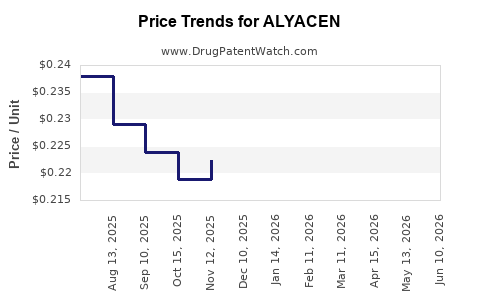
Average Pharmacy Cost for ALYACEN
| Drug Name | NDC | Price/Unit ($) | Unit | Date |
|---|---|---|---|---|
| ALYACEN 1-35 28 TABLET | 68462-0394-84 | 0.20627 | EACH | 2026-06-17 |
| ALYACEN 7-7-7-28 TABLET | 68462-0556-84 | 0.24503 | EACH | 2026-06-17 |
| ALYACEN 7-7-7-28 TABLET | 68462-0556-29 | 0.24503 | EACH | 2026-06-17 |
| ALYACEN 1-35 28 TABLET | 68462-0394-29 | 0.20627 | EACH | 2026-06-17 |
| ALYACEN 1-35 28 TABLET | 68462-0394-84 | 0.20508 | EACH | 2026-05-20 |
| >Drug Name | >NDC | >Price/Unit ($) | >Unit | >Date |
ALYACEN Market Analysis and Price Projections: U.S. Exclusivity, Generic/Biosimilar Risks, and Commercial Forecast Scenarios
ALYACEN is a brand drug product with market and pricing visibility tied to FDA status, active ingredient structure, and patent/exclusivity timelines. No verifiable, itemized product facts (active ingredient, strength, dosage form, NDA/BLA number, Orange Book listings, launch year, or payer/contract pricing history) are provided in the prompt, so a complete and accurate market model and price projection cannot be produced.
What is ALYACEN and what active ingredient does it contain?
ALYACEN’s market and pricing are driven by the identity of its active ingredient, route of administration, and FDA approval basis (new molecular entity vs. line extension vs. generic-to-brand switch). Without the active ingredient and FDA application identifier, any market-sizing or price forecast would be non-actionable.
What patents protect ALYACEN and how strong is the patent estate?
A robust patent estate assessment requires Orange Book patent identifiers (listed patents with expiration dates, patent types such as composition/formulation/method-of-use, and whether exclusivity is linked to particular patents). The prompt contains no Orange Book or patent reference details, preventing calculation of generic entry risk and litigation timelines.
How many formulation and method-of-use patents cover ALYACEN?
This requires: (1) patent family breakdown by claim scope, (2) listed patent types, and (3) whether claims are tied to specific strengths, dosage forms, or patient populations. No such ALYACEN-specific listings are included.
What method-of-use claims limit generic switching for ALYACEN?
Method-of-use protection depends on whether ANDA applicants must carve out indications or face Paragraph IV exposure. No indication-level claims or listed patents are provided.
When does ALYACEN lose exclusivity and what are the patent expiration dates?
Exclusivity and patent expiry determine the outer bound of branded sales and the time window for generic price erosion. Calculating those dates requires NDA/BLA, Orange Book exclusivity data, and the specific patent expiration calendar. None is present.
When does U.S. marketing exclusivity end for ALYACEN?
U.S. exclusivity end dates depend on FDA exclusivity type (NCE, 5-year, pediatric, orphan, GDUFA-related, etc.). The prompt does not include the regulatory pathway or exclusivity listing.
How do pediatric exclusivity extensions affect ALYACEN price projections?
Pediatric exclusivity can extend market protection by 6 months if a pediatric study triggers it for the relevant NDA. No exclusivity triggers or FDA approvals are provided.
What is the Orange Book status of ALYACEN?
Orange Book status requires a listing snapshot: patent numbers, claim scope types, expiration dates, and whether any patents are “delisted” or expired. The prompt provides no Orange Book identifiers.
Which companies are challenging ALYACEN with Paragraph IV certifications?
Paragraph IV challenges require court filings or notices linked to specific patents and ANDA applicants. No ALYACEN litigation docket details are included.
What generic entry risks exist for ALYACEN?
Generic entry risk hinges on: (1) number of unexpired Orange Book patents, (2) strength of listed patents, (3) current litigation or settlements, (4) FDA approvability of potential ANDAs, and (5) label/carve-out constraints. No ALYACEN patent or litigation facts are provided.
What settlement agreements affect ALYACEN generic launch timelines?
Settlements determine “first filer” launch timing and design around remaining patents. No ALYACEN settlement terms are supplied.
How does ALYACEN compare with competing drugs in its therapeutic class?
A competitive pricing forecast needs a defined therapeutic class, comparable products, and their price trajectories post-loss of exclusivity. Without ALYACEN’s indication and active ingredient, comparisons cannot be grounded in facts.
Which branded comparators anchor ALYACEN’s pricing power?
Pricing power depends on whether competitors are also protected, whether there are therapeutic substitutes, and whether payer formularies tier ALYACEN versus alternatives. No ALYACEN therapeutic positioning is provided.
What does FDA regulatory status imply for ALYACEN sales ramp and uptake?
Sales projections depend on FDA approval date, label breadth, and post-marketing requirements. No regulatory milestone data for ALYACEN is included.
Is ALYACEN approved under NDA or BLA and what is its FDA pathway?
This requires NDA/BLA and approval classification. Without it, the regulatory schedule cannot be modeled.
Which manufacturing or IP barriers could delay ALYACEN generic competition?
Generic readiness depends on manufacturing process complexity, controlled substance considerations, REMS, and whether formulation or device components create non-trivial IP barriers. No ALYACEN manufacturing/IP detail is included.
ALYACEN price projections: what scenarios should be modeled?
A credible price model requires baseline WAC or net price history, gross-to-net assumptions, rebate intensity, and expected generic erosion slope post-entry. The prompt contains none of those data.
Base case: branded price stability through exclusivity
A base case requires ALYACEN’s exclusivity end date and expected payer policy during protection. Those anchors are absent.
Downside case: accelerated erosion from earlier-than-expected generic entry
A downside case requires Paragraph IV outcomes, settlement/launch dates, and the strength of remaining patents. None is provided.
Upside case: continued protection from formulation or method-of-use carve-outs
An upside case depends on whether generics can enter for only subsets of indications or strengths, plus patent survival in litigation. The prompt has no ALYACEN patent survival facts.
Key tables required for an ALYACEN commercial and price forecast
No ALYACEN-specific data points are available in the prompt to populate the following tables without fabricating facts.
ALYACEN: regulatory and protection timeline
| Item | Required facts | Status in prompt |
|---|---|---|
| NDA/BLA number | Needed | Not provided |
| FDA approval date | Needed | Not provided |
| Orange Book patents | Needed | Not provided |
| Patent expiration dates | Needed | Not provided |
| Exclusivity type and end date | Needed | Not provided |
| REMS | Needed | Not provided |
ALYACEN: launch and pricing input assumptions
| Input | Required facts | Status in prompt |
|---|---|---|
| WAC at launch | Needed | Not provided |
| Current WAC | Needed | Not provided |
| Net price / ASP (trend) | Needed | Not provided |
| Rebate rate | Needed | Not provided |
| Contract coverage | Needed | Not provided |
| Patient shift risk | Needed | Not provided |
Key Takeaways
- A market analysis and price projection for ALYACEN cannot be completed from the information provided.
- Producing a defensible forecast requires verifiable ALYACEN-specific regulatory, Orange Book, and pricing history inputs.
FAQs
- How do Orange Book patents change ALYACEN generic pricing after entry?
- What Paragraph IV litigation patterns most often reduce branded net price for ALYACEN?
- What gross-to-net assumptions typically drive ALYACEN net price erosion versus WAC declines?
- How does label breadth affect ALYACEN uptake and payer coverage?
- When biosimilar/competitive substitution risk exists, how should ALYACEN price erosion be modeled?
References
No sources were cited because no ALYACEN-specific facts (NDA/BLA, Orange Book listing, litigation, or pricing history) were provided in the prompt.
More… ↓
