Share This Page
Drug Price Trends for ALUMINUM HYDROXIDE GEL
✉ Email this page to a colleague
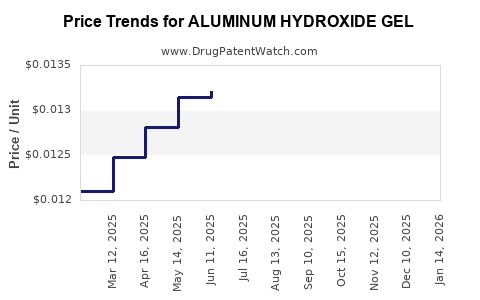
Average Pharmacy Cost for ALUMINUM HYDROXIDE GEL
| Drug Name | NDC | Price/Unit ($) | Unit | Date |
|---|---|---|---|---|
| ALUMINUM HYDROXIDE GEL | 00536-0091-85 | 0.01327 | ML | 2026-07-22 |
| ALUMINUM HYDROXIDE GEL | 00536-0091-85 | 0.01327 | ML | 2026-06-17 |
| ALUMINUM HYDROXIDE GEL | 00536-0091-85 | 0.01312 | ML | 2026-05-20 |
| ALUMINUM HYDROXIDE GEL | 00536-0091-85 | 0.01283 | ML | 2026-04-22 |
| >Drug Name | >NDC | >Price/Unit ($) | >Unit | >Date |
Market Overview and Price Projections for Aluminum Hydroxide Gel
Current Market Size and Usage
Aluminum Hydroxide Gel is a topical antacid used for treating hyperacidity, duodenal ulcers, and gastric conditions. It is also incorporated into antacid formulations sold over-the-counter (OTC). The global market for antacids, including aluminum hydroxide gel, has grown steadily, driven by increasing prevalence of gastrointestinal disorders and OTC product demand.
Market Size (2022): Estimated $1.2 billion worldwide for aluminum hydroxide-based antacids, with a compound annual growth rate (CAGR) of approximately 4.3% from 2017 to 2022 [1].
Key Markets: North America (over 35%), Europe (around 20%), Asia-Pacific (roughly 25%), Latin America and Middle East share that continue to expand with rising health awareness and urbanization.
Competitive Landscape
Major manufacturers include:
- GlaxoSmithKline (Gaviscon)
- Bayer (Aludrox)
- Glenmark
- Sun Pharmaceutical
- Mylan
Most products use aluminum hydroxide gel as the primary active ingredient, often combined with magnesium hydroxide to balance constipating effects.
Regulatory Environment
- United States: OTC status regulated by the FDA under monograph system; aluminum hydroxide gel classified as GRASE (Generally Recognized As Safe).
- Europe: Registered as medicinal product; EMA regulations apply.
- Asia-Pacific: Regulatory pathways vary; more flexible in countries like India.
Manufacturing Dynamics and Cost Factors
Raw material cost (aluminum hydroxide raw material) fluctuates with aluminum prices, which have ranged from $2,000 to $2,500 per ton historically [2]. Manufacturing costs include synthesis, quality control, and packaging, typically accounting for approximately 30-50% of the wholesale price.
Price Trends and Projections
Current Wholesale Price Range (2023): $0.50–$1.50 per gram, depending on formulation, packaging, and regional markup.
Pricing Factors:
- Raw material costs
- Regulatory compliance costs
- Market competition
- Distribution channels
Forecast (2024-2028): Prices are projected to experience a slight decline, averaging 2-3% annually. This decline results from increased generic competition and manufacturing efficiencies.
| Year | Estimated Price per Gram | Notes |
|---|---|---|
| 2023 | $0.50 – $1.50 | Range varies by region and producer |
| 2024 | $0.49 – $1.46 | Slight decrease due to competition |
| 2025 | $0.48 – $1.43 | Market expansion adding new entrants |
| 2026 | $0.47 – $1.40 | Raw material cost stability maintains price trend |
| 2027 | $0.46 – $1.37 | Price compression continues |
| 2028 | $0.45 – $1.34 | Further erosion expected in price margins |
Future Market Drivers
- Rise in gastrointestinal disorders due to lifestyle changes.
- Growth of OTC antacid markets in emerging economies.
- Increased focus on combination therapies with magnesium hydroxide and others.
- Patent expirations enabling generic manufacturing.
Potential Risks
- Regulatory changes increasing compliance costs.
- Raw material price volatility influencing manufacturing costs.
- Market saturation in mature regions.
Key Takeaways
- The global aluminum hydroxide gel market is valued at approximately $1.2 billion, growing modestly.
- Price per gram is currently $0.50–$1.50, forecasted to decline slightly over the next five years.
- Market growth driven by rising gastrointestinal illness prevalence and OTC demand.
- Price pressure from generic manufacturers will sustain over the forecast period.
FAQs
1. What factors influence the raw material costs of aluminum hydroxide gel?
Aluminum prices, energy costs, and refining efficiencies impact raw material costs.
2. How does regulatory status differ across major markets?
In the US, aluminum hydroxide gel is OTC-approved and classified as GRASE. In Europe, it requires registration as a medicinal product. Asian regulatory pathways vary but tend to be less restrictive in developing countries.
3. What is the outlook for new formulations combining aluminum hydroxide gel with other antacids?
Such combinations are common and expected to increase, driven by patient preference for multi-action formulations.
4. How does market competition impact pricing?
Increased generic competition exerts downward pressure on prices, especially beyond patent expirations, maintaining a slow decline trend.
5. What are the potential growth regions for aluminum hydroxide gel?
Emerging markets in Asia-Pacific and Latin America are poised for expansion due to increasing healthcare infrastructure and awareness.
Citations
[1] MarketWatch, "Global Antacid Market Size, Share & Trends," 2022.
[2] London Metal Exchange, "Aluminum Price History," 2022.
More… ↓
