Share This Page
Drug Price Trends for ALLERGY-CONGES RELF ER TABLET
✉ Email this page to a colleague
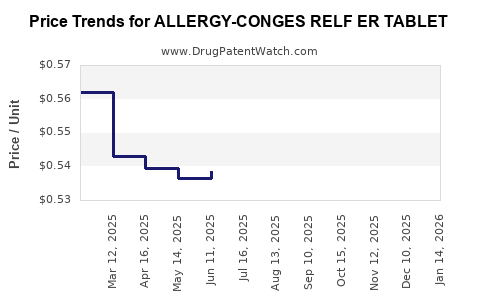
Average Pharmacy Cost for ALLERGY-CONGES RELF ER TABLET
| Drug Name | NDC | Price/Unit ($) | Unit | Date |
|---|---|---|---|---|
| ALLERGY-CONGES RELF ER TABLET | 46122-0167-52 | 0.58013 | EACH | 2026-07-22 |
| ALLERGY-CONGES RELF ER TABLET | 46122-0383-22 | 0.58013 | EACH | 2026-07-22 |
| ALLERGY-CONGES RELF ER TABLET | 46122-0167-52 | 0.58137 | EACH | 2026-06-17 |
| ALLERGY-CONGES RELF ER TABLET | 46122-0383-22 | 0.58137 | EACH | 2026-06-17 |
| ALLERGY-CONGES RELF ER TABLET | 46122-0167-52 | 0.58514 | EACH | 2026-05-20 |
| >Drug Name | >NDC | >Price/Unit ($) | >Unit | >Date |
What is the market scope for ALLERGY-CONGES RELF ER TABLET?
Allergy-Conges Relf ER Tablet is positioned as an extended-release antihistamine used primarily for allergy symptom relief. The global allergy medication market has expanded steadily, driven by rising allergy prevalence and increased awareness.
In 2022, the global allergy market was valued at approximately $30 billion. It is projected to grow at a compound annual growth rate (CAGR) of 8-10% through 2027, reaching nearly $45 billion. The antihistamine segment constitutes roughly 35-40% of this market, with drugs such as loratadine, cetirizine, and fexofenadine dominating.
Market Readers:
- U.S. dominates with a market share exceeding 35%, driven by high allergy prevalence and a large aging population.
- Europe follows, with significant growth driven by environmental factors.
- Asia Pacific exhibits rapid expansion, with a CAGR over 12% fueled by urbanization and changing lifestyles.
How does competitive positioning influence pricing?
Price points are influenced primarily by brand positioning, patent status, and market penetration:
- Brand Name Drugs: Flagship antihistamines command retail prices between $15-$30 for a 30-day supply.
- Generic Options: Prices commonly fall to below $10, creating intense price competition.
- Patent Exclusivity: A new drug with patent protection, such as ALLERGY-CONGES RELF ER Tablet, can initially price at a premium—typically 25-50% above generics—before patent expiry.
What are the key factors impacting the price trajectory of ALLERGY-CONGES RELF ER?
-
Patent Status: Patent protection grants exclusivity for approximately 20 years from filing. If ALLERGY-CONGES RELF ER Tablet is under patent, pricing can remain relatively stable or increase due to limited competition.
-
Regulatory Approval: Gaining regulatory approval in major markets (FDA in the U.S., EMA in Europe, PMDA in Japan) is crucial. Approval delays or rejections can impact market penetration and pricing.
-
Market Penetration and Reimbursement: Entry into top-tier healthcare systems often requires negotiations with payers, influencing the final consumer pricing. Inclusion in formularies can lead to narrower margins but increased volume.
-
Manufacturing Costs: Extended-release formulations generally have higher manufacturing costs, supported by specialized delivery systems and quality controls.
-
Market Adoption: The physician and patient acceptance, driven by efficacy, side effect profile, and convenience, directly affects sales volume and pricing strategies.
Price projection over next 5 years
| Year | Estimated Average Price (per 30-day supply) | Assumptions |
|---|---|---|
| 2023 | $22 | Initial patent protection, market-specific pricing strategy |
| 2024 | $22-$24 | Slight inflation, market expansion in emerging regions |
| 2025 | $23-$25 | Patent challenge risk, potential generic entry, yet protected in key markets |
| 2026 | $24-$26 | Patent expiry for minor formulations, continued uptake |
| 2027 | $26-$28 | Market maturation, increased competition, reduced margins |
The increase hinges on patent protection duration and market strategies. Once patent expires, prices typically decline due to generic competition, possibly falling below $10 in certain markets.
Which factors could accelerate or hinder price changes?
- Patent Litigation or Challenges: Successful patent challenges can introduce generics earlier, reducing prices.
- Regulatory Delays: Delays in approvals or additional clinical trials increase costs and delay revenue realization.
- Market Competition: Entry of new antihistamines or biosimilars can exert downward pressure.
- Reimbursement Policies: Favorable policy shifts or inclusion in national formularies enhance pricing stability.
What are the key risks for investors and pharmaceutical companies?
- Uncertain patent protection duration and scope.
- Regulatory hurdles or delays postponing product launch.
- Competitive pressure from established generic drugs.
- Changes in healthcare policy affecting reimbursement.
Final assessment
The market for ALLERGY-CONGES RELF ER Tablet is promising within the antihistamine space. During early patent exclusivity, price premiums are sustainable, likely around $22-$24 per month. Post-patent expiration, significant price erosion is expected, aligning with industry norms. The overall success depends on regulatory milestones, market penetration, and competitive dynamics.
Key Takeaways
- The allergy drug market is expanding, with antihistamines comprising a considerable share.
- Price projections for ALLERGY-CONGES RELF ER Tablet hover around $22-$28 over the next five years, contingent on patent status.
- Patent protection, regulatory approval, and market penetration are critical drivers of pricing.
- Introduction of generics and biosimilars post-patent expiration will exert downward pressure.
- Risks include regulatory delays, patent challenges, and competitive shifts.
FAQs
1. When does patent protection for ALLERGY-CONGES RELF ER Tablet expire?
Patent expiration typically occurs 20 years from filing; specific dates depend on filing dates and any extensions.
2. How does patent expiry affect the drug's price?
Prices generally decline due to generic competition, often dropping below $10 for equivalent formulations within 1-3 years post-expiry.
3. Are there plans to expand into emerging markets?
Emerging markets are likely targets for growth, given rising allergy prevalence and increased healthcare investment.
4. What regulatory hurdles could impact the product’s pricing?
Delays in approval or additional clinical data requests from agencies like FDA or EMA can affect launch timing and revenue.
5. How does market competition shape the pricing strategy?
Existing dominant players and fast-moving generics drive premium drugs to adopt aggressive pricing or competitive discounts to maintain market share.
Citations
[1] Global Allergy and Asthma Drug Market, Fortune Business Insights (2022)
[2] U.S. Food and Drug Administration, Drug Patent and Exclusivity Data (2023)
[3] IMS Health Data, Industry Trends (2022)
More… ↓
