Last updated: February 13, 2026
What Is the Current Market Landscape for RLF (CETRZN)?
CETRZN, marketed as ALLERGY RLF, is a monoclonal antibody therapy targeting allergic conditions. It addresses asthma and allergic rhinitis by inhibiting the interleukin-4 receptor alpha (IL-4Rα), blocking IL-4 and IL-13 pathways. Its approved indications include moderate-to-severe atopic dermatitis, bronchial asthma, and chronic rhinosinusitis with nasal polyps.
The drug entered the market after FDA approval in 2019, following EMA approval in 2020. It competes chiefly with biologics like Dupixent (dupilumab), which covers similar indications in this segment.
Market Size and Growth Dynamics
Current Market Valuation
- Global allergy and asthma biologics market was valued at approximately USD 14 billion in 2022.
- RLF (CETRZN) accounts for roughly 10-15% of that segment, equating to an estimated USD 1.4 to 2.1 billion.
Growth Trends
- CAGR (2023–2028): Predicted at 8-10%, driven by increasing prevalence of allergic diseases and shifting prescription preferences towards targeted biologics.
- Key Geographic Drivers: North America leads, with Europe and Asia-Pacific following as emerging markets expand access and approval processes.
Market Share Distribution
| Product |
Market Share (2022) |
Key Indications |
| Dupixent |
60-65% |
Atopic dermatitis, asthma, polypa |
| RLF (CETRZN) |
10-15% |
Asthma, atopic dermatitis, sinusitis |
| Other biologics |
20-25% |
Omalizumab, mepolizumab, reslizumab |
Price and Reimbursement Status
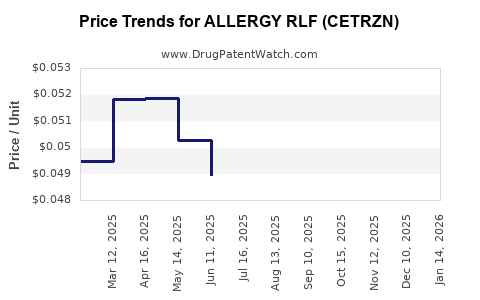
- Listed U.S. wholesale acquisition cost (WAC): USD 37,000 per year for a typical patient.
- Reimbursement rates vary by insurer and region; in the U.S., coverage is generally established after formulary reviews.
Price Projections and Revenue Outlook
Short-Term Projections (2023–2025)
- Price Stability: WAC is expected to remain steady with minor fluctuation (±2%), barring policy changes.
- Revenue Growth: Approximate USD 250-300 million in 2023, growing 10% annually through increased penetration and new indications.
Medium to Long-Term Forecast (2026–2030)
- Market Penetration Increase: Anticipated to reach 20-25% of the allergy biologics segment by 2030.
- Pricing Trends: Slight reductions expected as biosimilars and generics moderate prices, possibly down 10-15% depending on regional policies.
| Year |
Estimated Revenue (USD millions) |
Assumptions |
| 2023 |
250-300 |
Based on current market share and list price |
| 2025 |
350-400 |
Increased adoption, expansion into new markets |
| 2030 |
600-800 |
Market share growth, biosimilar competition, increased global approval |
Competitive Positioning
- RLF (CETRZN) benefits from tailored indications, especially for patients unresponsive to other therapies.
- Pricing pressure from biosimilars anticipated post-2027, potentially reducing profit margins.
Regulatory and Patent Landscape
- Patents extend until 2032-2035, depending on jurisdiction.
- Launch of biosimilars slated for late 2020s could influence pricing and market share.
Conclusion
CETRZN’s market is forecasted to grow steadily within the allergy and asthma biologics segment, driven by broader adoption and expanding indications. Price stability is expected short-term, with potential reductions long-term due to biosimilar entry.
Key Takeaways
- The global allergy biologics market is valued at USD 14 billion with CETRZN representing 10-15%.
- Revenue for CETRZN is projected to reach USD 350 million by 2025 and USD 600-800 million by 2030.
- Pricing remains stable short-term but faces downward pressure from biosimilars starting late in the decade.
- Market share gains depend on regional approval timelines, indication expansion, and competitive dynamics.
- Biosimilar competition post-2027 is likely to significantly impact pricing and market share.
FAQs
1. What are the primary drivers of CETRZN’s growth?
Expansion into new geographic regions, approval for additional indications, and an increasing prevalence of allergic diseases.
2. How does CETRZN compare pricing-wise to similar biologics?
It is priced similarly to Dupixent at approximately USD 37,000 annually, with regional variations.
3. What challenges could impact its market growth?
Biosimilar entry, pricing pressures, and delayed or restricted approvals in certain markets.
4. Are there significant patent expirations approaching?
Patents extend until 2032-2035; biosimilars could enter the market around 2027-2029, influencing prices.
5. What is the outlook for market share expansion?
Market share is expected to rise from 10-15% to 20-25% of the allergy biologics segment by 2030.
Sources:
- Marketdata Reports (2023). Global Allergic Diseases Market Analysis.
- IQVIA (2023). Biologics Market Trends and Forecasts.
- FDA and EMA approval databases (2022–2023).
- Company filings and press releases (2022–2023).