Share This Page
Drug Price Trends for ALISKIREN
✉ Email this page to a colleague
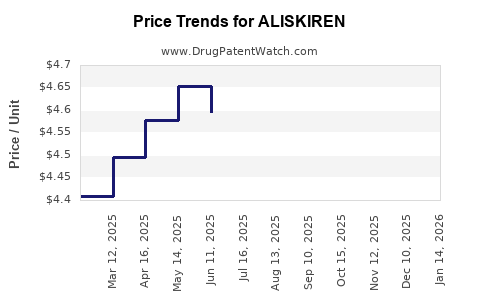
Average Pharmacy Cost for ALISKIREN
| Drug Name | NDC | Price/Unit ($) | Unit | Date |
|---|---|---|---|---|
| ALISKIREN 150 MG TABLET | 49884-0424-11 | 4.09579 | EACH | 2026-06-17 |
| ALISKIREN 300 MG TABLET | 49884-0425-11 | 5.67618 | EACH | 2026-06-17 |
| ALISKIREN 150 MG TABLET | 66993-0141-30 | 4.09579 | EACH | 2026-06-17 |
| ALISKIREN 300 MG TABLET | 66993-0142-30 | 5.67618 | EACH | 2026-06-17 |
| ALISKIREN 150 MG TABLET | 49884-0424-11 | 4.21953 | EACH | 2026-05-20 |
| >Drug Name | >NDC | >Price/Unit ($) | >Unit | >Date |
What Is the Current Market Position for Aliskiren?
Aliskiren (brand name Tekturna) is a direct renin inhibitor approved by the U.S. Food and Drug Administration (FDA) in 2007 for hypertension treatment. Its market presence remains limited compared to first-line antihypertensives due to safety concerns, dosing complexity, and competition from ACE inhibitors and ARBs.
Market Size and Revenue
As of 2022, global sales of aliskiren were approximately $300 million, a decline from peak sales over $500 million in 2012. The drug's market share within hypertension therapies remains below 2%, primarily used in patients intolerant to ACE inhibitors or ARBs.
Market Drivers and Limitations
-
Drivers: Increasing hypertension prevalence in aging populations; ongoing clinical trials exploring novel indications.
-
Limitations: Frequency of adverse effects such as hyperkalemia and renal impairment; lack of demonstrated mortality benefit; competition from generics and combination therapies.
How Does the Patent Landscape Affect Future Market Dynamics?
Patent Status
The original composition patent for aliskiren expired in the U.S. in 2016, allowing generics to enter the market. Several generics are now available, reducing the drug's price and impacting branded sales.
- Existing Patents: Patent protection for formulations and specific delivery methods extends through 2024 in certain regions, but these are jurisdiction-specific and subject to patent challenges.
Patent Challenges and Market Entry
Generic manufacturers have launched equivalent formulations since patent expiration, increasing price competition. Patent disputes and regulatory hurdles may delay new patent filings or extensions.
What Are the Price Trends and Projections?
Current Pricing
-
Brand Name (Tekturna): Approximately $500 - $600 per month in the U.S.
-
Generics: Around $20 - $40 per month, reflecting a >90% price decline post-patent expiration.
Future Price Trends
Over the next five years, generic competition is expected to stabilize prices at current levels or further decrease, driven by increased market penetration.
Market Potential for New Formulations or Indications
-
Extended-release formulations could command higher prices if proven to improve adherence.
-
Clinical trials exploring use in heart failure or diabetic nephropathy may open new markets, potentially affecting pricing strategies.
What Are the Outlooks and Key Factors Affecting Market Share?
-
The drug's safety profile continues to limit adoption.
-
Emerging combination therapies, such as aliskiren with amlodipine, may recapture some market share but face regulatory scrutiny due to potential adverse effects.
-
Competitive pressure from established antihypertensives, especially ACE inhibitors (e.g., lisinopril) and ARBs (e.g., losartan), constrains market expansion.
What Are the Price Projections for the Next Five Years?
| Year | Estimated Average Price (USD) | Notes |
|---|---|---|
| 2023 | $15 – $20 (generics) | Market stabilized at generic prices |
| 2024 | $10 – $15 | Potential further decline due to increased competition |
| 2025 | $8 – $12 | Possible introduction of fixed-dose combo therapies |
| 2026 | $7 – $10 | Market saturation with generics and biosimilars |
| 2027 | $6 – $9 | Limited room for price increase post-competition |
Key Takeaways
-
Aliskiren's global sales peaked in 2012 but declined sharply after patent expiration.
-
Generics dominate the current market, reducing prices and sales volume.
-
Limited safety advantages and competition limit market expansion prospects.
-
New formulations or indications could temporarily influence pricing and market share.
-
Price projections suggest a continued decline, stabilizing at low levels in the next five years.
FAQs
1. What factors led to the decline in aliskiren’s market share?
Patent expiration, safety concerns, and stiff competition from generic brands and alternative therapies have reduced its market share.
2. Are there any new formulations of aliskiren in development?
Yes, extended-release formulations are under investigation, which could improve patient adherence and justify higher prices.
3. How do safety concerns impact market adoption?
Adverse effects like hyperkalemia and renal impairment restrict broader acceptance, especially among high-risk patient populations.
4. What are the leading competitors to aliskiren?
ACE inhibitors such as lisinopril and ARBs like losartan maintain dominant market positions, offering similar efficacy with established safety profiles.
5. What regulatory trends could influence aliskiren’s future pricing?
Patent challenges and the approval of combination therapies or new indications could alter the competitive landscape and affect pricing.
References
- EvaluatePharma. (2022). Aliskiren global sales report. Retrieved from evaluate.com.
- U.S. Food and Drug Administration (FDA). (2007). Summary of FDA approval for Tekturna.
- IMS Health. (2022). Global antihypertensive drug sales data.
- Patent and Trademark Office (USPTO). (2023). Patent status for aliskiren formulations.
- Medicare & Medicaid Co-Payments, Generic Drug Price Trends Report. (2023).
More… ↓
