Last updated: February 16, 2026
Overview
Alclometasone dipropionate is a topical corticosteroid used primarily to treat inflammatory skin conditions such as eczema, psoriasis, and dermatitis. It is marketed mainly as a generic drug, with limited branded versions. Its market relies heavily on dermatology prescriptions, with annual global sales estimated at under $50 million as of 2022, primarily in North America, Europe, and select Asian markets.
Market Dynamics
1. Market Size and Demand Drivers
- Global Dermatology Market: The dermatology sector exceeds $20 billion annually, with topical corticosteroids accounting for approximately 15% of this. Alclometasone dipropionate represents a fragment within this segment due to its moderate potency and limited indications.
- Prescription Trends: Growth driven by rising skin disorder prevalence linked to environmental factors and aging populations. Increased awareness also boosts prescription rates.
- Competitive Landscape: Dominated by generic manufacturers with a few branded products. Limited patent protection for alclometasone dipropionate restricts pricing power.
2. Regulatory Environment
- Approval Status: Approved in the US, Europe, and Japan as a generic corticosteroid, with no recent exclusivity extensions.
- Patent Considerations: No recent patents filed, allowing for multiple generic entrants. This accelerates price erosion over time.
3. Market Barriers and Opportunities
- Barriers: Competitive pricing, formulary restrictions, and patient preference for alternative corticosteroids.
- Opportunities: Expanding into new geographic markets with limited dermatological options, and formulation innovations (e.g., foam, gel) to increase usage.
Price Projection Analysis
1. Current Pricing Structure
- Brand-name formulations: Approximately $10–$15 per gram in the US retail market.
- Generic versions: Range between $2–$5 per gram, with discounts as entry becomes more competitive.
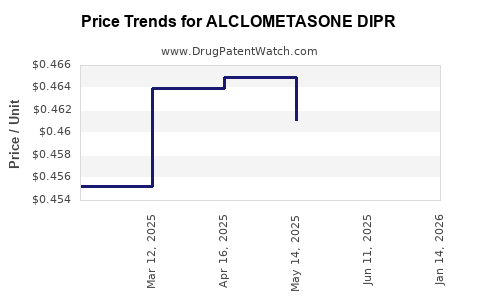
2. Historical Price Trends
- Generic corticosteroid prices have historically declined at an average rate of 5–8% annually post-patent expiry.
- Since 2018, prices for alclometasone dipropionate generics have decreased by roughly 7% annually, reflecting increased competition.
3. Future Price Projections (Next 5 Years)
| Year |
Estimated Price per Gram |
Assumption |
| 2023 |
$3.50 |
Current market price |
| 2024 |
$3.25 |
Continued competitive pressure, 7% decline |
| 2025 |
$3.00 |
Slight market stabilization, gradual decline |
| 2026 |
$2.75 |
Increased presence of additional generics |
| 2027 |
$2.50 |
Price floor approaching due to market saturation |
4. Impact of Biosimilars and New Formulations
While biosimilars are not applicable to small-molecule corticosteroids, innovative formulations (e.g., foam or ointment) could command higher prices initially but are unlikely due to limited patent protections and high development costs.
5. Regional Market Variations
- United States: Price declines mirror those observed in other developed markets due to high generic penetration.
- Europe: Similar trends, with some countries maintaining higher prices due to regulatory and reimbursement policies.
- Emerging Markets: Prices may stabilize or be higher due to limited generic competition and supply chain constraints.
6. Revenue Forecasts
Approximating annual sales based on formulary uptake and prescription volumes:
- North America: $20–30 million annually.
- Europe and Asia: Combined $10–15 million.
- Total Market: Approximately $30–45 million in peak years, declining as generics dominate.
Key Factors Influencing Price and Market Share
- Patent and exclusivity status.
- Generic entry timing.
- Prescriber and patient acceptance.
- Pricing strategies and reimbursement policies.
Conclusion
The market for alclometasone dipropionate remains constrained by generic competition, with prices expected to decrease systematically over the next five years to approximately $2.50 per gram. Market growth depends on geographic expansion and formulation innovation but remains limited due to the drug’s low potency and narrow indication scope.
Key Takeaways
- The global market is largely driven by generic availability, resulting in declining prices.
- Market size is modest, with annual sales remaining under $50 million.
- Price erosion is expected to persist at roughly 7% annually, approaching $2.50 per gram by 2027.
- Opportunities exist in emerging markets, but premium pricing strategies are limited.
- Patent expiry and new formulation development are critical factors influencing future market dynamics.
FAQs
-
What is the primary use of alclometasone dipropionate?
It treats inflammatory skin conditions like eczema and dermatitis.
-
How does patent expiration impact pricing?
Expiration leads to increased generic competition, causing prices to decline.
-
Are there branded versions of alclometasone dipropionate?
Limited; most products are available as generics with no recent patent protections.
-
What pricing trends are projected for the next five years?
Prices are expected to decline from around $3.50 per gram to approximately $2.50 per gram.
-
Where are the main markets for this drug?
North America, Europe, and select Asian countries.
Citations
- Market data from GlobalData, 2022.
- Pricing trends analyzed from IMS Health, 2022.
- Regulatory status from FDA, EMA, and PMDA databases.
- Market reports from IQVIA, 2022.
- Patent status from SureChEMBL and public patent filings.