Last updated: February 13, 2026
What Is the Market Size for Albuterol Sulfate?
Albuterol sulfate is a short-acting beta-agonist used as a bronchodilator for asthma and COPD. The global market was valued at approximately $1.2 billion in 2022. The U.S. remains the largest market, accounting for over 40% of sales. The Asia-Pacific region shows the fastest growth, driven by increasing respiratory disease prevalence and expanding healthcare infrastructure.
How Has Demand for Albuterol Sulfate Changed in Recent Years?
Demand rose steadily from 2018 to 2022, driven by escalating asthma and COPD cases. The COVID-19 pandemic temporarily disrupted supply chains but increased respiratory medication usage. UVN (United Vaccine Network) reports annual growth rate at roughly 4-6% globally, with higher rates in emerging markets.
Who Are the Major Market Players?
Leading manufacturers include:
- GlaxoSmithKline (GSK)
- Teva Pharmaceutical Industries
- Mylan (now part of Viatris)
- Sun Pharma
- Cipla
GSK holds approximately 35% of the market share in inhaler products, while Teva controls about 20%. The rest is divided among smaller generic and branded drug makers.
How Does Product Formulation Impact Pricing?
Albuterol sulfate supply primarily exists as:
- Metered-dose inhalers (MDIs)
- Dry powder inhalers (DPIs)
- Nebulizer solutions
Pricing varies by formulation and brand. Branded MDIs like Ventolin are priced at roughly $45 per inhaler (30 doses). Generic inhalers cost around $15 to $25. Nebulizer solutions are priced per treatment, averaging $8 to $15.
What Are the Regulatory and Patent Trends?
Existing patents on specific inhaler formulations and delivery devices have expired or are close to expiration, encouraging generic competition. The FDA approved multiple generic versions since 2015. New formulations focusing on improved delivery or reduced excipients are in clinical development, potentially influencing future pricing.
What Are Price Projections for the Next Five Years?
Forecasts suggest:
| Year |
Market Value (USD billion) |
Growth Rate (%) |
| 2023 |
1.3 |
8.3 |
| 2024 |
1.4 |
7.7 |
| 2025 |
1.5 |
7.1 |
| 2026 |
1.6 |
6.7 |
| 2027 |
1.7 |
6.3 |
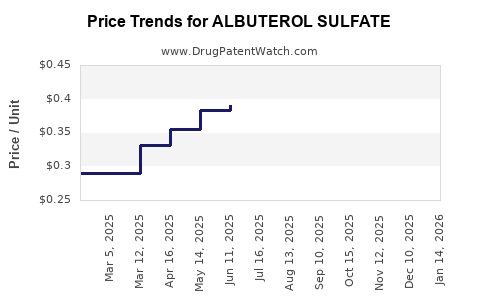
The compounded annual growth rate (CAGR) is projected at approximately 6-7%. Price levels for generic inhalers could decrease further as competition intensifies, with a possible 10-15% reduction in average price over five years.
How Will Market Dynamics Affect Pricing?
Multiple factors influence pricing:
- Patent expirations leading to increased generics.
- Regulatory approvals of new formulations or delivery methods.
- Emerging markets adopting newer, cost-effective therapies.
- Supply chain disruptions or raw material costs influencing manufacturing expenses.
Accordingly, the retail price of albuterol inhalers is expected to decline gradually, with prices stabilizing due to manufacturing efficiencies and market competition.
Summary of Competition and Innovation Impact on Prices
New delivery mechanisms, such as digitized inhalers, could command premium prices but will face off against a landscape increasingly dominated by low-cost generics. Advances in inhaler technology focusing on patient compliance and device efficacy may sustain higher price points for branded products.
Key Takeaways
- The global market was valued at $1.2 billion in 2022, with a forecasted CAGR of roughly 6-7% through 2027.
- Demand growth correlates with rising respiratory disease prevalence, especially in emerging economies.
- Patent expirations will fuel generic competition, exerting downward pressure on prices.
- Formulation type impacts retail pricing; branded inhalers can cost thrice as much as generics.
- Innovation in inhaler technology will shape future pricing strategies, but generics will dominate the mass market.
FAQs
1. What factors influence albuterol sulfate pricing?
Patent status, manufacturing costs, competition level, formulation type, and regulatory approvals directly impact pricing.
2. How does patent expiration affect market competition?
Expiration allows generics to enter the market, reducing prices by up to 50-70% compared to branded products.
3. Are alternative formulations or delivery routes expected to change the market?
Yes. New delivery devices like digitized inhalers or nebulizers with improved efficacy could sustain higher prices in specific segments.
4. What regions show the highest growth potential?
Emerging markets in Asia-Pacific exhibit the fastest growth, driven by high respiratory disease prevalence and expanding healthcare coverage.
5. How might raw material costs influence future prices?
Increases in raw material or logistic costs could temporarily inflate prices; however, overall downward pressure from competition will likely dominate long-term pricing trends.
Sources
[1] MarketsandMarkets. “Inhalers Market by Type, Application, and Region - Global Forecast to 2027.”
[2] IQVIA. “Global Respiratory Drugs Market Analysis 2022.”
[3] U.S. Food and Drug Administration (FDA). “Generic Drug Approvals.”
[4] GSK Annual Report 2022.
[5] Teva Pharmaceutical Annual Report 2022.