Share This Page
Drug Price Trends for ALBENDAZOLE
✉ Email this page to a colleague
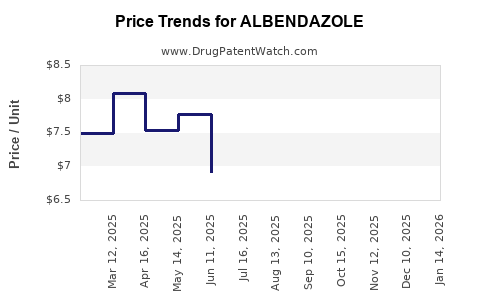
Average Pharmacy Cost for ALBENDAZOLE
| Drug Name | NDC | Price/Unit ($) | Unit | Date |
|---|---|---|---|---|
| ALBENDAZOLE 200 MG TABLET | 00591-2712-02 | 4.37514 | EACH | 2026-07-22 |
| ALBENDAZOLE 200 MG TABLET | 31722-0935-02 | 4.37514 | EACH | 2026-07-22 |
| ALBENDAZOLE 200 MG TABLET | 42799-0110-02 | 4.37514 | EACH | 2026-07-22 |
| ALBENDAZOLE 200 MG TABLET | 43598-0452-02 | 4.37514 | EACH | 2026-07-22 |
| ALBENDAZOLE 200 MG TABLET | 72205-0051-08 | 4.37514 | EACH | 2026-07-22 |
| >Drug Name | >NDC | >Price/Unit ($) | >Unit | >Date |
Best Wholesale Price for ALBENDAZOLE
| Drug Name | Vendor | NDC | Count | Price ($) | Price/Unit ($) | Unit | Dates | Price Type |
|---|---|---|---|---|---|---|---|---|
| ALBENDAZOLE 200MG TAB | AvKare, LLC | 42291-0093-02 | 2 | 95.99 | 47.99500 | EACH | 2023-06-15 - 2028-06-14 | FSS |
| ALBENDAZOLE 200MG TAB | Golden State Medical Supply, Inc. | 51407-0258-02 | 2 | 96.59 | 48.29500 | EACH | 2023-06-15 - 2028-06-14 | FSS |
| ALBENZA 200MG TAB | Amneal Pharmaceuticals of New York, LLC | 64896-0693-49 | 2 | 43.55 | 21.77500 | EACH | 2023-01-01 - 2027-06-30 | Big4 |
| ALBENDAZOLE 200MG TAB | Amneal Pharmaceuticals of New York, LLC | 00115-1701-49 | 2 | 9.09 | 4.54500 | EACH | 2023-01-01 - 2027-06-30 | Big4 |
| ALBENZA 200MG TAB | Amneal Pharmaceuticals of New York, LLC | 64896-0693-49 | 2 | 478.02 | 239.01000 | EACH | 2023-01-01 - 2027-06-30 | FSS |
| >Drug Name | >Vendor | >NDC | >Count | >Price ($) | >Price/Unit ($) | >Unit | >Dates | >Price Type |
Albendazole: Market Dynamics and Price Projections
Market Overview
Albendazole is an anthelmintic medication used to treat a variety of parasitic worm infestations. It is classified as a broad-spectrum benzimidazole. The global market for albendazole is driven by its widespread use in both human and veterinary medicine, particularly in regions with high prevalence of soil-transmitted helminths and other parasitic infections. Key factors influencing market growth include increasing awareness of parasitic diseases, government initiatives for mass deworming programs, and the expanding pet care industry.
Prevalence and Disease Burden
Parasitic infections remain a significant global health concern. Soil-transmitted helminths (STHs) affect hundreds of millions of people, disproportionately impacting children in low- and middle-income countries. According to the World Health Organization (WHO), billions of people are at risk of helminth infections, with an estimated 1.5 billion infected with ascariasis, 1 billion with trichuriasis, and over 1 billion with hookworm [1]. These infections can lead to malnutrition, anemia, impaired cognitive development, and reduced productivity.
In veterinary medicine, parasitic infections in livestock and companion animals can cause significant economic losses due to reduced growth rates, decreased milk and meat production, and increased mortality. Common parasitic infections in animals include gastrointestinal nematodes, cestodes, and protozoa.
Therapeutic Applications and Mechanism of Action
Albendazole's primary mechanism of action involves binding to beta-tubulin in parasitic worms. This binding inhibits microtubule polymerization, disrupting essential cellular functions such as glucose uptake and the formation of intracellular transport systems. This disruption leads to the depletion of energy stores in the parasite, ultimately resulting in its death.
The drug is effective against a wide range of helminths, including:
- Roundworms (Ascaris lumbricoides)
- Hookworms (Ancylostoma duodenale, Necator americanus)
- Whipworms (Trichuris trichiura)
- Pinworms (Enterobius vermicularis)
- Strongyloides stercoralis
- Taenia species (tapeworms)
- Giardia duodenalis
Albendazole is also used to treat neurocysticercosis, a parasitic infection of the central nervous system caused by the larval cysts of the pork tapeworm (Taenia solium).
Market Segmentation
The albendazole market can be segmented based on several factors:
By Application
- Human Health: This segment includes treatments for parasitic infections in humans, often administered through national deworming programs or prescription by healthcare professionals.
- Veterinary Health: This segment encompasses the use of albendazole in livestock (cattle, sheep, goats, pigs) and companion animals (dogs, cats) to prevent and treat parasitic infestations.
By Formulation
- Tablets: Oral tablets are the most common formulation, available in various strengths.
- Suspensions/Oral Solutions: Liquid formulations are often preferred for pediatric use or for animals.
- Chewable Tablets: Convenient for administration, especially in veterinary settings.
By Distribution Channel
- Hospitals Pharmacies: For direct patient treatment.
- Retail Pharmacies: For over-the-counter and prescription sales.
- Veterinary Clinics and Hospitals: For animal healthcare.
- Online Pharmacies: Increasing in popularity for both human and veterinary products.
By Region
- Asia-Pacific: This region, particularly South Asia and Southeast Asia, has a high burden of parasitic diseases and significant government-led deworming initiatives, driving demand for albendazole.
- Africa: Similar to Asia-Pacific, Africa faces substantial challenges from parasitic infections, making it a key market.
- Latin America: Parasitic infections are prevalent, and public health programs contribute to market growth.
- North America: Demand is primarily from veterinary applications and specific human parasitic infections.
- Europe: Market size is moderate, driven by both human and veterinary uses.
Key Market Drivers
- High Prevalence of Parasitic Infections: The persistent global burden of helminthic and protozoal infections in humans and animals directly fuels the demand for effective treatments like albendazole.
- Government Initiatives and Public Health Programs: Many countries implement mass drug administration (MDA) programs, particularly for school-aged children, to combat soil-transmitted helminth infections. These programs significantly boost the consumption of anthelmintics like albendazole. The WHO's Global Network for the Elimination of Lymphatic Filariasis also utilizes albendazole as part of its strategy [2].
- Growing Veterinary Pharmaceutical Market: The increasing number of companion animals and the focus on animal health and productivity in livestock farming contribute to the demand for veterinary anthelmintics.
- Increasing Awareness and Diagnosis: Enhanced public health awareness campaigns and improved diagnostic capabilities lead to earlier detection and treatment of parasitic infections.
- Product Availability and Affordability: Albendazole is a widely available and relatively affordable medication, making it accessible in resource-limited settings where parasitic infections are most prevalent.
Market Restraints
- Development of Drug Resistance: Overuse and inappropriate use of anthelmintics can lead to the development of resistance in parasites, potentially diminishing the long-term efficacy of albendazole. This is a significant concern in both human and veterinary medicine.
- Side Effects and Adverse Reactions: While generally well-tolerated, albendazole can cause side effects, including gastrointestinal disturbances, headache, and dizziness. In some cases, more serious adverse reactions can occur, particularly with long-term or high-dose therapy.
- Regulatory Hurdles and Patent Expirations: While the primary patents for albendazole have expired, ongoing research and development for new formulations or combination therapies may face regulatory scrutiny. The generic nature of most albendazole products leads to intense price competition.
- Availability of Alternative Treatments: The emergence of new anthelmintic drugs or alternative treatment modalities could impact the market share of albendazole over time.
Competitive Landscape
The albendazole market is characterized by a large number of generic manufacturers, leading to significant price competition. Key global players include:
- GSK (GlaxoSmithKline): Historically a major producer, though emphasis has shifted to other areas.
- Mylan N.V. (now Viatris): A significant generic pharmaceutical company with a broad portfolio.
- Perrigo Company plc: Manufactures and distributes a wide range of generic and branded health and wellness products.
- Sanofi S.A.: Involved in the production of various pharmaceutical products, including anthelmintics.
- Indian Pharmaceutical Manufacturers: Companies like Cipla, Sun Pharmaceutical Industries Ltd., Zydus Lifesciences, and Lupin are major global suppliers of generic albendazole, often exporting to developing countries.
The market is highly fragmented, with many regional and local manufacturers also contributing to the supply chain. The focus for many companies is on cost-effective manufacturing and efficient distribution, particularly for public health tenders.
Price Projections and Market Value
The global albendazole market value is estimated to be in the range of USD 250 million to USD 350 million annually. This figure is an approximation due to the widespread availability of generic products and the inclusion in broader anthelmintic market data.
Factors Influencing Price:
- Generic Competition: The presence of numerous generic manufacturers creates downward pressure on prices.
- Raw Material Costs: Fluctuations in the cost of active pharmaceutical ingredients (APIs) and excipients can impact manufacturing costs.
- Regulatory Compliance: Meeting quality standards (e.g., GMP) and obtaining necessary approvals adds to production costs.
- Tender Pricing: Public health programs often procure albendazole through competitive bidding processes, which can lead to significantly lower prices for bulk purchases.
- Geographic Market: Prices can vary significantly between developed and developing economies due to local market dynamics, distribution costs, and pricing regulations.
Price Trends:
- Stable to Declining Prices: Due to intense generic competition and high-volume public health procurement, the average selling price of albendazole has remained relatively stable or experienced a slight decline over the past decade, particularly in bulk purchasing scenarios.
- Retail vs. Bulk Pricing: Retail prices for albendazole tablets (e.g., 400mg) typically range from USD 0.50 to USD 3.00 per pack of 1-6 tablets, depending on the brand, region, and quantity. Bulk prices for APIs or finished formulations purchased by governments or large NGOs can be substantially lower, potentially in the range of USD 0.05 to USD 0.20 per unit dose.
- Veterinary Products: Veterinary formulations may command slightly higher prices due to specialized packaging or combination products, but still face significant generic competition.
Market Growth Projections:
The albendazole market is projected to grow at a Compound Annual Growth Rate (CAGR) of 3% to 5% over the next five to seven years. This growth is expected to be primarily driven by:
- Continued support for national deworming programs: As global health organizations and national governments prioritize the reduction of parasitic disease burden, demand for albendazole in mass drug administration remains robust.
- Expansion of veterinary medicine: The increasing focus on animal welfare and economic productivity in livestock will sustain demand for veterinary anthelmintics.
- Population growth in endemic regions: Higher populations in areas with high prevalence of parasitic infections will naturally increase the patient pool.
However, the growth rate is moderated by the factors mentioned earlier, particularly drug resistance and the availability of alternative treatments in specific niches.
Key Takeaways
- The albendazole market is sustained by its critical role in combating widespread parasitic infections in humans and animals.
- Government-led mass deworming programs are a significant driver, particularly in Asia-Pacific and Africa.
- The market is dominated by generic manufacturers, leading to price stability and intense competition.
- Projected growth is moderate, expected between 3% and 5% CAGR, primarily due to sustained public health initiatives and a growing veterinary sector.
- Price points vary considerably between bulk procurement for public health and retail sales, with bulk prices significantly lower.
Frequently Asked Questions
-
What are the primary therapeutic areas driving demand for albendazole? The primary therapeutic areas are the treatment of soil-transmitted helminth infections (ascariasis, hookworm, trichuriasis, enterobiasis) in humans and a broad range of gastrointestinal parasites in both humans and animals, including tapeworm infections and neurocysticercosis.
-
How has drug resistance impacted the albendazole market? Drug resistance is a growing concern that can diminish the efficacy of albendazole over time. This necessitates careful stewardship of its use, rotation of anthelmintics, and ongoing research into alternative or combination therapies. While it presents a challenge, it has not yet significantly eroded the overall market demand due to its continued effectiveness against many common parasites and its affordability.
-
What is the typical price range for a standard course of albendazole treatment for an individual? For an individual, the retail cost for a standard course of albendazole (typically 1-6 tablets of 400mg) can range from USD 0.50 to USD 3.00. This price is highly variable by region and specific product branding.
-
Which regions represent the largest markets for albendazole? The largest markets for albendazole are the Asia-Pacific and African regions due to the high prevalence of parasitic infections and extensive government and NGO-led public health initiatives, including mass drug administration programs.
-
Are there significant patent barriers affecting the production or pricing of albendazole? The primary patents for albendazole have long since expired. This has led to a highly competitive generic market where numerous manufacturers can produce and sell the drug, contributing to its affordability and limiting significant patent-related price increases.
Citations
[1] World Health Organization. (2022). Soil-transmitted helminthiases. Retrieved from https://www.who.int/news-room/fact-sheets/detail/soil-transmitted-helminthiases
[2] World Health Organization. (n.d.). Global Program to Eliminate Lymphatic Filariasis. Retrieved from https://www.who.int/campaigns/end-lymphatic-filariasis/global-program
More… ↓
