Share This Page
Drug Price Trends for ALAHIST PE
✉ Email this page to a colleague
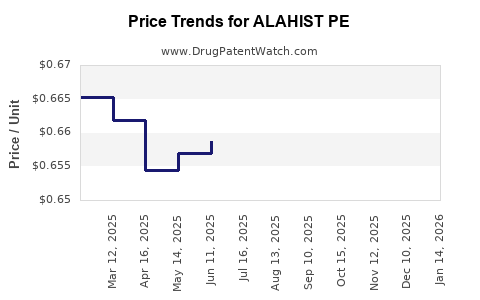
Average Pharmacy Cost for ALAHIST PE
| Drug Name | NDC | Price/Unit ($) | Unit | Date |
|---|---|---|---|---|
| ALAHIST PE 2-7.5 MG TABLET | 50991-0788-90 | 0.66610 | EACH | 2026-03-18 |
| ALAHIST PE 2-7.5 MG TABLET | 50991-0788-90 | 0.66479 | EACH | 2026-02-18 |
| ALAHIST PE 2-7.5 MG TABLET | 50991-0788-90 | 0.66265 | EACH | 2026-01-21 |
| ALAHIST PE 2-7.5 MG TABLET | 50991-0788-90 | 0.66238 | EACH | 2025-12-17 |
| ALAHIST PE 2-7.5 MG TABLET | 50991-0788-90 | 0.66019 | EACH | 2025-11-19 |
| ALAHIST PE 2-7.5 MG TABLET | 50991-0788-90 | 0.66141 | EACH | 2025-10-22 |
| ALAHIST PE 2-7.5 MG TABLET | 50991-0788-90 | 0.66326 | EACH | 2025-09-17 |
| >Drug Name | >NDC | >Price/Unit ($) | >Unit | >Date |
ALAHIST PE Market Analysis and Financial Projection
What is ALAHIST PE and its current market status?
Alahist PE is a combination drug containing cetirizine (an antihistamine) and phenylephrine (a decongestant). It targets allergic rhinitis, congestion, and other allergy-related conditions. It is marketed in various regions under different brand names, with ALAHIST PE being one of the formulations. As a non-prescription medication, its distribution spans pharmacies, drugstores, and online retail.
Current market presence: ALAHIST PE is available primarily in Southeast Asia, parts of the Middle East, and some emerging markets. It faces competition from other combination antihistamines like loratadine-pseudoephedrine formulations and standalone antihistamines.
Projected growth drivers:
- Rising prevalence of allergic rhinitis globally.
- Increased consumer awareness about allergy management.
- Expansion into new markets with growing healthcare infrastructure.
How has the market for antihistamine-decongestant combinations evolved?
The antihistamine-decongestant segment demonstrates a compound annual growth rate (CAGR) of approximately 6% globally (2018-2022). The segment's valuation increased from $2.4 billion in 2018 to $3.2 billion in 2022 [1].
Outlook confirms continued expansion driven by several factors:
- Market penetration in Asia-Pacific and Latin America.
- Aging populations in developed countries add to demand.
- Growing focus on over-the-counter (OTC) allergy medications.
Competition from generics reduces prices, expanding accessibility.
What are the main factors influencing ALAHIST PE's pricing?
Pricing dynamics depend on several elements:
- Manufacturing costs: Include API synthesis, formulation, and packaging. For ALAHIST PE, costs are influenced by API prices, which have seen volatility due to raw material scarcity.
- Market competition: Entry of generics and private label brands pressures prices downward.
- Regulatory landscape: Policies affecting OTC drug sales and import tariffs impact pricing strategies.
- Demand elasticity: High demand in markets with limited healthcare options sustains pricing levels.
For example, in Southeast Asia, retail prices for similar antihistamine-decongestant combinations range from $0.10 to $0.30 per tablet, depending on branding and retail markup [2].
What are the future price projections for ALAHIST PE?
Price projections consider market growth, competition, and manufacturing costs:
| Year | Estimated Price Range (per unit) | Key Influences |
|---|---|---|
| 2023 | $0.10 - $0.30 | Stable manufacturing costs; high competition |
| 2024 | $0.10 - $0.28 | Increased generic competition; price compression |
| 2025 | $0.09 - $0.26 | Market saturation; cost efficiencies |
| 2026 | $0.09 - $0.25 | Continued competition; volume-driven pricing |
The general trend indicates a gradual decline in per-unit prices, consistent with generic market expansion and price competition. However, premium pricing may persist in markets with limited competition or regulatory constraints.
What are key risks impacting market and pricing?
- Regulatory shifts: Stricter regulations may limit OTC availability, affecting sales volume.
- Supply chain disruptions: Raw material shortages or geopolitical issues can increase production costs.
- Market saturation: Increased competition reduces margins.
- Consumer preferences: Shift towards natural or alternative therapies can reduce demand.
What are strategic considerations for market entry or expansion?
Companies should consider:
- Localized pricing strategies: Adjust prices based on regional purchasing power and competition.
- Regulatory compliance: Engage early with regulatory agencies to minimize delays.
- Manufacturing scale: Invest in cost-efficient production to sustain margins against declining prices.
- Brand differentiation: Emphasize quality and efficacy to justify premium pricing where applicable.
How does the competitive landscape affect ALAHIST PE’s pricing?
Major players include:
- Local generic manufacturers competing on price.
- Established brands with wider distribution networks.
- Online pharmacies offering discounts.
Generic versions often retail at 30-50% lower than branded equivalents, exerting downward pressure on prices. Patent expirations in various markets can accelerate generic proliferation, with prices declining within six to twelve months post-patent expiry.
Key Takeaways
- ALAHIST PE operates in a growing antihistamine-decongestant market projected to expand at a CAGR of about 6%.
- Pricing is influenced by manufacturing costs, competition, regulatory factors, and consumer demand.
- Prices are expected to decline gradually due to generic entry and market saturation.
- Regional variations necessitate localized pricing and marketing strategies.
- Supply chain stability and regulatory environment are critical risk factors.
FAQs
Q1: What markets are most promising for ALAHIST PE expansion?
A1: Southeast Asia, Latin America, and emerging Middle Eastern markets show growing allergy medication consumption with limited local competition.
Q2: How do patent laws impact ALAHIST PE’s pricing?
A2: Patent expirations encourage generic competition, leading to significant price reductions approximately 6-12 months after expiry.
Q3: What are average retail prices of similar antihistamine-decongestant products?
A3: Retail prices range from $0.10 to $0.30 per tablet, varying by region and branding.
Q4: How do raw material costs affect pricing?
A4: Volatility in API prices due to raw material shortages can increase manufacturing costs, putting upward pressure on prices unless offset by efficiencies or scale.
Q5: What regulatory factors could influence future sales?
A5: Regulations limiting OTC sales, import restrictions, and age restrictions can reduce accessible markets, thereby affecting sales volume and pricing.
Sources:
[1] Market Research Future, "Antihistamines Market Analysis," 2022.
[2] IQVIA, "Pharmaceutical Pricing Trends Asia," 2021.
More… ↓
