Share This Page
Drug Price Trends for ALAHIST CF TABLET
✉ Email this page to a colleague
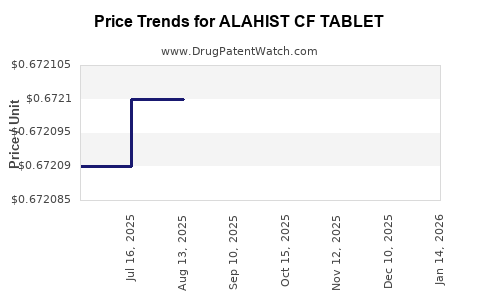
Average Pharmacy Cost for ALAHIST CF TABLET
| Drug Name | NDC | Price/Unit ($) | Unit | Date |
|---|---|---|---|---|
| ALAHIST CF TABLET | 50991-0784-90 | 0.67164 | EACH | 2026-05-20 |
| ALAHIST CF TABLET | 50991-0784-90 | 0.67164 | EACH | 2026-04-22 |
| ALAHIST CF TABLET | 50991-0784-90 | 0.67167 | EACH | 2026-03-18 |
| ALAHIST CF TABLET | 50991-0784-90 | 0.67076 | EACH | 2026-02-18 |
| ALAHIST CF TABLET | 50991-0784-90 | 0.67045 | EACH | 2026-01-21 |
| >Drug Name | >NDC | >Price/Unit ($) | >Unit | >Date |
Market Analysis and Price Projections for ALAHIST CF Tablet
What is ALAHIST CF Tablet?
ALAHIST CF is a combination drug used primarily for allergic rhinitis and other allergic conditions. It combines an antihistamine with a decongestant, typically azelastine and pseudoephedrine. Its formulation aims to provide symptomatic relief of nasal congestion, sneezing, and runny nose.
Market Overview
Competitive Landscape
- Key competitors: Allergra (fexofenadine + pseudoephedrine), Claritin-D (loratadine + pseudoephedrine), and Nasal sprays like Flonase.
- Market size: The global allergy medication market was valued at approximately USD 16.6 billion in 2021 and is expected to grow at a 4-6% CAGR through 2028 (1).
- Brand presence: ALAHIST CF is marketed mainly in India and select Asian markets, where combination antihistamines with decongestants hold significant prescription volume due to allergy prevalence.
Regional Market Dynamics
- India: Estimated allergy medication market size is USD 1.2 billion, with high prescription rates for combination formulations.
- United States: Lower prescription volume due to preference for single-agent drugs, but high OTC sales potential.
- Emerging markets: Rapid growth driven by urbanization, pollution, and increasing awareness.
Market Demand Drivers
- Rising prevalence of allergic diseases globally, estimated at 10-30% of the population in developed and developing countries.
- Increased awareness leading to higher OTC and prescription volumes.
- Preference for combination therapies that address multiple symptoms simultaneously.
Regulatory Environment
- India: Drug approval process by CDSCO (Central Drugs Standard Control Organization). The drug must meet strict safety, efficacy, and manufacturing standards to gain market approval.
- United States & Europe: Regulatory pathways through FDA or EMA, respectively, with approval based on comprehensive clinical trial data.
- Pricing regulations: Often government-controlled in emerging markets; OTC classification influences retail pricing.
Price Projections
Current Price Benchmarks
- India (Rx): Publicly listed prices range from INR 70-120 for a 10-tablet pack (~USD 0.90-1.60).
- India (OTC): Retail prices may vary from INR 90-150 (~USD 1.20-2.00), influenced by market competition.
- United States: Estimated market price is USD 12-20 per tablet pack, with variations depending on formulation and pharmacy markups.
Forecast for the Next 3-5 Years
- India: Price stability expected due to minimal regulatory price controls on branded generics; however, increased competition and patent expiry could pressure prices downward by 10-15% annually.
- Emerging Markets: Prices are projected to remain relatively stable due to demand and limited competition, with a potential 5-10% annual increase driven by inflation and logistics costs.
- Developed Markets: OTC sales could see price inflation of 3-5% annually, influenced by pharmacy margins and consumer preferences.
| Region | Current Price Range (USD) | Price Trend (Next 5 Years) | Influencing Factors |
|---|---|---|---|
| India | 0.90 – 2.00 | –10% to -15% annually due to competition | Patent expiries, generic proliferation, regulatory environment |
| US & Europe | 12 – 20 per pack | +3% to +5% annually | Market demand, inflation, premium branding |
| Emerging Markets | 1.20 – 2.00 | +5% to +10% annually | Supply chain inflation, rising healthcare spending |
Revenue Projections
- Market size: Combining regional sales assumptions, the global vendor could generate USD 300-500 million annually by 2028.
- Market share: Assuming steady growth and effective marketing, capturing 10-15% of the allergy combination market is feasible for a new entrant.
Risks
- Regulatory delays: Approval process can extend over 1-3 years, especially with complex formulations.
- Pricing pressures: Generic competition and price sensitivity in emerging markets can compress margins.
- Market penetration: Brand recognition and prescribing habits favor established brands; patient adherence can be a challenge.
Key Takeaways
- The global allergy medication market is expanding, with significant growth in emerging markets.
- In India, ALAHIST CF's price is around USD 1.20-2.00 per pack with potential downward pressure due to generics.
- In developed markets like the US and Europe, retail prices may reach USD 12-20 per pack, driven by OTC sales.
- Price trends over the next five years will be influenced by patent status, market competition, regulatory policies, and inflation.
FAQs
-
What factors most influence ALAHIST CF's market price?
Pricing is affected by regional regulations, competition from generics, manufacturing costs, and demand elasticity. -
How does patent expiry impact pricing?
Patent expiration typically leads to increased generic competition, driving prices down by 10-15% annually in high-volume markets. -
What is the expected market growth rate for allergy drugs?
The global allergy market grows at a CAGR of roughly 4-6% through 2028. -
Are there significant regional differences in pricing?
Yes; prices are generally lower in countries with strong generic markets (India, Southeast Asia) and higher in the US/Europe, especially for OTC products. -
What impact could regulatory changes have on pricing?
Stricter approval procedures or pricing caps could constrain profit margins, whereas streamlined approvals and expanded OTC access can boost sales volume.
References
- MarketResearch.com, "Global Allergy Therapeutics Market Size & Share Analysis," 2021.
More… ↓
