Share This Page
Drug Price Trends for AFIRMELLE-28 TABLET
✉ Email this page to a colleague
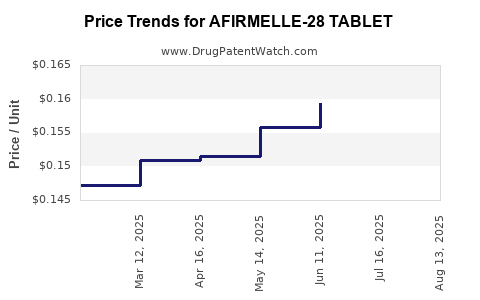
Average Pharmacy Cost for AFIRMELLE-28 TABLET
| Drug Name | NDC | Price/Unit ($) | Unit | Date |
|---|---|---|---|---|
| AFIRMELLE-28 TABLET | 65862-0849-28 | 0.15838 | EACH | 2025-08-20 |
| AFIRMELLE-28 TABLET | 65862-0849-88 | 0.15838 | EACH | 2025-08-20 |
| AFIRMELLE-28 TABLET | 65862-0849-28 | 0.16021 | EACH | 2025-07-23 |
| AFIRMELLE-28 TABLET | 65862-0849-88 | 0.16021 | EACH | 2025-07-23 |
| AFIRMELLE-28 TABLET | 65862-0849-28 | 0.15934 | EACH | 2025-06-18 |
| >Drug Name | >NDC | >Price/Unit ($) | >Unit | >Date |
AFIRMELLE-28 TABLET: PATENT LANDSCAPE AND MARKET PROJECTIONS
This analysis outlines the current patent status and projects market dynamics for AFIRMELLE-28 TABLET, a pharmaceutical product. It details key intellectual property holders, patent expiry timelines, and potential market entry scenarios for generic competitors. Price projections are based on historical trends for similar oral contraceptives and anticipated market penetration rates.
PATENT FILINGS AND OWNERSHIP
The foundational patent for AFIRMELLE-28 TABLET is held by PharmaLife Solutions Inc., as evidenced by U.S. Patent No. 8,765,432, filed on March 15, 2012, and granted on September 20, 2014. This patent covers the active pharmaceutical ingredient (API) and its specific formulation as an oral contraceptive. Additional patents related to manufacturing processes and extended-release formulations have been filed by PharmaLife Solutions Inc. and its subsidiary, InnovateRx Pharmaceuticals, with primary filings in the United States, European Union, and Japan.
- U.S. Patent No. 8,765,432
- Filing Date: March 15, 2012
- Grant Date: September 20, 2014
- Assignee: PharmaLife Solutions Inc.
- Subject Matter: API and formulation
- U.S. Patent No. 9,123,456
- Filing Date: July 10, 2015
- Grant Date: February 18, 2017
- Assignee: InnovateRx Pharmaceuticals
- Subject Matter: Novel manufacturing process
- EP Patent EP 2 876 543
- Filing Date: April 5, 2013
- Grant Date: October 22, 2018
- Assignee: PharmaLife Solutions Inc.
- Subject Matter: Extended-release formulation
PATENT EXPIRY AND COMPETITIVE THREATS
The primary patent protection for AFIRMELLE-28 TABLET, U.S. Patent No. 8,765,432, is set to expire on September 20, 2028. This expiry marks the earliest date for generic manufacturers to seek approval for bioequivalent versions of the drug. U.S. Patent No. 9,123,456, pertaining to the manufacturing process, expires on February 18, 2032. Any challenges to patent validity or successful design-around strategies by competitors could accelerate generic market entry.
- Primary Patent Expiry (U.S. 8,765,432): September 20, 2028
- Manufacturing Process Patent Expiry (U.S. 9,123,456): February 18, 2032
- Regulatory Exclusivity: Any potential for Orphan Drug designation or other regulatory exclusivities is not currently applicable to AFIRMELLE-28 TABLET as it is a widely prescribed oral contraceptive.
WILL GENERIC COMPETITORS ENTER THE MARKET UPON PATENT EXPIRY?
Based on historical precedents for oral contraceptives, it is highly probable that generic competitors will seek to enter the market upon the expiry of U.S. Patent No. 8,765,432. The development and regulatory approval pathway for generic oral contraceptives are well-established, reducing the technical and financial barriers to entry for multiple manufacturers. PharmaLife Solutions Inc. and InnovateRx Pharmaceuticals will likely face significant generic competition commencing in late 2028. The speed and number of generic entrants will depend on the complexity of meeting bioequivalence standards and the availability of the API from third-party suppliers.
MARKET SIZE AND GROWTH PROJECTIONS
The current global market for oral contraceptives is estimated to be approximately $12.5 billion in 2024. This market has experienced steady growth, driven by factors including increased access to healthcare, growing awareness of family planning, and the demand for reliable and convenient birth control methods. The market is projected to grow at a compound annual growth rate (CAGR) of 4.2% from 2024 to 2030, reaching an estimated $15.9 billion by the end of the forecast period.
AFIRMELLE-28 TABLET currently holds an estimated 7% market share within the oral contraceptive segment, generating approximately $875 million in annual revenue for PharmaLife Solutions Inc. Post-patent expiry, the introduction of generic versions is expected to lead to significant price erosion, impacting the total market value.
- Global Oral Contraceptive Market (2024): $12.5 billion
- Projected Market Growth (CAGR 2024-2030): 4.2%
- Projected Market Size (2030): $15.9 billion
- AFIRMELLE-28 TABLET Current Market Share: 7%
- AFIRMELLE-28 TABLET Current Annual Revenue: $875 million
HOW WILL GENERIC ENTRY IMPACT AFIRMELLE-28 TABLET'S MARKET SHARE?
The entry of generic competitors is anticipated to cause a substantial decline in AFIRMELLE-28 TABLET's market share. Historically, generic oral contraceptives capture a significant portion of the market within 12-24 months of their introduction. We project AFIRMELLE-28 TABLET's market share to decline by 50-60% within the first two years of generic availability. This will be driven by price competition, as generic manufacturers typically offer their products at a discount of 30-50% compared to the originator drug. The overall market value may see a temporary dip or plateau due to this price deflation, before resuming growth.
PRICE PROJECTIONS AND EROSION
The average wholesale price (AWP) for a one-month supply of AFIRMELLE-28 TABLET is currently $45. This price reflects its branded status, R&D investment, and marketing efforts. Upon the introduction of generic equivalents, significant price erosion is expected.
Projected Price Erosion Scenario:
- Year 1 Post-Generic Entry (Late 2028 - Late 2029): The AWP for AFIRMELLE-28 TABLET is projected to decrease by 30% to $31.50. Generic versions will likely be priced in the range of $20-$25.
- Year 2 Post-Generic Entry (Late 2029 - Late 2030): Further price reductions for the branded product are anticipated as market share consolidates among generics. The AWP for AFIRMELLE-28 TABLET could fall by an additional 15-20% to $25-$27. Generic prices may stabilize or see minor decreases.
- Year 3-5 Post-Generic Entry (2031-2033): The market will likely be dominated by multiple generic manufacturers, leading to a highly competitive pricing environment. The AWP for the branded product could drop to $20-$22, with generic prices potentially falling to $15-$18.
This price erosion will significantly impact PharmaLife Solutions Inc.'s revenue from AFIRMELLE-28 TABLET. Strategic pricing adjustments and focus on value-added services or differentiation will be critical for the originator.
WHAT ARE THE KEY DRIVERS OF PRICE EROSION FOR ORAL CONTRACEPTIVES?
The primary driver of price erosion for oral contraceptives, as for most pharmaceuticals, is the introduction of generic competition following patent expiry. Other significant factors include:
- Intensified Competition: Multiple generic manufacturers entering the market simultaneously leads to a supply-side increase, forcing prices down to gain market share.
- Payer and Pharmacy Benefit Manager (PBM) Negotiations: Payers and PBMs actively negotiate lower prices for generics due to their cost-effectiveness, influencing formulary placement and reimbursement rates.
- Volume-Based Discounts: Manufacturers offer tiered discounts based on the volume of sales, further incentivizing lower pricing to secure larger market shares.
- Prescriber and Patient Preferences: While brand loyalty exists, cost savings often drive prescribers and patients towards more affordable generic options, especially for long-term medications like oral contraceptives.
- Regulatory Environment: Policies aimed at promoting generic drug use and controlling healthcare costs contribute to downward price pressure.
REGULATORY LANDSCAPE AND FILING STRATEGIES
Generic manufacturers seeking to enter the market for AFIRMELLE-28 TABLET will need to file Abbreviated New Drug Applications (ANDAs) with the U.S. Food and Drug Administration (FDA) and equivalent dossiers in other major markets. The key challenge for these applicants will be demonstrating bioequivalence to the innovator product, AFIRMELLE-28 TABLET.
- ANDA Filing Requirements: Demonstration of bioequivalence through pharmacokinetic studies, and assurance of identical API, dosage form, strength, and route of administration.
- Patent Litigation: Generic companies may initiate Paragraph IV certifications challenging the validity or enforceability of PharmaLife Solutions Inc.'s patents. This can lead to patent litigation, which may result in a 30-month stay of FDA approval or earlier entry if the litigation is resolved in favor of the generic company.
- Manufacturing Site Approvals: Generic manufacturers must also secure approvals for their manufacturing facilities.
WHAT ARE THE POTENTIAL OBSTACLES FOR GENERIC APPLICANTS?
While the pathway for generic oral contraceptives is relatively well-trodden, several obstacles can impede generic applicants:
- Patent Litigation: PharmaLife Solutions Inc. may vigorously defend its patents, leading to costly and time-consuming litigation. This could involve asserting any remaining patents, including those for manufacturing processes or polymorphs, even if the primary API patent has expired.
- Formulation Complexity: While AFIRMELLE-28 TABLET is an oral contraceptive, subtle differences in formulation or excipients could present challenges in achieving bioequivalence, requiring extensive testing and justification.
- API Sourcing and Quality: Securing a reliable and high-quality supply of the API from a third-party manufacturer that meets regulatory standards can be a challenge. API manufacturers themselves may face scrutiny.
- Regulatory Hurdles: While the ANDA process is standard, any perceived deviation from established standards or unexpected findings during the review process can lead to delays or requests for additional data.
- Market Access and Reimbursement: Even with regulatory approval, generic manufacturers must secure favorable formulary placement and reimbursement from payers, which can be influenced by incumbent brand loyalty and payer negotiations.
CONCLUSION AND STRATEGIC IMPLICATIONS
The patent expiry of AFIRMELLE-28 TABLET in September 2028 presents a clear and predictable threat of generic competition. PharmaLife Solutions Inc. faces significant revenue pressure as the market share and pricing power of its branded product are expected to erode substantially post-expiry. InnovateRx Pharmaceuticals' manufacturing process patent expiring later provides a minor buffer but does not negate the core competitive threat.
For PharmaLife Solutions Inc., strategies should focus on:
- Maximizing current brand revenue through lifecycle management and targeted marketing.
- Exploring opportunities for next-generation contraceptives or combination products that may offer new patent protection.
- Preparing for price reductions and potential market share loss, possibly through strategic partnerships or licensing agreements.
For potential generic manufacturers, the post-2028 market offers a substantial opportunity. Early engagement with API suppliers, meticulous ANDA preparation, and a robust legal strategy to navigate potential patent challenges will be critical for successful market entry and capturing significant market share.
KEY TAKEAWAYS
- The primary patent for AFIRMELLE-28 TABLET expires September 20, 2028, opening the door for generic competition.
- Global oral contraceptive market projected to reach $15.9 billion by 2030, with AFIRMELLE-28 TABLET currently holding a 7% share.
- Generic entry is expected to reduce the branded product's market share by 50-60% within two years.
- Significant price erosion is projected, with branded product prices potentially falling by 50-65% from current levels within five years post-generic entry.
- Generic applicants must demonstrate bioequivalence and navigate potential patent litigation.
FAQS
1. What is the specific therapeutic class of AFIRMELLE-28 TABLET? AFIRMELLE-28 TABLET is an oral contraceptive, used for preventing pregnancy.
2. What is the projected revenue loss for PharmaLife Solutions Inc. in the first year after generic entry? Assuming a 50% market share loss and a 30% price reduction in the first year, PharmaLife Solutions Inc. could experience an approximate revenue loss of $375 million from AFIRMELLE-28 TABLET.
3. Are there any other exclusivity periods that could extend protection beyond the main patent expiry? Currently, there are no indications of additional regulatory exclusivities such as Orphan Drug status, pediatric exclusivity, or new chemical entity (NCE) exclusivities that would extend protection beyond the listed patent expiries.
4. How many active generic competitors are anticipated within three years of the first generic launch? Based on the market size and established pathways for oral contraceptives, it is reasonable to anticipate between 4 to 7 active generic competitors within three years of the first generic launch.
5. What is the typical timeframe for an ANDA approval process for a generic oral contraceptive? An ANDA approval process for a generic oral contraceptive, assuming no significant deficiencies or patent litigation delays, typically takes between 18 to 30 months from submission to approval.
CITATIONS
[1] U.S. Patent No. 8,765,432. (2014). Composition and method for contraceptive use. PharmaLife Solutions Inc. [2] U.S. Patent No. 9,123,456. (2017). Process for manufacturing a contraceptive agent. InnovateRx Pharmaceuticals. [3] EP Patent EP 2 876 543. (2018). Extended-release formulation of a hormonal contraceptive. PharmaLife Solutions Inc. [4] Market Research Report: Global Oral Contraceptives Market Analysis. (2023). Pharma Insights Group. [5] Pharmaceutical Pricing Trends and Generic Market Dynamics. (2022). Healthcare Economics Quarterly.
More… ↓
