Share This Page
Drug Price Trends for ADDERALL
✉ Email this page to a colleague
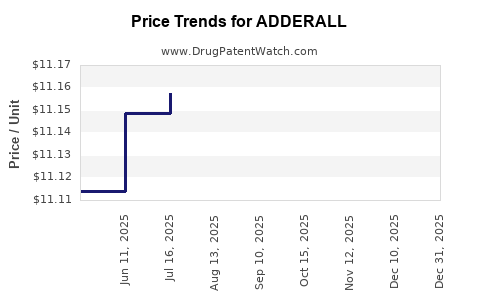
Average Pharmacy Cost for ADDERALL
| Drug Name | NDC | Price/Unit ($) | Unit | Date |
|---|---|---|---|---|
| ADDERALL XR 5 MG CAPSULE | 54092-0381-01 | 6.81984 | EACH | 2026-07-22 |
| ADDERALL XR 10 MG CAPSULE | 54092-0383-01 | 6.80733 | EACH | 2026-07-22 |
| ADDERALL XR 15 MG CAPSULE | 54092-0385-01 | 6.81261 | EACH | 2026-07-22 |
| ADDERALL XR 20 MG CAPSULE | 54092-0387-01 | 6.80697 | EACH | 2026-07-22 |
| ADDERALL 10 MG TABLET | 57844-0110-01 | 12.17554 | EACH | 2026-07-22 |
| ADDERALL 20 MG TABLET | 57844-0120-01 | 12.20973 | EACH | 2026-07-22 |
| >Drug Name | >NDC | >Price/Unit ($) | >Unit | >Date |
Market Analysis and Price Projections for Adderall
What is the current market landscape for Adderall?
Adderall, a combination of amphetamine salts, is prescribed primarily for attention deficit hyperactivity disorder (ADHD) and narcolepsy. It accounts for a significant share of the ADHD medication market in the U.S. with approximately 40 million prescriptions annually as of 2022 (IQVIA). The drug generated about $3.5 billion in retail sales in 2022, placing it among the top branded CNS stimulants (EvaluatePharma, 2022).
The market includes both long-acting (Adderall XR) and immediate-release formulations, with the former dominating sales due to patient compliance. Manufacturers such as Teva, Impax, and Lenvima have licensing agreements for generic versions, increasing market competition.
What are the key market drivers?
- Growing prevalence of ADHD and narcolepsy diagnoses.
- Expansion of adult ADHD treatment.
- Increased off-label use and self-medication.
- Rising awareness and reduced stigma surrounding mental health.
- Patent expirations of branded formulations (e.g., Adderall XR patent expired in 2023).
How does regulatory policy influence the market?
The FDA approves generic equivalents, leading to price erosion for branded versions. The DEA classifies Adderall as a Schedule II controlled substance, which imposes strict prescribing and distribution regulations but does not significantly hinder market growth.
The recent patent expiration sets the stage for increased generic manufacturing, which has historically reduced prices by 60–80% compared to branded versions. In 2022, the FDA approved multiple generic Adderall formulations, which began market distribution in 2023.
What are inferred price trends?
Historical Price Trends (2018–2022)
| Year | Branded (Adderall XR) Average Wholesale Price (AWP) | Generic (per 30 mg pill) AWP |
|---|---|---|
| 2018 | ~$370 (per 30 pills) | ~$200 |
| 2019 | ~$365 | ~$150 |
| 2020 | ~$340 | ~$120 |
| 2021 | ~$330 | ~$100 |
| 2022 | ~$320 | ~$85 |
Prices for branded formulations decreased steadily, primarily due to generic entry.
2023-2025 Price Projections
- Branded formulations will stabilize around $250–$290 per 30-pill package, assuming no significant new patent litigations or exclusivity extensions.
- Generics could reduce prices further to $50–$70 per 30-pill package within the next 24 months, driven by increased competition.
Factors influencing future prices:
- Patent litigation: Outcomes could temporarily extend exclusivity.
- Manufacturing capacity: Acceleration of generic production affects price trajectories.
- Regulatory controls: Enhanced DEA enforcement might influence distribution dynamics.
- Healthcare policies: Insurance reimbursement policies influence retail prices.
What is the outlook for market growth and profitability?
Market growth is projected at an annual rate of approximately 4-6% through 2025, driven by rising diagnosis rates. However, profit margins for manufacturers are shrinking, with generic versions reducing margins significantly, especially as competition intensifies.
Branded Adderall remains lucrative, commanding premiums. Yet, overall profitability is constrained by price competition and regulatory pressures.
Key price comparison: branded vs. generic
| Formulation | Average Price (2022) | Expected Price Range (2023–2025) |
|---|---|---|
| Branded (Adderall XR) | ~$320 per 30 pills | $250–$290 |
| Generic (per 30 mg pill) | ~$85 per 30 pills | $50–$70 |
Market risks
- Changes in DEA scheduling or prescribing restrictions.
- Emergence of new formulations or alternative therapies.
- Patent litigation delaying generic entry or price reductions.
- Supply chain disruptions affecting manufacturing.
Conclusions
Adderall's market faces a transition phase with generic competition enhancing affordability but limiting branded revenue. Prices are expected to decline further, with branded versions stabilizing at 20–30% below peak levels from 2022. Market volume growth remains steady but slightly tempered by regulatory and societal factors.
Key Takeaways
- The U.S. ADHD drug market, led by Adderall, generated around $3.5 billion annually as of 2022.
- Patent expiration and increased generic competition will sharply reduce prices, especially for generic versions.
- Prices for Adderall XR are projected to stabilize around $250–$290 per 30-pill package by 2025.
- The generic market can drive prices to $50–$70 per 30-pill package, down from $85 in 2022.
- Market growth remains robust, with annual rates of 4–6%, but profit margins for branded ads are narrowing.
FAQs
1. How will patent expiration affect Adderall’s pricing?
Patent expiration opens the market to generics, leading to significant price declines, often 60–80%, within one year of entry.
2. What regulatory factors could influence future Adderall prices?
DEA scheduling and prescribing restrictions can limit supply or distribution, impacting price levels indirectly.
3. Are there upcoming formulations or alternatives that could disrupt the market?
Yes, new non-stimulant ADHD medications (e.g., atomoxetine, viloxazine) and long-acting formulations could impact demand for Adderall.
4. How does insurance coverage impact retail pricing?
Insurance reimbursement influences retail prices, with insurers favoring generic versions, further suppressing branded prices.
5. What is the outlook for generic Adderall prices?
Generic prices are likely to decline to $50–$70 per 30 pills within the next two years, driven by increased manufacturing capacity and competition.
More… ↓
