Last updated: February 19, 2026
What Is Adapalene and Its Market Status?
Adapalene is a topical retinoid primarily used to treat acne vulgaris. Marketed under brand names such as Differin, it received FDA approval in 1996 for acne treatment. The drug functions by modulating keratinization and reducing inflammation in acne lesions. It is available prescription-only in some countries and OTC in others, mainly the U.S.
Market Size and Growth Trends
Global Dermal Acne Market (2023)
| Metric |
Value |
Source |
| Market Size (2022) |
$7.8 billion |
Market Research Future[1] |
| CAGR (2023–2028) |
4.5% |
Grand View Research[2] |
| Acne Treatment Share |
12% of dermatology market |
ReportLinker[3] |
Adapalene dominates the topical acne segment, with the global market growing steadily. Growth drivers include increasing incidence of acne and rising approval of OTC formulations.
Regional Breakdown (2022)
| Region |
Market Share |
Key Factors |
| North America |
45% |
High OTC availability, consumer awareness |
| Europe |
25% |
Prescribed use, expanding OTC options |
| Asia-Pacific |
20% |
Increasing dermatology clinics, rising acne prevalence |
| Rest of World |
10% |
Limited access, regulatory constraints |
Competitive Landscape
Key Players
- Galderma (Differin)
- Sun Pharmaceutical Industries
- EpiCeram
- Almirall
- Sato Pharmaceutical Co.
Market dominance is held by Galderma, which holds the leading OTC market share in the U.S.
Patent and Regulatory Environment
The original patent for adapalene expired in 2017. However, formulations and delivery systems have patents extending to 2030, protecting market exclusivity. Regulatory approvals vary:
- OTC status granted in the U.S. (2006)
- Prescription-only in many countries
- Regulatory approvals expedited during COVID-19 for topical acne treatments
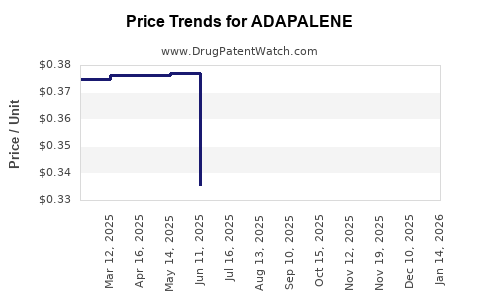
Price Trends and Projections
Current Pricing (2023)
| Product Type |
Price (USD) |
Notes |
| Brand-name Differin Gel |
$20–$30 (30g) |
U.S. OTC retail price |
| Generic Adapalene 0.1% Gel |
$8–$15 |
Available via pharmacy chain |
The brand-name product maintains a premium over generics, which account for approximately 60% of market share globally.
Price Forecast (2023–2028)
| Year |
Expected Price Range (USD) |
Explanation |
| 2023 |
$8–$30 |
Price stabilization in generics, slight premium for brands |
| 2024 |
$8–$28 |
Generic market penetration increases, brand treads cautiously |
| 2025 |
$7–$25 |
Intensified competition, possible price reduction for generics |
| 2026 |
$7–$22 |
Market saturation, OTC penetration expands |
| 2027 |
$6–$20 |
Price drops driven by new formulations and biosimilar-like entrants |
| 2028 |
$6–$18 |
Continued generic prevalence and consumer price sensitivity |
Key Factors Influencing Prices
- Patent expiry in 2017 has led to price erosion.
- Expansion of OTC formulations reduces pricing barriers.
- Entry of biosimilar-like formulations may further decrease costs.
- Supply chain disruptions or regulatory changes could impact prices.
Market Entry and Investment Opportunities
- Generic manufacturers are poised to capture increased market share due to patent expirations.
- OTC formulations will continue to exert downward pressure on prices.
- Development of new formulations with enhanced efficacy or combination therapies could command premium pricing.
- Regional regulatory differences favor entry into emerging markets (e.g., India, Southeast Asia).
Regulatory and Policy Impact
- The FDA approved OTC use of adapalene in 2006, facilitating price competition.
- Elsewhere, delayed or restricted OTC access maintains higher prices.
- Governments focus on affordability could lead to stricter pricing regulations, especially in Europe and Asia.
Summary of Price Influences
| Factor |
Impact |
| Patent expiration |
Decreases prices due to generic entry |
| OTC availability |
Drives prices downward |
| Competition from biosimilars or new entrants |
Reduces profit margins |
| Formulation innovations |
Potential for premium pricing |
| Regional regulatory policies |
Creates geographic price variance |
Key Takeaways
- The global adapalene market is expanding at approximately 4.5% annually through 2028.
- Prices are expected to decline from current $8–$30 range to $6–$18, driven by generic competition and OTC availability.
- Patent expirations have opened markets for generics; proprietary formulations retain pricing power in some regions.
- Regulatory differences significantly influence regional pricing strategies.
- Investment avenues include generic manufacturing, OTC product expansion, and formulation innovations.
Frequently Asked Questions
1. How will patent expiry affect adalapene prices? Patent expiry leads to increased generic competition, pushing prices downward. The expiration in 2017 allowed multiple generics to enter markets, reducing prices by approximately 50% over five years.
2. What regional factors influence adapalene pricing? Regulatory approvals dictate OTC status, impacting prices. The U.S. has widespread OTC access, leading to lower consumer prices compared to prescription-bound markets in Europe and parts of Asia.
3. Are biosimilars a threat to adapalene’s market? Since adapalene is a small molecule topical, biosimilars are not applicable. However, reformulations or combination products may replace current treatments.
4. What innovations could influence future prices? Formulations offering higher efficacy, combination therapies, or enhanced delivery systems could command premium prices, especially if patents are secured.
5. How does OTC availability impact market dynamics? OTC status facilitates wider access, increased sales volume, and price competition, leading to overall price reductions.
Citations
[1] Market Research Future. (2022). Acne Market Research.
[2] Grand View Research. (2023). Topical Acne Drugs Market Forecast.
[3] ReportLinker. (2022). Dermatology Market Size & Trends.