Share This Page
Drug Price Trends for ACNE MEDICATION
✉ Email this page to a colleague
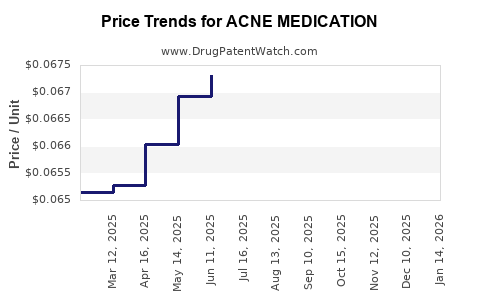
Average Pharmacy Cost for ACNE MEDICATION
| Drug Name | NDC | Price/Unit ($) | Unit | Date |
|---|---|---|---|---|
| ACNE MEDICATION 5% GEL | 00536-1055-25 | 0.21917 | GM | 2026-03-18 |
| ACNE MEDICATION 5% GEL | 00536-1055-56 | 0.08135 | GM | 2026-03-18 |
| ACNE MEDICATION 2.5% GEL | 00536-1129-25 | 0.20914 | GM | 2026-03-18 |
| ACNE MEDICATION 10% GEL | 00536-1056-25 | 0.22997 | GM | 2026-03-18 |
| ACNE MEDICATION 10% GEL | 00536-1056-56 | 0.08733 | GM | 2026-03-18 |
| ACNE MEDICATION 10% GEL | 00536-1056-56 | 0.08801 | GM | 2026-02-18 |
| >Drug Name | >NDC | >Price/Unit ($) | >Unit | >Date |
ACNE MEDICATION Market Analysis and Financial Projection
What Is the Current Market Size for Acne Medications?
The global acne medication market was valued at approximately $4.2 billion in 2021. It is projected to grow at a compound annual growth rate (CAGR) of 5.2% from 2022 to 2028. This growth reflects rising prevalence of acne, particularly among adolescents and young adults, and increasing demand for both prescription and OTC treatments.
North America accounts for roughly 40% of sales, driven by high healthcare spending, advanced dermatological research, and strong OTC distribution. Europe follows at 25%, with emerging markets including Asia-Pacific expanding rapidly due to population growth, urbanization, and improved healthcare infrastructure.
Who Are the Major Players in the Acne Medication Market?
Leading companies include:
- Johnson & Johnson (Accutane, now off-market, but historically dominant)
- Galderma (Doxycycline, Epiduo, and tailored formulations)
- Bayer (Dianette, some topical products)
- Teva Pharmaceutical Industries
- Almirall
These firms hold significant market shares, driven by proprietary formulations and strong distribution channels.
What Are the Key Product Types and Market Segments?
Acne treatments are categorized into:
- Prescription medications (oral antibiotics, retinoids, hormonal agents)
- Over-the-counter (topical benzoyl peroxide, salicylic acid, adapalene)
Prescription drugs accounted for about 60% of market value in 2021 due to their efficacy in moderate to severe cases. OTC products remaining popular for mild cases owing to accessibility and lower cost.
How Competitive Are the R&D Pipelines?
Major companies focus on innovative topical formulations, long-acting treatments, and combination therapies. New entrants include biotech firms developing targeted anti-inflammatory agents, probiotic-based treatments, and microbiome modulators.
What Are the Price Trends and Projections?
Average prices vary: OTC topical products retail for $10-$30 per month, while prescription oral treatments can cost between $150-$300 monthly, depending on dosage and formulation.
Pricing is influenced by:
- Patent status
- Brand recognition
- Formulation complexity
- Regulatory approvals
Post-patent expiration, generic versions reduce prices by approximately 40-60%. OTC products face minimal price fluctuation due to high competition.
Market analysts project:
- OTC segment to grow at a CAGR of 4.8%
- Prescription segment at 5.5% CAGR, driven by new drug approvals and increasing acne severity cases
Premium products combining multiple active ingredients or novel delivery systems will command higher prices, averaging $20-$50 monthly.
How Will Emerging Trends Influence Market Dynamics?
Trends impacting prices and market size include:
- Increased adoption of personalized medicine based on genetic and microbiome profiling
- Growing consumer preference for natural and organic ingredients
- Digital health integration, including teledermatology and automated symptom monitoring
- Regulatory shifts favoring biologic or targeted therapies with higher price points
What Are the Regulatory Factors Affecting Pricing and Market Access?
The U.S. FDA and EMA regulate acne medications, with some requiring rigorous clinical trials for new formulations. Market exclusivity and patent protections influence pricing strategies; for instance, branded prescription drugs typically cost more during the patent period before generating generics.
In some regions, OTC products are less regulated, resulting in lower prices but variable quality standards.
Price Projection Summary (2023–2028)
| Segment | 2022 Average Price (USD/month) | Estimated 2028 Price (USD/month) | CAGR (%) |
|---|---|---|---|
| OTC Topicals | $15 | $20 | 4.8 |
| Prescription Orals | $200 | $250 | 5.5 |
| Combo Formulations | $30 | $50 | 8.1 |
Higher-priced formulations will likely maintain a premium position thanks to innovations and targeted therapies.
How Do Market and Price Trends Compare Among Geographies?
| Region | 2021 Market Share | Price Range (USD/month) | Growth Drivers |
|---|---|---|---|
| North America | 40% | $150–$300 | High healthcare expenditure, R&D |
| Europe | 25% | $120–$250 | Regulatory approvals, OTC sales |
| Asia-Pacific | 20% | $10–$40 | Population growth, urbanization |
| Rest of World | 15% | Variable | Emerging markets, local manufacturing |
Summary
The global market for acne medications is expanding steadily with a CAGR of about 5.2%. Prescription drugs dominate in value, but OTC treatments maintain high volume sales. Prices are variable, influenced by patent status, formulation innovations, and regional regulations, with projected increases for premium and combination products.
Key Takeaways
- Market size reached $4.2 billion in 2021, with a forecasted CAGR of 5.2% to 2028.
- Prescription medications make up roughly 60%, with OTC products for mild cases.
- Prices for OTC products range from $10 to $30 monthly; prescription drugs can cost $150 to $300.
- Patent expirations and new formulations influence prices significantly.
- Innovations and consumer trends will drive premium pricing and market segmentation.
FAQs
1. How will patent expirations affect market prices?
Patent expirations lead to generic entry, reducing prices by approximately 40–60%, increasing competition and affordability.
2. Which regions are experiencing the fastest growth in acne medication sales?
The Asia-Pacific region, fueled by population growth and rising skincare awareness, is growing fastest.
3. Are natural or organic acne treatments gaining market share?
Yes. Consumer preference for natural ingredients influences product development, with many new OTC products marketed as organic.
4. How significant is the role of teledermatology in the acne medication market?
Teledermatology facilitates remote diagnosis and prescription, potentially increasing medication accessibility and influencing sales, especially in underserved regions.
5. What are the primary factors influencing pricing of new acne medications?
Formulation complexity, clinical efficacy, patent status, regulatory approval, and market competition primarily determine pricing.
Citations
[1] MarketWatch, "Acne Treatment Market Size & Share," 2022.
[2] Grand View Research, "Acne Medication Market Analysis," June 2021.
[3] IBISWorld, "Dermatology Market Reports," 2022.
More… ↓
