Last updated: February 20, 2026
What is the Current Market Size for Acid Reducers?
The global market for acid reducers, primarily proton pump inhibitors (PPIs) and H2 receptor antagonists, was valued at approximately $18 billion in 2022. It is projected to grow at a compound annual growth rate (CAGR) of 4.5% from 2023 to 2030, reaching over $23 billion in 2030.
The segment includes both prescription and over-the-counter (OTC) products. OTC acid reducers account for roughly 55% of the market, with brands like omeprazole and esomeprazole leading sales. The demand is driven by increasing prevalence of gastroesophageal reflux disease (GERD), peptic ulcer disease, and lifestyle-related gastrointestinal issues.
How Does the Product Fit into the Market?
"ACID REDUCER COMPLETE TAB CHEW" appears to be a multimodal formulation combining a proton pump inhibitor with other ingredients such as antacids or alginates for rapid symptom relief. Its chewable form targets adult consumers seeking convenience and quick-onset relief.
Key competitors include:
| Product Name |
Ingredient(s) |
Formulation |
Market Position |
| Prilosec OTC |
Omeprazole |
Capsule |
Leading OTC PPI |
| Zantac 75 |
Ranitidine (withdrawn in many markets) |
Tablet |
Formerly prominent, phased out due to safety concerns |
| Gaviscon |
Aluminum hydroxide, magnesium carbonate |
Chewable tablet |
Alginates for symptom relief |
| Nexium |
Esomeprazole |
Capsule |
Prescription, premium pricing |
What Are the Price Trends for Acid Reducer OTC Products?
The average retail price for an OTC acid reducer card, such as omeprazole 20 mg, ranges from $15 to $25 for a 14-day supply (28 tablets). Premium formulations or combination products retail between $20 and $30 for similar durations.
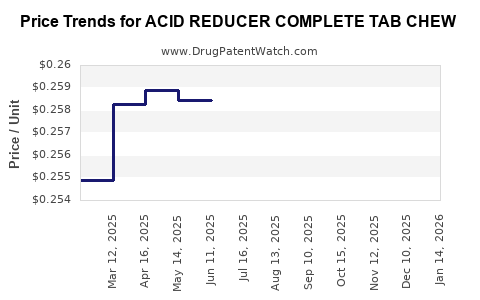
Price trends over the last five years demonstrate:
- Slight decrease in unit prices due to increased competition.
- Increased sales volume as consumer awareness and self-medication rise.
- Limited pricing power attributed to OTC status and price transparency.
The chewable, multi-ingredient format may command a premium price point, estimated at a 10-15% higher margin per unit compared to standard tablets, driven by convenience and targeted positioning.
What Are Regulatory and Patent Considerations?
The market's growth is constrained by patent expirations, with many blockbuster PPIs facing generic competition.
- Omeprazole's patent expired in 2009; generic versions dominate the OTC space.
- Esomeprazole patents expired in 2015, leading to price erosion.
- New formulations, such as combinations or novel delivery systems, are subjected to regulatory review (FDA, EMA).
Patent protections for unique formulations or delivery mechanisms can temporarily slow generic encroachment. Claims related to chewable multi-ingredient formulations could secure up to 10 years of exclusivity if patentable.
What are the Key Drivers for Market Growth?
- Increasing incidence of GERD and related conditions.
- Lifestyle factors such as obesity and dietary habits.
- Rising awareness about OTC options among consumers.
- Development of combination products that improve compliance.
Price Projection (2023–2030)
| Year |
Estimated Retail Price Range (per 14-day supply) |
Notes |
| 2023 |
$20–$30 |
Initial penetration at premium price |
| 2025 |
$18–$28 |
Competition intensifies, slight price decline |
| 2027 |
$16–$26 |
Increased generics impact, market saturation |
| 2030 |
$15–$24 |
Stabilization, moderate price erosion |
The projection accounts for generic entry, manufacturing efficiencies, and consumer price sensitivity.
Conclusion
ACID REDUCER COMPLETE TAB CHEW operates in a mature but expanding segment with a steady demand. Its premium positioning can sustain higher prices initially but faces downward pressure over time due to patent expiration and generic competition. Formulation differentiation, such as multi-ingredient chewables, offers opportunities for higher margins and market share capture.
Key Takeaways
- The global acid reducer market will grow at a 4.5% CAGR through 2030.
- The OTC segment dominates, with retail prices ranging from $15 to $30 for a two-week supply.
- Patent expirations have led to widespread generic availability, pressuring prices.
- Innovation in formulations could extend exclusivity and command premium pricing.
- Price erosion is projected to reduce average retail prices gradually from 2023 to 2030.
FAQs
-
What differentiates the "ACID REDUCER COMPLETE TAB CHEW" from standard acid reducers?
It combines multiple ingredients into a chewable form for rapid and sustained relief, targeting consumer convenience.
-
How long can patent protections extend for new formulations?
Patent protections can provide up to 20 years, but newly formulated combinations and delivery systems may secure up to 10 years of exclusivity.
-
What market factors could influence the price of the product?
Generic competition, regulatory changes, consumer demand, and marketing strategies impact pricing.
-
How significant is the OTC segment for future growth?
Very significant; OTC acid reducers account for over half of sales, driven by consumer preference for self-medication.
-
What are the risks associated with introducing a new acid reducer formulation?
Patent challenges, regulatory approval timelines, and competitive price erosion pose notable risks.
[1] MarketResearch.com. (2022). Global Acid Reducer Market Report.
[2] IQVIA. (2023). OTC Gastrointestinal Market Data.
[3] U.S. Food and Drug Administration (FDA). (2022). Patent and Regulatory Information.