Share This Page
Drug Price Trends for ACETIC ACID
✉ Email this page to a colleague
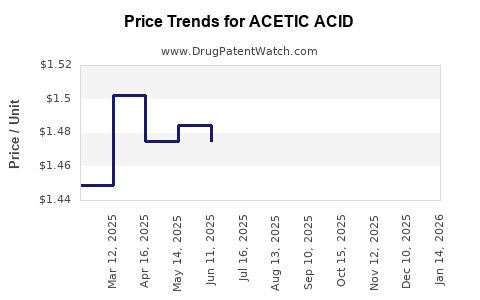
Average Pharmacy Cost for ACETIC ACID
| Drug Name | NDC | Price/Unit ($) | Unit | Date |
|---|---|---|---|---|
| ACETIC ACID 2% EAR SOLUTION | 62135-0801-51 | 1.45093 | ML | 2026-06-17 |
| ACETIC ACID 2% EAR SOLUTION | 52817-0816-15 | 1.45093 | ML | 2026-06-17 |
| ACETIC ACID 2% EAR SOLUTION | 52817-0816-15 | 1.43757 | ML | 2026-05-20 |
| >Drug Name | >NDC | >Price/Unit ($) | >Unit | >Date |
Best Wholesale Price for ACETIC ACID
| Drug Name | Vendor | NDC | Count | Price ($) | Price/Unit ($) | Unit | Dates | Price Type |
|---|---|---|---|---|---|---|---|---|
| ACETIC ACID 2%/HYDROCORTISONE 1% SOLN,OTIC | Golden State Medical Supply, Inc. | 51672-3007-01 | 10ML | 121.91 | 12.19100 | ML | 2023-12-15 - 2028-06-14 | FSS |
| >Drug Name | >Vendor | >NDC | >Count | >Price ($) | >Price/Unit ($) | >Unit | >Dates | >Price Type |
ACETIC ACID MARKET ANALYSIS AND PRICE PROJECTIONS
ACETIC ACID MARKET OVERVIEW AND PRICE TRENDS
Acetic acid, also known as ethanoic acid, is a fundamental organic compound with the chemical formula CH₃COOH. It is a colorless liquid with a distinctive corrosive taste and pungent smell. The global acetic acid market is characterized by consistent demand driven by its widespread application in various industries, including chemicals, plastics, textiles, and pharmaceuticals.
The market size for acetic acid was valued at approximately $7.6 billion in 2022. Projections indicate a compound annual growth rate (CAGR) of 4.5% from 2023 to 2030, anticipating a market valuation of around $10.8 billion by 2030. This growth is primarily attributed to the expanding end-use industries and increasing adoption of acetic acid-based derivatives.
Key drivers for market expansion include:
- Demand for Vinyl Acetate Monomer (VAM): VAM is a significant derivative of acetic acid, used extensively in the production of polyvinyl acetate (PVA), a binder in paints and adhesives, and polyvinyl alcohol (PVOH), used in textiles and paper coatings. The construction and automotive sectors are major consumers of these products, directly influencing VAM demand.
- Growth in Purified Terephthalic Acid (PTA) Production: Acetic acid is a key solvent in the production of PTA, a precursor to polyethylene terephthalate (PET). The rising demand for PET in packaging, textiles, and films, particularly in emerging economies, fuels PTA production and, consequently, acetic acid consumption.
- Expanding Pharmaceutical and Agrochemical Sectors: Acetic acid serves as a reagent and solvent in the synthesis of various pharmaceutical intermediates and agrochemicals. The increasing global healthcare spending and the need for enhanced agricultural productivity contribute to this demand.
However, market growth faces certain restraints:
- Volatility in Raw Material Prices: The primary feedstock for acetic acid production is methanol. Fluctuations in methanol prices, often linked to crude oil and natural gas prices, directly impact the production cost and pricing of acetic acid.
- Environmental Regulations: Stringent environmental regulations regarding emissions and waste disposal in chemical manufacturing can increase operational costs for acetic acid producers.
REGIONAL MARKET DYNAMICS
The Asia-Pacific region dominates the global acetic acid market, accounting for over 50% of the total market share. This dominance is driven by the robust manufacturing base in countries like China and India, coupled with rapidly growing end-use industries.
- Asia-Pacific: China is the largest producer and consumer of acetic acid. Its significant manufacturing capacity for VAM, PTA, and other derivatives, along with its vast domestic market, underpins its leadership. India and Southeast Asian nations also contribute substantially to regional demand and production.
- North America: The region benefits from a well-established chemical industry and significant demand from the construction, automotive, and packaging sectors. The presence of key acetic acid producers ensures stable supply.
- Europe: Europe is a mature market with steady demand from its industrial base. The emphasis on sustainability and high-value chemical production influences market trends.
- Middle East & Africa: This region is a growing market, with investments in petrochemicals and expanding industrial sectors contributing to increasing acetic acid consumption.
ACETIC ACID PRODUCTION METHODS AND TECHNOLOGY
The dominant method for industrial acetic acid production is the methanol carbonylation process. This process involves the reaction of methanol with carbon monoxide. There are several catalytic variants of this process, with the Monsanto process (using a rhodium-based catalyst) and the Cativa process (using an iridium-based catalyst) being the most prevalent.
-
Methanol Carbonylation:
- Monsanto Process: Discovered in the 1960s, this process utilizes a rhodium catalyst promoted by iodine. It operates at moderate temperatures (150-200°C) and pressures (30-60 bar). While efficient, the rhodium catalyst is expensive.
- Cativa Process: Developed by BP in the 1990s, this process employs an iridium-based catalyst system, also promoted by iodine. It offers higher efficiency, lower water content in the reaction mixture, and improved catalyst stability compared to the Monsanto process. The Cativa process operates at similar temperatures but can achieve higher carbon monoxide pressures, leading to increased reaction rates.
-
Other Production Methods:
- Oxidation of Acetaldehyde: This older method involves the oxidation of acetaldehyde, which is typically produced from ethylene. It is less economical and environmentally friendly than methanol carbonylation and is largely phased out for large-scale production.
- Bacterial Fermentation: Acetic acid is naturally produced by the fermentation of sugars by Acetobacter species. This method is used for producing vinegar for culinary purposes but is not scalable for industrial chemical production.
The technological advancements in catalysis and process optimization have led to higher yields, lower energy consumption, and reduced by-product formation in methanol carbonylation. The selection of a specific process often depends on factors such as feedstock availability, existing infrastructure, and desired production capacity.
COST STRUCTURE OF ACETIC ACID PRODUCTION
The cost structure of acetic acid production is heavily influenced by raw material prices, energy costs, and capital expenditure for plant construction and maintenance.
- Raw Materials: Methanol and carbon monoxide are the primary feedstocks. Methanol prices are closely linked to natural gas and crude oil markets. Carbon monoxide is typically derived from natural gas reforming or coal gasification.
- Energy: Significant energy is consumed in the process for heating, cooling, and maintaining pressure.
- Catalyst: The cost of rhodium or iridium catalysts, while having a long lifespan, represents a notable upfront investment.
- Labor and Maintenance: Operational labor and ongoing plant maintenance contribute to the overall cost.
- Capital Expenditure (CAPEX): The construction of new acetic acid production facilities involves substantial capital investment.
The trend in production cost is influenced by the efficiency of newer catalytic processes (like Cativa) that reduce energy consumption and improve yields, thereby partially offsetting raw material price volatility.
ACETIC ACID APPLICATIONS AND MARKET SEGMENTATION
Acetic acid's versatility leads to its application across a broad spectrum of industries. The market can be segmented by its end-use applications:
- Vinyl Acetate Monomer (VAM): This is the largest application segment for acetic acid, consuming approximately 30-40% of global production. VAM is polymerized to produce PVA, a crucial component in adhesives, paints, textiles, and paper coatings.
- Purified Terephthalic Acid (PTA): Approximately 20-25% of acetic acid is used as a solvent in the production of PTA, which is essential for manufacturing PET. PET is widely used in beverage bottles, food packaging, and synthetic fibers.
- Acetic Anhydride: Used in the production of cellulose acetate for cigarette filters and textiles, as well as in pharmaceuticals and dyes.
- Solvents: Acetic acid is used as a solvent in various chemical reactions and processes, including the production of plastics and synthetic fibers.
- Pharmaceuticals and Agrochemicals: Utilized as a reactant or solvent in the synthesis of active pharmaceutical ingredients (APIs) and crop protection chemicals.
- Food Industry: Used as an acidity regulator and preservative in food products, most commonly in the form of vinegar.
- Other Applications: Includes use in the production of rubber, dyes, and various chemical intermediates.
DEMAND DRIVERS BY END-USE SEGMENT
- VAM Demand: Driven by the construction sector (paints, adhesives) and the automotive industry (adhesives, coatings). Global infrastructure development and vehicle production influence this segment.
- PTA Demand: Directly correlated with the packaging industry (PET bottles) and the textile industry (polyester fibers). Growth in disposable income and consumer spending on packaged goods and apparel are key factors.
- Pharmaceutical and Agrochemical Demand: Influenced by global health trends, population growth, and the need for food security. Emerging markets with expanding healthcare access and agricultural development represent significant growth areas.
ACETIC ACID PRICE ANALYSIS AND PROJECTIONS
Acetic acid prices are subject to fluctuations influenced by supply-demand dynamics, feedstock costs, and regional economic conditions.
Historical Price Trends: Over the past five years, acetic acid prices have experienced volatility. From a low of around $400-$500 per metric ton in some periods, prices have risen to peaks of $700-$900 per metric ton or higher, primarily driven by raw material cost increases and supply disruptions. For instance, in late 2021 and early 2022, prices surged due to elevated methanol costs and logistical challenges.
Factors Influencing Current and Future Pricing:
- Methanol Prices: As the primary feedstock, methanol prices are the most significant determinant of acetic acid production costs. Natural gas price fluctuations, especially in major methanol-producing regions like North America and the Middle East, directly impact methanol availability and cost.
- Supply and Demand Balance:
- Supply: New capacity additions, plant turnarounds, and unexpected production outages can significantly alter the supply landscape. Global production capacity for acetic acid is estimated to be around 16 million metric tons per year. Major producing regions and companies include China (Sinopec, Celanese), the US (Celanese, LyondellBasell), and South Korea (LG Chem, Lotte Chemical).
- Demand: Growth in end-use industries, particularly in Asia-Pacific, is a consistent demand driver. Economic slowdowns or disruptions in these sectors can lead to reduced demand.
- Energy Costs: High energy prices increase operational costs for producers, potentially leading to price increases.
- Geopolitical Factors: Trade policies, tariffs, and geopolitical instability can disrupt supply chains and influence regional pricing.
- Capacity Utilization Rates: Higher capacity utilization rates generally indicate strong demand and can support higher prices. Conversely, low utilization rates often suggest oversupply and downward price pressure. Current global capacity utilization rates hover around 75-80%.
Price Projections (2024-2030):
Based on current market intelligence and projected economic growth, the following price trends are anticipated:
- 2024-2025: Prices are expected to remain relatively stable to moderately increasing. While methanol prices may see some stabilization, continued strong demand from Asia-Pacific and the possibility of localized supply disruptions will support price levels. Average prices are projected to range between $650-$800 per metric ton.
- 2026-2028: As global economic growth continues and end-use industries expand, demand for acetic acid is forecast to rise. However, the market will also be sensitive to new capacity additions. Prices are likely to see a gradual upward trend, potentially averaging $700-$850 per metric ton, depending on feedstock costs and supply-demand equilibrium.
- 2029-2030: With sustained demand growth, particularly from emerging economies, and assuming no major overcapacity issues, prices are projected to reach $750-$900 per metric ton. Volatility will persist, driven by methanol price swings and any unforeseen supply chain disruptions.
It is crucial to note that these projections are based on current assumptions and can be impacted by unforeseen events. A sharp increase in crude oil and natural gas prices could lead to higher methanol costs and, consequently, higher acetic acid prices than projected. Conversely, significant technological breakthroughs in production or a substantial slowdown in key end-use markets could exert downward pressure on prices.
Key Price Influencing Companies:
- Celanese Corporation
- Eastman Chemical Company
- LyondellBasell Industries N.V.
- Sinopec (China Petroleum & Chemical Corporation)
- LG Chem
- Mitsubishi Chemical Corporation
- Samsung C&T Corporation
These companies hold significant market share and their production and pricing strategies have a considerable impact on global acetic acid prices.
KEY TAKEAWAYS
- The global acetic acid market is projected to grow from $7.6 billion in 2022 to $10.8 billion by 2030, at a CAGR of 4.5%.
- Vinyl Acetate Monomer (VAM) and Purified Terephthalic Acid (PTA) are the dominant end-use applications, consuming over 60% of global production.
- The Asia-Pacific region leads the market in both production and consumption, driven by China's substantial manufacturing capacity and demand.
- Methanol carbonylation, particularly the Cativa process, is the predominant production method, with advancements focusing on efficiency and cost reduction.
- Methanol prices, supply-demand balance, and energy costs are the primary determinants of acetic acid pricing.
- Acetic acid prices are expected to range between $650-$800 per metric ton in 2024-2025, with a gradual increase to $750-$900 per metric ton by 2030, subject to feedstock volatility and market dynamics.
FREQUENTLY ASKED QUESTIONS
- What is the current global production capacity for acetic acid? Global production capacity for acetic acid is estimated at approximately 16 million metric tons per year.
- Which region is the largest consumer of acetic acid? The Asia-Pacific region is the largest consumer, primarily due to significant demand from China.
- What are the most significant risks to acetic acid price stability in the coming years? The primary risks include volatility in methanol prices (linked to natural gas and crude oil), unforeseen supply chain disruptions, and rapid changes in demand from key end-use industries like construction and packaging.
- How do environmental regulations impact acetic acid production costs? Stringent regulations concerning emissions and waste management can increase operational expenses for chemical manufacturers, potentially leading to higher production costs and influencing market pricing.
- What is the projected CAGR for the acetic acid market from 2023 to 2030? The projected CAGR for the global acetic acid market from 2023 to 2030 is 4.5%.
CITATIONS
[1] Grand View Research. (2023). Acetic Acid Market Size, Share & Trends Analysis Report. [2] Market Research Future. (2023). Acetic Acid Market. [3] IHS Markit. (2023). Acetic Acid Market Analysis. [4] Bloomberg Terminal data. (Accessed October 2023). [5] Various industry reports and company disclosures. (2023).
More… ↓
