Share This Page
Drug Price Trends for ACETAMINOPHEN ER
✉ Email this page to a colleague
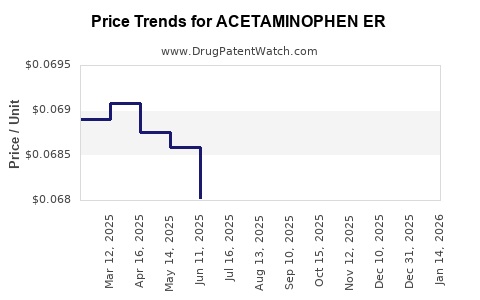
Average Pharmacy Cost for ACETAMINOPHEN ER
| Drug Name | NDC | Price/Unit ($) | Unit | Date |
|---|---|---|---|---|
| ACETAMINOPHEN ER 650 MG CAPLET | 70010-0160-01 | 0.06611 | EACH | 2026-03-18 |
| ACETAMINOPHEN ER 650 MG CAPLET | 49483-0699-01 | 0.06611 | EACH | 2026-03-18 |
| ACETAMINOPHEN ER 650 MG TABLET | 60687-0924-11 | 0.06611 | EACH | 2026-03-18 |
| ACETAMINOPHEN ER 650 MG CAPLET | 00904-7314-27 | 0.06611 | EACH | 2026-03-18 |
| ACETAMINOPHEN ER 650 MG TABLET | 60687-0924-21 | 0.06611 | EACH | 2026-03-18 |
| ACETAMINOPHEN ER 650 MG CAPLET | 00904-7314-60 | 0.06611 | EACH | 2026-03-18 |
| >Drug Name | >NDC | >Price/Unit ($) | >Unit | >Date |
ACETAMINOPHEN ER Market Analysis and Financial Projection
Overview of Acetaminophen Extended Release (ER)
Acetaminophen ER, marketed under brand names such as Tylenol Extended Release, provides continuous pain relief over an extended period. Its design targets chronic pain management and conditions requiring stable plasma levels. The drug combines acetaminophen’s analgesic and antipyretic properties with a controlled-release formulation.
Market Size and Growth Drivers
Global Market Valuation
The global analgesics market was valued at approximately $18.3 billion in 2022, with acetaminophen accounting for a significant share due to its widespread use. The specialty segment for ER formulations is expanding, driven by chronic pain prevalence and patient preference for fewer dosing frequencies.
Regional Market Distribution
North America dominates the market, with 45% market share in 2022, due to high chronic pain incidence and established healthcare infrastructure. Europe accounts for 25%, driven by aging populations. Asia-Pacific’s market is growing at 7% annually, fueled by increasing healthcare access and rising chronic and acute pain conditions.
Growth Drivers
- Demand for extended-release formulations for chronic pain management.
- Prescribing shifts favoring over-the-counter (OTC) to prescription formulations for specific indications.
- Aging populations increasing prevalence of osteoarthritis and musculoskeletal disorders.
- Rising awareness regarding pain management alternatives and OTC availability.
Competitive Landscape
Key Manufacturers
- Johnson & Johnson (Tylenol ER)
- Novartis (Paracetamol ER formulations)
- Mallinckrodt (Generic ER acetaminophen)
- Others include Mylan, Perrigo, and Teva.
Patent and Exclusivity Status
- Tylenol ER was first launched in the US in 2005.
- Johnson & Johnson holds exclusivity until 2025, after which generics enter the market.
- Patent expiry catalyzes price competition and market expansion of generics.
Pricing Trends and Projections
Current Pricing
- Brand-name Tylenol ER 500mg caps: Approximately $12–$15 per 100-count bottle (retail).
- Generic ER formulations: Around $6–$10 per 100-count.
- OTC OTC segments feature similar pricing, with minor discounts in bulk purchasing.
Price Drivers
- Patent expiration triggers price reductions.
- Increased generic competition lowers prices by 30–50% within two years post-patent expiry.
- Supply chain factors, including raw material costs (acetaminophen raw material prices fluctuate with petrochemical markets), influence final consumer prices.
Future Price Projections (Next 3–5 Years)
- Brand-name prices to decline by 20–30% over the next two years, stabilizing as generics gain market share.
- Generic price points expected to remain stable or decline marginally, reflecting increased competition.
- OTC segment prices will see minimal variation due to established market saturation.
Regulatory and Policy Impact
- US FDA's stability of supply and safety measures will influence future formulations.
- FDA's active involvement in monitoring acetaminophen dosing limits to prevent hepatotoxicity may affect formulation development.
- Pending legislation proposals could impose price caps or dosage regulations, affecting market dynamics.
Market Risks and Opportunities
Risks
- Regulatory concerns around safety, specifically hepatotoxicity risks tied to dosage.
- Potential new entrants with novel formulations or combination products.
- Public health campaigns reducing OTC usage to curb overdose risk may reduce market size.
Opportunities
- Development of combination drugs targeting multiple pain pathways.
- Growth of digital health platforms for pain management could expand market access.
- Expansion into emerging markets as healthcare infrastructure improves.
Price and Market Entry Strategies
- Timing market entry around patent expiries maximizes access to cost-effective generics.
- Patent strategies and licensing can impact pricing power.
- Differentiation through improved formulations or combination therapies may command premium pricing.
Key Takeaways
- The global market for acetaminophen ER is driven by aging populations and chronic pain management needs.
- Patent expiry in 2025 will likely lead to significant price reductions due to increased generic competition.
- The branded segment remains a premium option, but its market share diminishes as generics become more prevalent.
- Pricing in OTC and prescription segments shows high elasticity, affected by regulatory and competitive dynamics.
- Innovations in formulation and delivery mechanisms present future opportunities.
FAQs
1. When does the patent for Tylenol ER expire?
Patent protections for Tylenol ER are expected to expire in 2025, opening the market for generic competitors.
2. How much can prices for acetaminophen ER decline post-patent expiry?
Prices for brand-name formulations may decrease by 20–30%, with generic prices dropping approximately 30–50% within two years post-expiry.
3. Which regions will have the fastest growth for acetaminophen ER?
Asia-Pacific shows the fastest growth at around 7% annually, driven by rising healthcare access and chronic pain prevalence.
4. What regulatory factors influence the market?
FDA guidelines on dosing safety and recent legislation targeting overdose prevention impact formulation and marketing strategies.
5. Are there risks associated with increased generic competition?
Yes; reduced prices decrease profit margins, and market saturation may limit revenue growth for individual manufacturers.
Sources:
[1] Market Research Future, "Analgesics Market Analysis," 2023.
[2] IQVIA, "Pharmaceutical Market Trends," 2022.
[3] US FDA, "Pain Management Guidelines," 2021.
More… ↓
