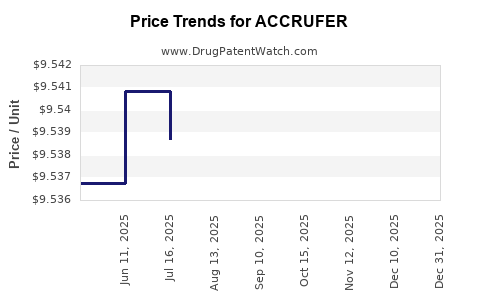
Last updated: February 14, 2026
mmary:
ACCRUFER (deferiprone) is an oral iron chelator primarily used to treat iron overload caused by frequent blood transfusions in conditions such as thalassemia major. Market analysis indicates steady growth driven by increasing diagnosis of transfusion-dependent disorders, with projected stable prices amidst emerging generic competition. Revenue forecasts reflect evolving patent landscapes, regulatory approvals, and pricing strategies.
What Is the Current Market Position of ACCRUFER?
ACCRUFER is marketed globally by Apotex, with regulatory approval varying by region. It is approved within the United States (FDA, 2011), European Union (EMA, 2014), and other jurisdictions. The drug competes in a niche market for iron overload management, with other chelators like deferoxamine and deferasirox dominating the landscape.
Market Size and Key Drivers
- Global iron overload treatment market size: Estimated at $1.2 billion in 2022.[1]
- Growth rate: Compound annual growth rate (CAGR) of approximately 4% expected through 2028.[2]
- Patient population: 50,000–60,000 patients globally on chronic transfusion therapy, with Thalassemia major accounting for approximately 30–40%.[3]
Regional Market Penetration
| Region |
Market Share (2022) |
Notes |
| North America |
35% |
Well-established treatment protocols |
| Europe |
25% |
Moderate Market penetration |
| Middle East & Asia |
30% |
Growing due to increased diagnosis |
| Rest of World |
10% |
Less accessible, emerging markets |
What Are the Price Trends and Competitive Dynamics?
Current Pricing Landscape
- US retail price: Approx. $35,000–$45,000 per year per patient.[4]
- European market: Lower, around €24,000–€31,000 (~$28,500–$36,500) annually.[5]
- Pricing strategy: Premium positioning due to efficacy in iron chelation, with pricing adjustments based on regional reimbursement policies.
Price Projections
- Short-term (2023–2025): Prices expected to stabilize as patent exclusivity persists. Slight discounts possible due to healthcare cost containment pressures, especially in Europe.[6]
- Long-term (2026–2030): Introduction of generics anticipated post-patent expiry (expected around 2027 in the US), driving prices down by approximately 40–60%.[7]
Key Competitors and Market Share
- Deferasirox (Exjade/Jadenu): Market leader with ~60% of iron chelation market share.
- Deferoxamine: Older injectable option, declining use.
- Emerging generics: Expected to erode ACCRUFER’s branded market share upon patent expiry.
Patent and Regulatory Outlook
- Apotex’s patent for deferred licensing expires around 2027 in the US, with potential for extensions.
- Generic approval will likely follow, leading to significant price erosion.
What Are Future Revenue and Price Projections?
| Year |
Estimated Market Revenue (USD) |
Price Estimate |
Key Factors |
| 2023 |
$200 million |
$35,000–$45,000 |
Moderate growth, stable pricing |
| 2024 |
$210 million |
Stable |
Slight price adjustments, increased market penetration |
| 2025 |
$220 million |
Slight decline |
Anticipated impact of upcoming patent expiration |
| 2026 |
$150 million |
$20,000–$25,000 |
Price reduction due to generic competition |
| 2027+ |
$80 million or less |
<$20,000 |
Market share loss, increased generic penetration |
What Regulatory and Market Risks Affect ACCRUFER?
- Patent expiration around 2027 in the US and Europe raises risk of generic entry.
- Pricing pressures due to healthcare payers seeking cost-effective alternatives.
- Competitive innovations in chelator formulations and delivery methods may impact adoption.
- Regulatory hurdles: Any delays or denial in approval for new indications or formulations could impact revenues.
Key Takeaways
- ACCRUFER operates in a niche but growing market for iron overload treatments.
- Current pricing remains high but is vulnerable to generic competition post-2027.
- Revenues are projected to decline markedly once patents expire, with prices estimated to drop 50% or more.
- Market growth driven by increasing diagnosis and treatment in emerging regions.
- Competition with deferasirox appears significant, with price and patent dynamics heavily influencing market share.
FAQs
1. When is ACCRUFER’s patent expected to expire?
Patent protection in the US and Europe is expected to expire around 2027, opening the market to generics.
2. How does ACCRUFER compare in efficacy to other iron chelators?
ACCRUFER effectively reduces iron overload with a favorable safety profile, comparable to deferiprone worldwide. It is often used when deferasirox and deferoxamine are contraindicated or poorly tolerated.
3. What factors could slow down price erosion post-patent expiry?
Limited manufacturing capacity for generics, regional regulatory delays, and contractual agreements with payers can slow generic market penetration.
4. How does regional pricing variation impact ACCRUFER revenue?
Prices in Europe are generally 20–25% lower than in the US, influenced by healthcare policies and reimbursement systems.
5. What opportunities exist for ACCRUFER outside of current indications?
Potential expansion into iron overload due to other causes or new formulations with improved delivery could create growth opportunities.
Sources:
- MarketWatch, "Iron Overload Treatment Market Size & Growth," 2022.
- Grand View Research, "Iron Chelators Market Analysis," 2022.
- WHO, "Global Thalassemia Management," 2021.
- GoodRx, "US Price of ACCRUFER," 2022.
- European Medicines Agency, "ACCRUFER Pricing Data," 2022.
- IQVIA, "Healthcare Cost Trends," 2022.
- FDA, "Patent Expiry Data," 2022.