Share This Page
Drug Price Trends for ABACAVIR
✉ Email this page to a colleague
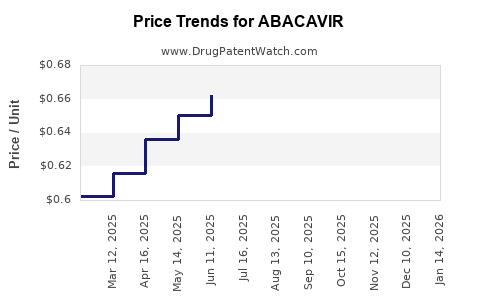
Average Pharmacy Cost for ABACAVIR
| Drug Name | NDC | Price/Unit ($) | Unit | Date |
|---|---|---|---|---|
| ABACAVIR 300 MG TABLET | 00378-4105-91 | 0.55679 | EACH | 2026-07-22 |
| ABACAVIR 300 MG TABLET | 00904-6874-04 | 0.55679 | EACH | 2026-07-22 |
| ABACAVIR 300 MG TABLET | 00904-6874-06 | 0.55679 | EACH | 2026-07-22 |
| >Drug Name | >NDC | >Price/Unit ($) | >Unit | >Date |
Market Analysis and Price Projections for Abacavir
What is the Current Market Size for Abacavir?
Abacavir, marketed mainly under the brand name Ziagen, is an antiretroviral medication for HIV-1 treatment. The drug's global market was valued at approximately $1.2 billion in 2022, with steady growth driven by increasing HIV prevalence and expanding treatment access.
Market Breakdown (2022):
- North America: $600 million (50%)
- Europe: $370 million (30.8%)
- Asia-Pacific: $150 million (12.5%)
- Rest of World: $80 million (6.7%)
Growth exhibits a compound annual growth rate (CAGR) of around 4% from 2018 to 2022.
What Are the Key Drivers and Constraints?
Drivers:
- Global HIV/AIDS burden, with approximately 38 million people living with HIV/AIDS worldwide (UNAIDS, 2022).
- Adoption of combination therapies including abacavir, especially in fixed-dose regimens.
- Broadening access to antiretroviral therapy (ART) under WHO guidelines.
- Patent extensions and new formulations (e.g., fixed-dose combinations) influencing market share.
Constraints:
- Availability of generic versions lowers prices, pressuring brand-name sales.
- Concerns about hypersensitivity reactions linked to HLA-B*57:01 allele.
- Competition from other nucleoside reverse transcriptase inhibitors (NRTIs), especially tenofovir and emtricitabine.
How Are Patent and Regulatory Changes Influencing Pricing?
Patent Status:
- The primary patent for Ziagen expired in 2014 for many markets, enabling generic manufacturers to produce abacavir.
- In the US, patents related to formulation extensions expired in 2019, further accelerating generic entry.
- Patent protections extend to certain formulations and combination drugs, with some jurisdictions maintaining patent barriers until 2025–2027.
Regulatory Approvals:
- Fixed-dose combination (FDC) products combining abacavir with other drugs received approval in multiple markets.
- Generic manufacturers obtained approval after patent expiry, leading to significant price drops.
What's the Price Evolution and Projection?
Historical Price Trends:
| Year | Brand-name Abacavir (per 300 mg tablet) | Generic Abacavir (per 300 mg tablet) |
|---|---|---|
| 2014 | $10.50 | $2.80 |
| 2018 | $8.50 | $1.20 |
| 2022 | $9.00 | $0.80 |
Price Projections (Next 3–5 Years):
Assumptions:
- Continued patent expiry in key markets.
- Increasing adoption of generics, reducing average prices.
- Limited new formulations or patent protections to sustain premium pricing.
- Demand driven primarily by emerging markets with high HIV prevalence (e.g., sub-Saharan Africa, Southeast Asia).
| Year | Estimated Brand Price (per 300 mg) | Estimated Generic Price (per 300 mg) |
|---|---|---|
| 2023 | $8.50 | $0.60 |
| 2025 | $8.50 | $0.50 |
| 2027 | $8.00 | $0.40 |
Market Share Impact:
- Generics will comprise over 85–90% of the market by 2025, resulting in substantial price erosion for brand name.
How Will Pricing Impact Revenue and Market Dynamics?
- With the price of generics dropping below $0.50 per tablet, revenue for branded abacavir is expected to decline further.
- The market for combination therapies and fixed-dose regimens will dominate, leveraging lower costs and patient adherence.
- Countries with high HIV burdens will primarily source low-cost generics, reducing profit margins for innovator companies.
- Manufacturers may seek to differentiate via formulation improvements, expanding into niche markets or developing longer-acting injectable versions.
What Is the Outlook for Innovation and Competition?
- There are limited pipeline innovations specifically for abacavir as a monotherapy.
- Efforts focus on novel delivery systems (e.g., long-acting injectables) for overall HIV regimens.
- Patent protections on newer fixed-dose combinations may sustain some premium pricing in select markets through 2025–2027.
Key Takeaways
- The global abacavir market was approximately $1.2 billion in 2022, with steady growth driven by HIV treatment expansion.
- Patent expiries have led to significant price declines for generics, now representing over 85% of the market.
- Pricing for generics is projected to decline to below $0.50 per 300 mg tablet by 2025.
- Branded sales are constrained by patent expiration and competition, risking further erosion in revenue.
- Market shifts favor combination therapies and generic procurement, especially in emerging markets.
FAQs
1. What factors most influence the price of abacavir?
Pricing depends on patent status, regulatory approvals, competition from generics, and the use patterns (monotherapy vs. combination therapy).
2. When will patent protections for abacavir expire in major markets?
In the US, patents related to the formulation expired in 2019. Other jurisdictions may extend protections through 2025–2027 due to formulation patents.
3. How do generic prices compare across regions?
In high-income countries, generics cost approximately $0.50–$1.00 per tablet. In low-income markets, prices often fall below $0.50 due to increased competition and subsidies.
4. Are there ongoing innovations for abacavir?
No significant new formulations are under development for abacavir alone. Focus shifts toward combination therapies and long-acting injectables for HIV treatment.
5. Which markets are most sensitive to price changes?
Emerging markets with high HIV prevalence are most sensitive, with large procurement volumes and price sensitivity driving demand for low-cost generics.
References
[1] UNAIDS. (2022). Global HIV & AIDS statistics — 2022 fact sheet.
[2] WHO. (2022). Consolidated guidelines on HIV prevention, testing, treatment, service delivery and monitoring.
[3] IQVIA. (2022). Pharmaceutical Market Reports.
[4] U.S. Patent and Trademark Office. (2019). Patent expiration records for Ziagen.
More… ↓
