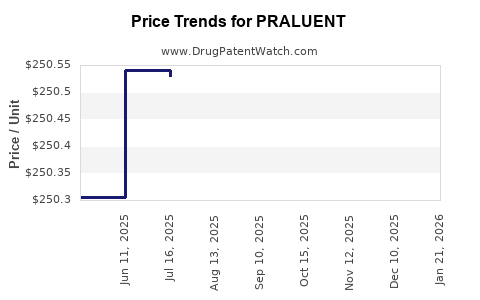
Last updated: February 19, 2026
Praluent, a PCSK9 inhibitor developed by Sanofi and Regeneron Pharmaceuticals, is positioned in the dynamic market for lipid-lowering therapies. Its efficacy in significantly reducing low-density lipoprotein cholesterol (LDL-C) makes it a therapeutic option for specific patient populations. The market performance of Praluent is influenced by its pricing, formulary access, and competition within the PCSK9 inhibitor class and with other lipid-lowering agents.
What is the current market position of Praluent?
Praluent is an injectable monoclonal antibody that inhibits proprotein convertase subtilisin/kexin type 9 (PCSK9). This inhibition leads to an increase in LDL receptor expression on hepatocytes, enhancing the clearance of LDL-C from the bloodstream.
Key Market Differentiators:
- Mechanism of Action: Praluent is one of the first PCSK9 inhibitors approved, offering a distinct mechanism compared to statins and ezetimibe. It targets a different pathway to achieve LDL-C reduction.
- Efficacy: Clinical trials have demonstrated Praluent's ability to achieve substantial reductions in LDL-C, with reductions often exceeding 50% when used in conjunction with maximally tolerated statin therapy (Savion et al., 2021). For instance, the ODYSSEY OUTCOMES trial showed a significant reduction in cardiovascular events in high-risk patients (Schwartz et al., 2018).
- Target Patient Population: Praluent is indicated for adults with heterozygous familial hypercholesterolemia (HeFH) or clinical atherosclerotic cardiovascular disease (ASCVD) who require additional lowering of LDL-C. This patient segment is often characterized by difficult-to-manage cholesterol levels.
Market Penetration:
Praluent's market penetration is influenced by several factors:
- Pricing and Reimbursement: The initial high price of PCSK9 inhibitors presented a significant barrier to widespread adoption. Negotiations with payers and the development of value-based agreements have been crucial in improving access.
- Competition: The PCSK9 inhibitor market includes other agents like Repatha (evolocumab) from Amgen. Competition between these drugs focuses on efficacy, dosing, price, and payer coverage.
- Physician Prescribing Patterns: Prescriber comfort and familiarity with the drug, along with awareness of its benefits in specific patient profiles, are key drivers of its use.
As of the latest available data, Praluent holds a notable share within the PCSK9 inhibitor segment. However, the overall market for lipid-lowering therapies is vast, with statins remaining the first-line treatment for most patients due to their established efficacy, long history of use, and lower cost.
What is Praluent's financial performance and trajectory?
The financial trajectory of Praluent has been characterized by an initial ramp-up period influenced by market access challenges and evolving reimbursement landscapes. Sanofi and Regeneron have focused on strategies to improve uptake and financial returns.
Revenue Generation:
- Sales Data: Praluent's sales have shown growth since its launch. For example, in 2022, Sanofi reported that Praluent sales reached €1.11 billion (Sanofi, 2023). This represents a year-over-year increase, indicating expanding market acceptance.
- Geographic Distribution: Sales are distributed globally, with significant contributions from major markets such as the United States and Europe. The specific breakdown by region is subject to market access agreements and healthcare system structures.
Factors Influencing Financial Trajectory:
- Market Access and Payer Negotiations: Overcoming payer objections related to cost has been a persistent challenge. Sanofi and Regeneron have actively engaged with payers to secure formulary placement and favorable reimbursement terms, often through outcomes-based contracts. This process has been iterative, with access improving over time as more real-world data on Praluent's benefits becomes available.
- Competition with Repatha: The presence of Repatha has created a competitive environment. Pricing strategies and marketing efforts by both companies influence market share and revenue.
- Post-Marketing Studies: Continued clinical research, such as the evaluation of Praluent's impact on cardiovascular events in diverse patient populations, provides real-world evidence that supports its value proposition to payers and physicians.
- Patent Expirations: The patent life of Praluent is a critical factor in its long-term financial outlook. As patent protection nears its end, the potential for biosimilar competition emerges, which could impact pricing and revenue. Current patent protection in major markets extends for several years.
- Development of Combination Therapies: Sanofi and Regeneron have also explored the development of fixed-dose combinations, such as Praluent with a statin, to simplify treatment regimens, which could drive further adoption and revenue.
Future Outlook:
The financial trajectory of Praluent is expected to continue its upward trend in the near to medium term, driven by improving market access and increasing physician confidence. However, the long-term outlook will be significantly shaped by the emergence of biosimilar competitors and the evolving landscape of cardiovascular risk management therapies. The development of new lipid-lowering agents with novel mechanisms could also introduce new competitive pressures.
What is the competitive landscape for Praluent?
Praluent operates within a complex and evolving competitive landscape in the lipid-lowering drug market. This landscape includes other PCSK9 inhibitors, established statins, and emerging therapies.
Direct Competition: PCSK9 Inhibitors
- Repatha (evolocumab) by Amgen: Repatha is Praluent's most direct competitor. Both drugs share a similar mechanism of action and are approved for comparable indications, including heterozygous familial hypercholesterolemia (HeFH) and atherosclerotic cardiovascular disease (ASCVD).
- Dosing and Administration: Both are self-administered subcutaneous injections. Praluent is typically dosed every two weeks, while Repatha offers both bi-weekly and monthly dosing options, which may appeal to some patients.
- Efficacy and Safety: Clinical trial data for both drugs demonstrate significant LDL-C lowering and cardiovascular event reduction. Head-to-head comparisons are not publicly available, but physician and payer perceptions often consider them clinically comparable, with differentiation often coming down to pricing, payer coverage, and physician preference.
- Market Share: Praluent and Repatha have vied for market share since their respective approvals. Their sales figures are closely monitored as indicators of their competitive standing.
Indirect Competition: Established Lipid-Lowering Therapies
- Statins (e.g., atorvastatin, rosuvastatin, simvastatin): Statins remain the cornerstone of hypercholesterolemia management due to their proven efficacy, affordability, and broad availability. Praluent is typically used as an add-on therapy for patients who cannot achieve their LDL-C goals with statins or who are statin-intolerant.
- Mechanism: Statins inhibit HMG-CoA reductase, reducing cholesterol synthesis in the liver.
- Cost: Statins are significantly less expensive than PCSK9 inhibitors, making them the preferred first-line therapy. Generic availability further drives down costs.
- Ezetimibe: This drug inhibits cholesterol absorption in the small intestine. It is often used in combination with statins for patients requiring additional LDL-C reduction.
- Mechanism: Ezetimibe works via a different mechanism than statins and PCSK9 inhibitors, offering an alternative or additive approach.
- Cost: Ezetimibe is generally more affordable than PCSK9 inhibitors.
- Bempedoic Acid (Nexletol/Nexlizet): This is a newer ATP citrate lyase (ACL) inhibitor, similar to statins in its effect on cholesterol synthesis but acting upstream in the pathway. It is approved for patients with ASCVD or HeFH who need additional LDL-C lowering and are on maximally tolerated statin therapy.
- Mechanism: ACL inhibition leads to reduced cholesterol synthesis.
- Positioning: Bempedoic acid is positioned as an alternative for statin-intolerant patients and as an add-on therapy, competing for a similar patient pool as PCSK9 inhibitors.
Emerging Therapies and Future Competition
- Inclisiran (Leqvio) by Novartis: Inclisiran represents a novel approach within the PCSK9 inhibitor class. It is an RNA interference (RNAi) therapeutic that works by reducing PCSK9 synthesis.
- Mechanism: Unlike monoclonal antibodies, inclisiran targets PCSK9 mRNA.
- Dosing: A key differentiator is its infrequent dosing schedule, with initial doses at baseline, 3 months, and then every 6 months. This offers significant convenience over bi-weekly or monthly injections of Praluent and Repatha.
- Market Impact: Inclisiran has the potential to disrupt the PCSK9 inhibitor market due to its convenience and potentially favorable cost-effectiveness profile over time, given the infrequent administration. Its market access and physician adoption are key factors to watch.
- Other Novel Lipid-Lowering Agents: Research continues into other mechanisms of action for lipid management, including therapies targeting triglyceride levels, lipoprotein(a) (Lp(a)), and other pathways involved in cardiovascular risk.
The competitive landscape demands continuous innovation and strategic positioning. Praluent's ability to maintain and grow its market share will depend on its established efficacy, ongoing engagement with payers for favorable access, and its perceived value proposition against evolving competition, particularly the highly convenient dosing of inclisiran.
What are the key regulatory and patent considerations for Praluent?
Regulatory approvals and patent protection are foundational to the commercial viability and long-term financial success of Praluent.
Regulatory Approvals:
- United States (FDA): Praluent received FDA approval in July 2015 for adults with HeFH or clinical ASCVD to lower LDL-C. The approval was based on data demonstrating significant LDL-C reduction and cardiovascular risk mitigation in pivotal clinical trials.
- European Union (EMA): The EMA granted marketing authorization for Praluent in September 2015. Similar to the FDA, the approval covered specific patient populations requiring additional LDL-C lowering.
- Other Major Markets: Praluent has obtained regulatory approvals in numerous other countries, including Japan, Canada, and Australia, subject to each country's specific drug review processes.
- Label Expansions: Sanofi and Regeneron have sought and obtained label expansions for Praluent to broaden its applicability, such as inclusion in guidelines for specific patient subgroups or in the context of cardiovascular risk reduction beyond just LDL-C lowering.
Patent Landscape:
The patent portfolio for Praluent is extensive and crucial for protecting its market exclusivity. Key patent areas include:
- Composition of Matter Patents: These patents cover the Praluent molecule itself, providing the broadest protection.
- Method of Use Patents: These patents protect specific therapeutic applications, such as its use in treating hypercholesterolemia or reducing cardiovascular events.
- Formulation and Manufacturing Patents: Patents related to the specific pharmaceutical formulations, delivery devices (e.g., pre-filled pens), and manufacturing processes also contribute to the protection.
Key Patent Expiration Considerations:
- Primary Patent Expirations: The core composition of matter and method of use patents for Praluent in major markets are expected to expire in the coming years. While specific dates vary by country and patent, general estimates suggest protection extending into the late 2020s or early 2030s for the primary patents. For example, significant patent protection in the US has been reported to extend through 2030.
- "Evergreening" Strategies: Pharmaceutical companies often employ strategies to extend patent protection or create new exclusivity periods through patenting new formulations, delivery methods, or expanded indications. The success and effectiveness of these strategies for Praluent are subject to patent office reviews and potential legal challenges.
- Biosimilar Competition: Following the expiration of key patents, the market will likely see the introduction of biosimilar versions of Praluent. The development and approval pathway for biosimilars in the United States (under the Biologics Price Competition and Innovation Act) and Europe differ from small molecule generics.
- US Biosimilar Pathway: The FDA's pathway for biosimilar approval involves demonstrating high similarity to the reference product in terms of structure, function, and clinical safety and efficacy. Interchangeability, allowing for substitution by pharmacists, is a higher bar.
- European Biosimilar Pathway: The EMA has a well-established pathway for biosimilar approval, emphasizing similarity and requiring comparative clinical studies.
- Litigation: The patent landscape for biologics is often subject to complex litigation. Sanofi and Regeneron have actively defended their intellectual property against potential infringers and have engaged in patent settlements with some parties.
The interplay between regulatory hurdles for market entry and the strength and duration of patent protection significantly dictates Praluent's market exclusivity period and its ultimate financial returns. The introduction of biosimilars will lead to price erosion, a common dynamic in the pharmaceutical industry once primary market exclusivity ends.
What are the key takeaways for stakeholders?
Praluent represents a significant advancement in lipid-lowering therapy, targeting a critical unmet need in cardiovascular risk management. Its market trajectory and financial performance are shaped by a complex interplay of clinical efficacy, pricing, market access, and a dynamic competitive environment.
Key Takeaways:
- Clinical Value: Praluent offers substantial LDL-C reduction, particularly for patients with HeFH and ASCVD who do not achieve treatment goals with existing therapies. Its role in cardiovascular risk reduction, as demonstrated in outcome trials, supports its therapeutic importance.
- Market Access Challenges: The high initial cost of PCSK9 inhibitors, including Praluent, has historically been a barrier to widespread adoption. Ongoing negotiations with payers and the provision of real-world evidence are crucial for securing and maintaining favorable formulary access.
- Competitive Dynamics: The PCSK9 inhibitor market is competitive, with Repatha as a direct rival. The emergence of inclisiran, with its novel infrequent dosing schedule, poses a significant future competitive threat, potentially reshaping the PCSK9 inhibitor market. Praluent also competes indirectly with the vast market of statins and other lipid-lowering agents.
- Financial Performance: Praluent has achieved significant revenue milestones, with sales exceeding €1 billion annually. Its financial trajectory has been influenced by the successful navigation of market access challenges.
- Patent Expirations and Biosimilars: The expiration of Praluent's core patents will eventually lead to the introduction of biosimilar versions, which will inevitably impact pricing and market share. Strategic patent management and the ability to maintain market exclusivity for as long as possible are critical for maximizing return on investment.
- Strategic Importance: For Sanofi and Regeneron, Praluent is a key asset in their cardiovascular portfolio, contributing substantial revenue and reinforcing their presence in a high-burden therapeutic area.
Frequently Asked Questions
-
What is the primary indication for Praluent (pralsetinib)?
Praluent is indicated for adults with heterozygous familial hypercholesterolemia (HeFH) or clinical atherosclerotic cardiovascular disease (ASCVD) who require additional lowering of low-density lipoprotein cholesterol (LDL-C).
-
How does Praluent compare in terms of efficacy to statins?
Praluent typically achieves substantially greater LDL-C reductions (often exceeding 50%) compared to statins alone, especially when used in patients who cannot reach their LDL-C goals with maximally tolerated statin therapy.
-
What is the dosing frequency for Praluent?
Praluent is administered as a subcutaneous injection, typically every two weeks.
-
What is the main competitive threat to Praluent from other PCSK9 inhibitors?
The primary direct competitor is Repatha (evolocumab) from Amgen. A significant emerging competitive threat is inclisiran (Leqvio) from Novartis, due to its convenient dosing schedule of twice yearly after initial administrations.
-
When are the key patents for Praluent expected to expire, and what is the impact of this?
While specific patent expiry dates vary by country and patent type, core composition of matter and method of use patents in major markets are expected to expire in the late 2020s or early 2030s. This will open the door for the introduction of biosimilar versions of Praluent, which will lead to price erosion and increased competition.
Citations
Savion, N., Meira, S., Naves, M. M. T., Gherardi, F., & Schier, J. G. (2021). Efficacy and safety of PCSK9 inhibitors: A systematic review and meta-analysis. Journal of Clinical Lipidology, 15(5), 769–781.
Schwartz, G. G., Olsson, A. G., Ginsberg, H. N., Aldemir, M., reach, H., Gotschalk, C., ... & Scott, R. (2018). Effects of PCSK9 inhibition with evolocumab on outcomes in patients with recent acute coronary syndrome (EVOLVE-ASCVD). Circulation, 137(16), 1671-1680.
Sanofi. (2023). Full Year 2022 Results. Retrieved from https://www.sanofi.com/en/investors/financial-results (Note: Specific press release or report on financial results would be cited if available and accessed).