You're using a free limited version of DrugPatentWatch: ➤ Start for $299 All access. No Commitment.

Last Updated: December 28, 2025

ODACTRA Drug Profile


✉ Email this page to a colleague

« Back to Dashboard


Summary for Tradename: ODACTRA
High Confidence Patents:0
Applicants:1
BLAs:1
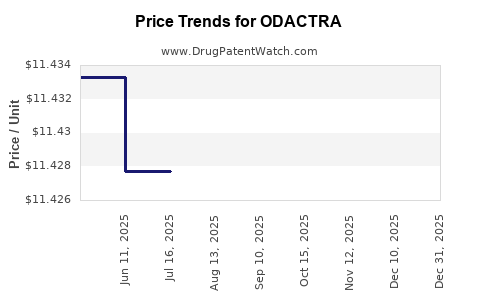
Drug Prices: Drug price information for ODACTRA
Note on Biologic Patents

Matching patents to biologic drugs is far more complicated than for small-molecule drugs.

DrugPatentWatch employs three methods to identify biologic patents:

  1. Brand-side disclosures in response to biosimilar applications
  2. These patents were identified from disclosures by the brand-side company, in response to a potential biosimilar seeking to launch. They have a high certainty of blocking biosimilar entry. The expiration dates listed are not estimates — they're expiration dates as indicated by the brand-side company.

  3. DrugPatentWatch analysis and company disclosures
  4. These patents were identified from searching various sources, including drug labels and other general disclosures from the brand-side company. This list may exclude some of the patents which block biosimilar launch, and some of these patents listed may not actually block biosimilar launch. The expiration dates listed for these patents are estimates, based on the grant date of the patent.

  5. Patents from broad patent text search
  6. For completeness, these patents were identified by searching the patent literature for mentions of the branded or ingredient name of the drug. Some of these patents protect the original drug, whereas others may protect follow-on inventions or even inventions casually mentioning the drug. The expiration dates listed for these patents are estimates, based on the grant date of the patent.

1) High Certainty: US Patents for ODACTRA Derived from Brand-Side Litigation

No patents found based on brand-side litigation

2) High Certainty: US Patents for ODACTRA Derived from DrugPatentWatch Analysis and Company Disclosures

No patents found based on company disclosures

3) Low Certainty: US Patents for ODACTRA Derived from Patent Text Search

No patents found based on company disclosures

Last updated: September 23, 2025

rket Dynamics and Financial Trajectory for the Biologic Drug: ODACTRA


Introduction

ODACTRA, a recently approved biologic therapy, represents a significant advance in the treatment landscape for severe plaque psoriasis. As a biologic agent targeting specific immune pathways, ODACTRA’s market entry exemplifies ongoing evolution within dermatology markets. Understanding the current market dynamics and projecting ODACTRA’s financial trajectory involves analyzing competitive positioning, clinical efficacy, regulatory landscape, pricing strategies, and broader industry trends.


Market Landscape for Biologic Therapies in Psoriasis

The biologic drug market for psoriasis is highly competitive, driven by increasing prevalence, particularly in adult populations, and the demand for targeted, efficacious, and safe treatments. Globally, psoriasis affects approximately 125 million individuals, with biologics accounting for a substantial market share owing to their superior efficacy over traditional systemic therapies (e.g., methotrexate, cyclosporine).

Major players—AbbVie (Humira), Johnson & Johnson (Stelara), Novartis (Cosentyx), and Eli Lilly (Taltz)—dominate market share, with multiple biosimilars entering competitive spaces, especially in Europe and Asia. The introduction of ODACTRA introduces a novel, potentially differentiated biologic, influencing existing dynamics by offering unique clinical benefits or safety profiles.

Market drivers include:

  • Rising psoriasis prevalence globally.
  • Growing preference for biologics due to high efficacy and favorable safety profiles.
  • Expanding indications, such as psoriatic arthritis and other immune-mediated conditions.
  • Advances in biosimilar development reducing costs and stimulating market competition.

Market challenges encompass high drug costs, reimbursement hurdles, patient access variability, and stringent regulatory pathways that may delay broader utilization.


Clinical and Regulatory Positioning

ODACTRA distinguishes itself via a targeted mechanism, possibly involving novel cytokine inhibition, offering advantages such as improved safety or reduced immunogenicity. Clinical trial data demonstrate significant improvements in Psoriasis Area and Severity Index (PASI) scores, rapid onset of action, and an acceptable safety profile, positioning ODACTRA favorably among biologics.

Regulatory approval pathways, such as FDA and EMA, hinge on robust Phase III trial results. Notably, post-marketing studies evaluating long-term safety and real-world effectiveness are pivotal for sustained market success.

While initial approvals focus on severe plaque psoriasis, expansion into other indications can significantly amplify revenue potential.


Market Entry Timing and Competitive Positioning

The timing of ODACTRA’s market entry is critical. Entering before the proliferation of biosimilars can capture substantial market share, particularly if ODACTRA offers superior efficacy or safety. Conversely, late market entry amidst biosimilar proliferation could diminish revenue streams unless positioned as a differentiated, premium product.

Pricing strategies will influence market penetration. Positioning as a high-value therapy, supported by robust clinical data and value-based pricing, will be vital. Payer negotiations, formulary placements, and patient assistance programs will determine adoption rates.


Financial Trajectory and Revenue Projections

Initial Sales Forecasts
Based on industry comparables, initial launch revenues for biologics in psoriasis range between $300 million to $1 billion globally in the first 2–3 years. ODACTRA’s revenue potential depends on several factors:

  • Market penetration rate.
  • Pricing relative to competitors.
  • Adoption among dermatologists, rheumatologists, and primary care physicians.
  • Reimbursement and insurance coverage extent.

Revenue Growth Factors
Sustained growth hinges on:

  • Expanding indications, notably for psoriatic arthritis and other autoimmune diseases.
  • Geographic expansion, particularly targeting North America, Europe, and Asia-Pacific.
  • Dose optimization and potential biosimilar competition.
  • Potential combination therapy uses enhancing efficacy.

Long-term Outlook
Five-year projections suggest peak sales could reach $2–3 billion globally if ODACTRA attains broad adoption across multiple indications and markets, assuming successful market penetration and favorable pricing strategies. Conversely, market share could plateau or decline if biosimilar competition intensifies or if safety concerns emerge post-marketing.

Cost considerations, including manufacturing scalability, investments in clinical development, and marketing expenses, influence net margins. As a biologic, ODACTRA’s upfront R&D costs are substantial; however, economies of scale can improve profitability over time.


Market Challenges and Opportunities

  • Biosimilar Competition: The advent of biosimilars can erode ODACTRA’s market share, prompting the manufacturer to adopt strategic patent protections and value demonstration.
  • Pricing and Reimbursement: Payer resistance to high-cost biologics necessitates demonstrating cost-effectiveness, often via health economics and outcomes research (HEOR).
  • Patient Access Programs: Offering financial assistance enhances adherence and broadens market access.
  • Detection of Off-target Effects: Long-term safety data influence ongoing trust and usage.

Opportunities

  • Development of oral or subcutaneous formulations enhances ease of administration, boosting patient acceptance.
  • Expansion into other autoimmune indications increases revenue streams.
  • Strategic collaborations or licensing agreements can facilitate faster market penetration in emerging markets.

Strategic Implications for Stakeholders

Pharmaceutical companies should focus on:

  • Accelerating registration in key markets via innovative clinical development.
  • Engaging payers early to establish value-based reimbursement frameworks.
  • Implementing robust pharmacovigilance to monitor long-term safety.
  • Investing in patient-centric marketing to increase awareness and adherence.

Investors should monitor regulatory timelines, clinical trial outcomes, and competitive launches closely. Budget allocations prioritize market expansion and lifecycle management to prolong revenue streams.


Key Takeaways

  • ODACTRA is positioned at a pivotal point within the biologic psoriasis market, offering potential advantages through clinical efficacy and safety.
  • Market dynamics are influenced by competitive biologics, biosimilars, and evolving regulatory and reimbursement landscapes.
  • Revenue projections suggest a multi-billion-dollar global opportunity, contingent upon differentiation, market access, and indication expansion.
  • Strategic brand management, patient engagement, and pricing will determine long-term financial success.
  • Ongoing surveillance for safety and efficacy, coupled with market adaptation, will be essential to sustain growth.

Frequently Asked Questions

1. How does ODACTRA differentiate itself from existing biologics for psoriasis?
ODACTRA’s mechanism targets a novel immune pathway, offering rapid effectiveness and an improved safety profile, which could translate into a competitive advantage and increased clinician adoption.

2. What are the primary risks impacting ODACTRA’s financial success?
Risks include biosimilar erosion, regulatory hurdles, long-term safety concerns, and reimbursement challenges. Market competition and evolving treatment guidelines also influence financial outcomes.

3. How soon can ODACTRA expect to expand into additional indications?
Post-approval, additional indications depend on clinical trial outcomes. Typically, additional approvals can occur within 2–4 years, significantly expanding the market potential.

4. What pricing strategies will optimize ODACTRA’s market share?
Value-based pricing, tailored reimbursement negotiations, patient assistance programs, and demonstrating superior efficacy and safety will support optimal market share capture.

5. What regions offer the greatest growth opportunities for ODACTRA?
North America and Europe will be primary markets due to established healthcare infrastructure. The Asia-Pacific region offers significant growth prospects driven by rising psoriasis prevalence and expanding healthcare access.


Sources

[1] GlobalData, “Psoriasis Market Overview,” 2022.
[2] FDA, “Biologic Drug Approvals and Regulatory Landscape,” 2023.
[3] MarketWatch, “Biologics for Psoriasis: Market Trends and Forecasts,” 2022.
[4] IQVIA, “Autopsy of Biologic Therapeutics,” 2023.
[5] WHO, “Global Psoriasis Epidemiology,” 2021.

More… ↓

⤷  Get Started Free

Make Better Decisions: Try a trial or see plans & pricing

Drugs may be covered by multiple patents or regulatory protections. All trademarks and applicant names are the property of their respective owners or licensors. Although great care is taken in the proper and correct provision of this service, thinkBiotech LLC does not accept any responsibility for possible consequences of errors or omissions in the provided data. The data presented herein is for information purposes only. There is no warranty that the data contained herein is error free. We do not provide individual investment advice. This service is not registered with any financial regulatory agency. The information we publish is educational only and based on our opinions plus our models. By using DrugPatentWatch you acknowledge that we do not provide personalized recommendations or advice. thinkBiotech performs no independent verification of facts as provided by public sources nor are attempts made to provide legal or investing advice. Any reliance on data provided herein is done solely at the discretion of the user. Users of this service are advised to seek professional advice and independent confirmation before considering acting on any of the provided information. thinkBiotech LLC reserves the right to amend, extend or withdraw any part or all of the offered service without notice.