Share This Page
EBGLYSS Drug Profile
✉ Email this page to a colleague
Summary for Tradename: EBGLYSS
| High Confidence Patents: | 0 |
| Applicants: | 1 |
| BLAs: | 1 |
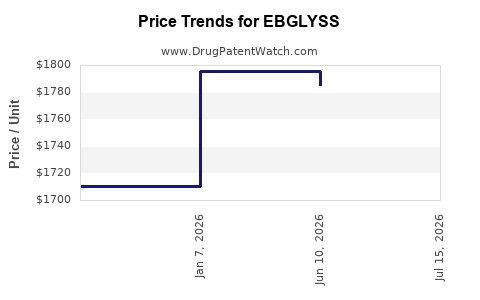
| Drug Prices: | Drug price information for EBGLYSS |
Pharmacology for EBGLYSS
| Mechanism of Action | Interleukin-13 Antagonists |
| Established Pharmacologic Class | Interleukin-13 Antagonist |
Note on Biologic Patents
Matching patents to biologic drugs is far more complicated than for small-molecule drugs.
DrugPatentWatch employs three methods to identify biologic patents:
- Brand-side disclosures in response to biosimilar applications
- DrugPatentWatch analysis and company disclosures
- Patents from broad patent text search
These patents were identified from disclosures by the brand-side company, in response to a potential biosimilar seeking to launch. They have a high certainty of blocking biosimilar entry. The expiration dates listed are not estimates — they're expiration dates as indicated by the brand-side company.
These patents were identified from searching various sources, including drug labels and other general disclosures from the brand-side company. This list may exclude some of the patents which block biosimilar launch, and some of these patents listed may not actually block biosimilar launch. The expiration dates listed for these patents are estimates, based on the grant date of the patent.
For completeness, these patents were identified by searching the patent literature for mentions of the branded or ingredient name of the drug. Some of these patents protect the original drug, whereas others may protect follow-on inventions or even inventions casually mentioning the drug. The expiration dates listed for these patents are estimates, based on the grant date of the patent.
1) High Certainty: US Patents for EBGLYSS Derived from Brand-Side Litigation
No patents found based on brand-side litigation
2) High Certainty: US Patents for EBGLYSS Derived from DrugPatentWatch Analysis and Company Disclosures
No patents found based on company disclosures
3) Low Certainty: US Patents for EBGLYSS Derived from Patent Text Search
No patents found based on company disclosures
Ebglyss Market Dynamics and Financial Trajectory
Ebglyss (lebrikizumab-lbkz) is an interleukin-13 inhibitor marketed by Eli Lilly and Almirall for moderate-to-severe atopic dermatitis. Its commercial opportunity is large because it enters a biologic market led by Dupixent, but its launch economics depend on differentiation against Dupixent, Adbry, Nemluvio, oral JAK inhibitors and topical therapies. U.S. approval in December 2024 expanded the addressable market, while European commercialization began earlier. Lilly and Almirall do not report Ebglyss revenue as a standalone line, limiting precision around current sales and consensus forecasts.
What is Ebglyss and how does it compete in atopic dermatitis?
Ebglyss is a monoclonal antibody that selectively binds interleukin-13, a cytokine central to the inflammatory pathway in atopic dermatitis. The FDA approved Ebglyss on December 13, 2024, for patients aged 12 years and older who weigh at least 40 kilograms and have moderate-to-severe atopic dermatitis inadequately controlled with prescription therapies or when those therapies are not advisable.[1]
The standard U.S. regimen is:
| Treatment phase | Dose |
|---|---|
| Loading dose | 500 mg subcutaneously at baseline and Week 2 |
| Maintenance through Week 16 | 250 mg every two weeks |
| Maintenance after Week 16 | 250 mg every four weeks for patients with adequate response |
The every-four-week maintenance schedule is commercially important. Dupixent typically requires dosing every two weeks in adolescent and adult atopic dermatitis, although dosing varies by indication and patient characteristics. Ebglyss can therefore compete on administration frequency for patients who achieve adequate disease control.[1,2]
Ebglyss is not the first IL-13-directed biologic. Tralokinumab, marketed as Adbry in the U.S., also targets IL-13. Nemluvio, or nemolizumab-ilto, targets the IL-31 receptor and received FDA approval in 2024 for atopic dermatitis. Oral therapies such as upadacitinib, abrocitinib and abrocitinib-class competitors provide faster systemic options but carry boxed warnings or other safety restrictions relevant to market access.
How does Ebglyss compare with Dupixent and other biologics?
| Product | Active ingredient | Primary mechanism | Typical atopic dermatitis positioning | Commercial implication |
|---|---|---|---|---|
| Dupixent | Dupilumab | IL-4 receptor alpha blockade, inhibiting IL-4 and IL-13 signaling | Established first-line systemic biologic | Dominant benchmark with broad label and extensive physician familiarity |
| Ebglyss | Lebrikizumab-lbkz | Selective IL-13 inhibition | Chronic moderate-to-severe disease | Differentiation through IL-13 selectivity and four-week maintenance |
| Adbry | Tralokinumab | IL-13 inhibition | Chronic moderate-to-severe disease | Direct mechanism competitor |
| Nemluvio | Nemolizumab-ilto | IL-31 receptor alpha inhibition | Moderate-to-severe atopic dermatitis | Pruritus-focused competitive positioning |
| Rinvoq | Upadacitinib | JAK1 inhibition | Systemic treatment for moderate-to-severe disease | Rapid efficacy, balanced against boxed-warning concerns |
| Cibinqo | Abrocitinib | JAK1 inhibition | Systemic treatment | Oral administration and safety-monitoring tradeoff |
Dupixent remains the principal commercial threat. Sanofi and Regeneron reported 2024 Dupixent sales of approximately €13.1 billion, reflecting use across multiple approved indications, including atopic dermatitis, asthma, chronic rhinosinusitis with nasal polyps, eosinophilic esophagitis and chronic obstructive pulmonary disease-related indications.[3] Ebglyss will not replicate that revenue base without substantial label expansion beyond dermatology.
What is Ebglyss’s geographic market footprint?
Ebglyss received European Union authorization in November 2023 for moderate-to-severe atopic dermatitis in adults and adolescents aged 12 years and older who are candidates for systemic therapy.[2] Almirall is responsible for commercialization in Europe, while Lilly commercializes Ebglyss in the United States and several other markets under the parties’ collaboration structure.[4,5]
Key regulatory milestones include:
| Date | Event | Market significance |
|---|---|---|
| November 2023 | European Commission authorization | First major-market approval |
| 2024 | European commercial rollout | Initial revenue generation for Almirall |
| December 13, 2024 | FDA approval | Entry into the largest high-value dermatology market |
| 2025 onward | U.S. payer and specialist launch | Main near-term driver of volume and revenue |
Japan and other international markets may contribute to the long-term opportunity, but the United States and Europe are the core launch territories. Country-level uptake will depend on reimbursement restrictions, prior authorization, specialist prescribing and the availability of patient-support programs.
How large is the commercial opportunity for Ebglyss?
The opportunity is substantial but highly contested. Moderate-to-severe atopic dermatitis affects a minority of the total atopic dermatitis population, yet systemic-treatment patients generate disproportionately high pharmaceutical spending. The commercial pool includes biologic-naive patients, patients switching from Dupixent or Adbry, and patients moving from oral immunomodulators because of safety or tolerability concerns.
Ebglyss’s main demand drivers are:
- Growth in diagnosed and treated moderate-to-severe disease.
- Expansion of systemic treatment into earlier lines of therapy.
- Greater use of biologics in adolescents.
- Switching from Dupixent because of inadequate response, conjunctivitis or dosing preferences.
- Adoption of four-week maintenance dosing.
- Future approvals in asthma, chronic rhinosinusitis or other type-2 inflammatory diseases.
The main constraints are:
- Dupixent’s entrenched prescriber base.
- Payer step edits and preferred-product arrangements.
- Competition from IL-13 and IL-31 biologics.
- Oral JAK inhibitors with rapid efficacy.
- High net pricing pressure in biologic dermatology.
- Limited physician incentive to switch stable responders.
- Lack of a pediatric under-12 label in the initial U.S. approval.
What is the financial trajectory for Ebglyss?
Ebglyss is in the early commercial-launch phase. Neither Lilly nor Almirall reports a complete, standalone global Ebglyss revenue series in the public financial disclosures reviewed for this analysis. Almirall reports product and portfolio performance, while Lilly’s reporting structure does not identify Ebglyss as a separately material revenue line.[4,5]
The expected trajectory has four stages:
| Period | Financial profile | Primary determinants |
|---|---|---|
| 2023-2024 | Initial European launch revenue | Reimbursement wins, launch sequencing and dermatologist adoption |
| 2025-2026 | First significant growth phase | U.S. launch, formulary access, switching and patient retention |
| 2027-2029 | Scale-up or plateau | Competitive intensity, label expansion and net-price evolution |
| 2030 onward | Mature biologic franchise | Geographic expansion, additional indications and biosimilar planning |
Almirall’s economics should benefit from European sales, milestone receipts and royalties or profit-sharing arrangements under its collaboration with Lilly. Lilly captures the strategic value of the U.S. launch and any broader indication expansion. The agreement’s complete commercial economics are not fully transparent in public reporting, so reported Ebglyss sales and the parties’ ultimate profit contribution cannot be mapped directly from consolidated financial statements.[4,5]
What revenue scenarios are reasonable for Ebglyss?
A practical commercial framework is:
| Scenario | Market outcome | Financial trajectory |
|---|---|---|
| Downside | Ebglyss remains a secondary IL-13 option with restricted payer access | Low hundreds of millions of dollars in annual global sales potential |
| Base case | Meaningful U.S. and European share, supported by four-week maintenance and switching | Several hundred million dollars annually, with potential to approach or exceed the billion-dollar range if label expansion succeeds |
| Upside | Strong differentiation, broad reimbursement, pediatric expansion and additional type-2 indications | Multi-billion-dollar annual franchise potential |
These are scenario ranges rather than company-issued guidance. The upside case requires Ebglyss to become a platform product rather than a single-indication dermatology asset. Dupixent’s scale demonstrates the value of additional indications, not the likely standalone outcome for Ebglyss.
What FDA regulatory status and exclusivity protect Ebglyss?
Ebglyss is FDA-approved as a biologic under the Public Health Service Act. It is listed in the FDA’s Purple Book framework rather than the small-molecule Orange Book system.[6]
The key U.S. regulatory protection is:
| Protection | Approximate timing |
|---|---|
| FDA approval | December 13, 2024 |
| Reference-product biologic exclusivity | Generally 12 years from approval |
| Earliest statutory biosimilar licensure date | Generally December 2036 |
| Pediatric exclusivity | Not established from the initial approval |
| Patent protection | Depends on issued patents, continuations and patent-term adjustments |
The 12-year biologic exclusivity period prevents FDA approval of a biosimilar before the statutory date, subject to the governing biologics framework. It does not eliminate patent litigation risk or prevent competitors from developing biosimilars before that date.
In Europe, the standard regulatory framework provides eight years of data exclusivity and two years of market protection, with a possible additional year for a qualifying new indication.[7] Because Ebglyss received EU authorization in 2023, the baseline regulatory protection extends into the early 2030s, subject to applicable extensions.
What patents protect Ebglyss and when could biosimilar competition begin?
Ebglyss is protected by a patent estate covering lebrikizumab, antibody sequences, binding characteristics, pharmaceutical compositions, dosing regimens and potentially methods of treating IL-13-mediated disease. Genentech originated lebrikizumab, and Lilly and Almirall commercialize the product under their collaboration arrangements.[4,5]
A complete public patent-expiry analysis requires review of issued U.S. and foreign patents, continuation practice, terminal disclaimers, patent-term adjustment, patent-term extension eligibility and claim scope. The regulatory exclusivity date is clearer than the practical patent-launch date.
Does Ebglyss face Paragraph IV challenges?
No. Paragraph IV certification applies primarily to small-molecule products submitted through the Abbreviated New Drug Application pathway. Ebglyss is a biologic, so a competing product would generally proceed through the 351(k) biosimilar pathway rather than an ANDA Paragraph IV filing.[6,8]
A biosimilar applicant must provide notice of commercial marketing and may participate in the statutory patent-information exchange commonly called the BPCIA patent dance. Litigation could involve composition, formulation, manufacturing, dosing or method-of-use patents.
What manufacturing and intellectual-property barriers exist?
The principal barriers are:
- Cell-line and process development.
- Analytical comparability for a complex monoclonal antibody.
- Demonstration of biosimilarity across critical quality attributes.
- Patent claims covering antibody sequence and function.
- Manufacturing-site qualification and supply-chain scale.
- Physician and payer confidence in interchangeability.
- Regulatory requirements for extrapolation across indications.
Because lebrikizumab is a monoclonal antibody, manufacturing complexity is materially higher than for conventional generic drugs. Even after regulatory exclusivity expires, biosimilar entry is unlikely to resemble an immediate multi-entrant generic launch.
What patent litigation and settlement risks affect Ebglyss?
No major publicly reported U.S. BPCIA litigation or Ebglyss patent settlement was identified in the principal FDA, Lilly and Almirall materials reviewed. The absence of reported litigation is consistent with the product’s recent U.S. launch and the long period before biosimilar commercialization becomes legally possible.
Future litigation risk is most likely to arise from:
- A biosimilar applicant’s pre-commercial patent challenge.
- Disputes over continuation patents.
- Formulation or dosing claims.
- Manufacturing-process claims.
- Patent-term calculations.
- A competing IL-13 antibody challenging market access through payer contracting rather than patent litigation.
How strong is the Ebglyss commercial and patent estate?
Commercial strength is moderate to high, but not yet proven at scale. The product has a validated target, an established atopic dermatitis market and a dosing feature that can support differentiation. Its weakness is the presence of a dominant incumbent with broad indications and extensive physician familiarity.
Patent strength is likely strongest for core molecule and antibody claims and weaker for narrowly drafted method-of-use or dosing claims that may face validity and infringement challenges. The most valuable long-term protection will be the combined effect of regulatory exclusivity, core composition patents, manufacturing know-how, additional indications and payer contracts.
What generic or biosimilar launch scenarios exist for Ebglyss?
The most likely competitive sequence is:
- Early competition from branded biologics and oral immunomodulators.
- Continued share pressure from Dupixent and Adbry during the initial launch years.
- Potential biosimilar development before the end of regulatory exclusivity.
- Patent litigation before any U.S. biosimilar launch.
- Staggered biosimilar entry across the United States, Europe and other jurisdictions.
A rapid post-exclusivity erosion pattern is less likely than for a small molecule. In Europe, multiple biosimilars could enter after regulatory and patent barriers clear, while U.S. uptake would depend on interchangeability, payer substitution and contracting.
What are the main financial risks for Lilly and Almirall?
The main risks are commercial rather than regulatory:
- Failure to displace or supplement Dupixent.
- Payer preference for lower-net-cost biologics.
- Insufficient differentiation in real-world outcomes.
- Limited uptake of the four-week regimen.
- Delayed pediatric expansion.
- Lack of additional approved indications.
- Royalty or milestone obligations reducing operating leverage.
- Manufacturing costs and launch-related selling expenses.
The principal upside is indication expansion. IL-13 biology is relevant to several type-2 inflammatory diseases, but each additional indication requires clinical development, regulatory approval and payer work. Ebglyss’s long-term valuation therefore depends more on the probability of label expansion than on atopic dermatitis alone.
Key Takeaways
- Ebglyss is an IL-13 biologic from Lilly and Almirall for moderate-to-severe atopic dermatitis.
- The FDA approved it on December 13, 2024; EU authorization occurred in November 2023.
- Its four-week maintenance regimen is the clearest product-level differentiation.
- Dupixent is the dominant commercial benchmark and the principal competitive risk.
- Standalone Ebglyss revenue is not separately disclosed by Lilly or Almirall.
- The U.S. reference-product biologic exclusivity period generally runs into December 2036.
- Paragraph IV litigation is not the relevant framework; biosimilar and BPCIA litigation are.
- The base commercial case is a substantial dermatology product; the upside case requires additional indications.
- Patent value will depend on core antibody claims, continuation patents, formulation and dosing claims, manufacturing know-how and regulatory exclusivity.
- No major publicly reported Ebglyss biosimilar litigation or settlement was identified in the reviewed sources.
FAQs about Ebglyss market potential and exclusivity
Will Ebglyss become a blockbuster drug?
Ebglyss has a credible path to blockbuster status if U.S. uptake is strong and Lilly expands it into additional type-2 inflammatory diseases. Atopic dermatitis alone creates a large opportunity but is heavily contested by Dupixent, Adbry, Nemluvio and JAK inhibitors.
Is Ebglyss a biosimilar of Dupixent?
No. Ebglyss contains lebrikizumab, while Dupixent contains dupilumab. They are distinct monoclonal antibodies with different molecular targets, despite both affecting type-2 inflammation.
What is the main commercial advantage of Ebglyss?
The main advantage is the potential for every-four-week maintenance dosing after the initial treatment period. This can reduce injection frequency for patients who achieve adequate disease control.
Can Ebglyss be used in children under 12?
The initial U.S. label covers patients aged 12 years and older who weigh at least 40 kilograms. Use in younger children would require a label expansion or a jurisdiction-specific authorization.
Which company benefits more financially from Ebglyss, Lilly or Almirall?
Lilly has greater exposure to the U.S. launch and global strategic upside, while Almirall has European commercialization rights and collaboration economics. Public filings do not disclose enough product-level detail to quantify the parties’ respective net profit contributions.
References
- U.S. Food and Drug Administration. (2024). Ebglyss (lebrikizumab-lbkz) prescribing information.
- European Medicines Agency. (2023). Ebglyss: EPAR product information.
- Sanofi. (2025). 2024 annual results and financial statements.
- Eli Lilly and Company. (2025). 2024 annual report.
- Almirall, S.A. (2025). 2024 annual report.
- U.S. Food and Drug Administration. (2024). Purple Book: Database of licensed biological products.
- European Commission. (2004). Directive 2004/27/EC on medicinal products for human use.
- U.S. Food and Drug Administration. (2023). Biosimilar and interchangeable products.
More… ↓
