INOMAX Drug Patent Profile
✉ Email this page to a colleague
When do Inomax patents expire, and when can generic versions of Inomax launch?
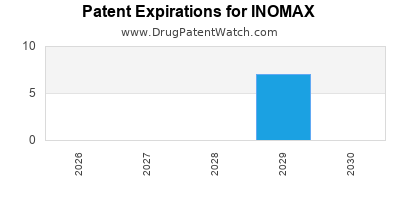
Inomax is a drug marketed by Mallinckrodt Ireland and is included in one NDA. There are seventeen patents protecting this drug and one Paragraph IV challenge.
This drug has one hundred and fourteen patent family members in fifteen countries.
The generic ingredient in INOMAX is nitric oxide. There are six drug master file entries for this compound. Four suppliers are listed for this compound. Additional details are available on the nitric oxide profile page.
DrugPatentWatch® Generic Entry Outlook for Inomax
Inomax was eligible for patent challenges on December 23, 2003.
There have been six patent litigation cases involving the patents protecting this drug, indicating strong interest in generic launch. Recent data indicate that 63% of patent challenges are decided in favor of the generic patent challenger and that 54% of successful patent challengers promptly launch generic drugs.
Indicators of Generic Entry
AI Deep Research
Questions you can ask:
- What is the 5 year forecast for INOMAX?
- What are the global sales for INOMAX?
- What is Average Wholesale Price for INOMAX?
Summary for INOMAX
| International Patents: | 114 |
| US Patents: | 17 |
| Applicants: | 1 |
| NDAs: | 1 |
| Finished Product Suppliers / Packagers: | 1 |
| Raw Ingredient (Bulk) Api Vendors: | 17 |
| Clinical Trials: | 15 |
| Drug Prices: | Drug price information for INOMAX |
| Patent Litigation and PTAB cases: | See patent lawsuits and PTAB cases for INOMAX |
| What excipients (inactive ingredients) are in INOMAX? | INOMAX excipients list |
| DailyMed Link: | INOMAX at DailyMed |

Recent Clinical Trials for INOMAX
Identify potential brand extensions & 505(b)(2) entrants
| Sponsor | Phase |
|---|---|
| Massachusetts General Hospital | N/A |
| University of California, Los Angeles | Phase 2 |
| Clinical & Translational Science Institute of Southeast Wisconsin | Phase 2/Phase 3 |
Pharmacology for INOMAX
| Drug Class | Vasodilator |
| Physiological Effect | Vasodilation |
Paragraph IV (Patent) Challenges for INOMAX
| Tradename | Dosage | Ingredient | Strength | NDA | ANDAs Submitted | Submissiondate |
|---|---|---|---|---|---|---|
| INOMAX | for Inhalation | nitric oxide | 100 ppm and 800 ppm | 020845 | 1 | 2014-05-20 |
US Patents and Regulatory Information for INOMAX
INOMAX is protected by seventeen US patents.
| Applicant | Tradename | Generic Name | Dosage | NDA | Approval Date | TE | Type | RLD | RS | Patent No. | Patent Expiration | Product | Substance | Delist Req. | Exclusivity Expiration |
|---|---|---|---|---|---|---|---|---|---|---|---|---|---|---|---|
| Mallinckrodt Ireland | INOMAX | nitric oxide | GAS;INHALATION | 020845-002 | Dec 23, 1999 | DISCN | Yes | No | 8,282,966*PED | ⤷ Start Trial | Y | ⤷ Start Trial | |||
| Mallinckrodt Ireland | INOMAX | nitric oxide | GAS;INHALATION | 020845-003 | Dec 23, 1999 | AA | RX | Yes | Yes | 8,573,209*PED | ⤷ Start Trial | Y | ⤷ Start Trial | ||
| Mallinckrodt Ireland | INOMAX | nitric oxide | GAS;INHALATION | 020845-003 | Dec 23, 1999 | AA | RX | Yes | Yes | 9,279,794*PED | ⤷ Start Trial | Y | ⤷ Start Trial | ||
| >Applicant | >Tradename | >Generic Name | >Dosage | >NDA | >Approval Date | >TE | >Type | >RLD | >RS | >Patent No. | >Patent Expiration | >Product | >Substance | >Delist Req. | >Exclusivity Expiration |
EU/EMA Drug Approvals for INOMAX
| Company | Drugname | Inn | Product Number / Indication | Status | Generic | Biosimilar | Orphan | Marketing Authorisation | Marketing Refusal |
|---|---|---|---|---|---|---|---|---|---|
| Linde Healthcare AB | INOmax | nitric oxide | EMEA/H/C/000337INOmax, in conjunction with ventilatory support and other appropriate active substances, is indicated:for the treatment of newborn infants ≥34 weeks gestation with hypoxic respiratory failure associated with clinical or echocardiographic evidence of pulmonary hypertension, in order to improve oxygenation and to reduce the need for extracorporeal membrane oxygenation;as part of the treatment of peri- and post-operative pulmonary hypertension in adults and newborn infants, infants and toddlers, children and adolescents, ages 0-17 years in conjunction to heart surgery, in order to selectively decrease pulmonary arterial pressure and improve right ventricular function and oxygenation. | Authorised | no | no | no | 2001-08-01 | |
| >Company | >Drugname | >Inn | >Product Number / Indication | >Status | >Generic | >Biosimilar | >Orphan | >Marketing Authorisation | >Marketing Refusal |
International Patents for INOMAX
When does loss-of-exclusivity occur for INOMAX?
Based on analysis by DrugPatentWatch, the following patents block generic entry in the countries listed below:
Australia
Patent: 09202685
Estimated Expiration: ⤷ Start Trial
Patent: 10202422
Patent: Methods of treating term and near-term neonates having hypoxic respiratory failure associated with clinical or echocardiographic evidence of pulmonary hypertension
Estimated Expiration: ⤷ Start Trial
Patent: 10206032
Patent: Methods of treating patients having hypoxic respiratory failure associated with clinical or echocardiographic evidence of pulmonary hypertension
Estimated Expiration: ⤷ Start Trial
Patent: 12201382
Patent: Methods of treating patients having hypoxic respiratory failure associated with clinical or echocardiographic evidence of pulmonary hypertension
Estimated Expiration: ⤷ Start Trial
Patent: 15100638
Patent: Methods of treating patients having hypoxic respiratory failure associated with clinical or echocardiographic evidence of pulmonary hypertension
Estimated Expiration: ⤷ Start Trial
Patent: 15100783
Patent: Methods of treating patients having hypoxic respiratory failure associated with clinical or echocardiographic evidence of pulmonary hypertension
Estimated Expiration: ⤷ Start Trial
Patent: 15202617
Patent: Methods of treating patients having hypoxic respiratory failure associated with clinical or echocardiographic evidence of pulmonary hypertension
Estimated Expiration: ⤷ Start Trial
Patent: 15202618
Patent: Methods of treating patients having hypoxic respiratory failure associated with clinical or echocardiographic evidence of pulmonary hypertension
Estimated Expiration: ⤷ Start Trial
Patent: 16259420
Patent: Methods of treating patients having hypoxic respiratory failure associated with clinical or echocardiographic evidence of pulmonary hypertension
Estimated Expiration: ⤷ Start Trial
Patent: 17201628
Patent: Methods of treating patients having hypoxic respiratory failure associated with clinical or echocardiographic evidence of pulmonary hypertension
Estimated Expiration: ⤷ Start Trial
Patent: 17201630
Patent: Methods of treating patients having hypoxic respiratory failure associated with clinical or echocardiographic evidence of pulmonary hypertension
Estimated Expiration: ⤷ Start Trial
Patent: 17202301
Patent: Methods of treating patients having hypoxic respiratory failure associated with clinical or echocardiographic evidence of pulmonary hypertension
Estimated Expiration: ⤷ Start Trial
Patent: 18205119
Patent: Methods of treating patients having hypoxic respiratory failure associated with clinical or echocardiographic evidence of pulmonary hypertension
Estimated Expiration: ⤷ Start Trial
Patent: 20201590
Patent: Methods of treating patients having hypoxic respiratory failure associated with clinical or echocardiographic evidence of pulmonary hypertension
Estimated Expiration: ⤷ Start Trial
Patent: 22201219
Patent: Methods of treating patients having hypoxic respiratory failure associated with clinical or echocardiographic evidence of pulmonary hypertension
Estimated Expiration: ⤷ Start Trial
Canada
Patent: 71029
Patent: PROCEDES DESTINES AU TRAITEMENT DES NOUVEAU-NES A TERME OU PRESQUE A TERME ATTEINTS D'UNE INSUFFISANCE RESPIRATOIRE HYPOXIQUE ASSOCIEE A DES SIGNES CLINIQUES OU ECHOCARDIOGRAPHIQUES D'HYPERTENSION PULMONAIRE (METHODS OF TREATING TERM AND NEAR-TERM NEONATES HAVING HYPOXIC RESPIRATORY FAILURE ASSOCIATED WITH CLINICAL OR ECHOCARDIOGRAPHIC EVIDENCE OF PULMONARY HYPERTENSION)
Estimated Expiration: ⤷ Start Trial
Patent: 30908
Patent: PROCEDES DESTINES AU TRAITEMENT DES NOUVEAU-NES A TERME OU PRESQUE A TERME ATTEINTS D'UNE INSUFFISANCE RESPIRATOIRE HYPOXIQUE ASSOCIEE A DES SIGNES CLINIQUES OU ECHOCARDIOGRAPHIQUES D'HYPERTENSION PULMONAIRE (METHODS OF TREATING TERM AND NEAR-TERM NEONATES HAVING HYPOXIC RESPIRATORY FAILURE ASSOCIATED WITH CLINICAL OR ECHOCARDIOGRAPHIC EVIDENCE OF PULMONARY HYPERTENSION)
Estimated Expiration: ⤷ Start Trial
European Patent Office
Patent: 69614
Patent: Procédé d'identification d'une population de patients éligibles au traitement au monoxyde d'azote (A method of identifying a patient population suited to receiving nitric oxide)
Estimated Expiration: ⤷ Start Trial
Patent: 48572
Patent: PROCÉDÉS D'IDENTIFICATION D'UNE POPULATION DE PATIENTS ÉLIGIBLES POUR LE TRAITEMENT AVEC DE L'OXYDE NITRIQUE PAR INHALATION (METHODS OF IDENTIFYING A PATIENT POPULATION ELIGIBLE FOR TREATMENT WITH NITRIC OXIDE VIA INHALATION)
Estimated Expiration: ⤷ Start Trial
Patent: 40304
Patent: Procédés pour réduire le risque ou prévenir l'apparition d'un événement défavorable ou d'un événement défavorable grave associés au traitement par oxyde nitrique inhalé (Methods for reducing the risk or preventing the occurrence of an adverse event or serious adverse event associated with the inhalation of nitric oxide treatment)
Estimated Expiration: ⤷ Start Trial
Japan
Patent: 11010865
Patent: METHOD OF TREATING TERM AND NEAR-TERM NEONATE HAVING HYPOXIC RESPIRATORY FAILURE ASSOCIATED WITH CLINICAL OR ECHOCARDIOGRAPHIC EVIDENCE OF PULMONARY HYPERTENSION
Estimated Expiration: ⤷ Start Trial
Patent: 11011059
Patent: METHOD OF TREATING INFANT HAVING HYPOXIC RESPIRATORY FAILURE ASSOCIATED WITH CLINICAL OR ECHOCARDIOGRAPHIC OF EVIDENCE OF PULMONARY HYPERTENSION
Estimated Expiration: ⤷ Start Trial
Patent: 11251155
Patent: METHOD OF TREATING TERM AND NEAR-TERM NEONATE HAVING HYPOXIC RESPIRATORY FAILURE ASSOCIATED WITH CLINICAL OR ECHOCARDIOGRAPHIC EVIDENCE OF PULMONARY HYPERTENSION
Estimated Expiration: ⤷ Start Trial
Mexico
Patent: 10006055
Patent: METODOS DE TRATAMIENTO DE RECIEN NACIDOS Y CASI A PUNTO DE NACER QUE TIENEN FALLAS RESPIRATORIAS HIPOXICAS ASOCIADA CON EVIDENCIA CLINICA O ECOCARDIOGRAFICA DE HIPERTENSION PULMONAR. (METHODS OF TREATING TERM AND NEAR-TERM NEONATES HAVING HYPOXIC RESPIRATORY FAILURE ASSOCIATED WITH CLINICAL OR ECHOCARDIOGRAPHIC EVIDENCE OF PULMONARY HYPERTENSION.)
Estimated Expiration: ⤷ Start Trial
Generics may enter earlier, or later, based on new patent filings, patent extensions, patent invalidation, early generic licensing, generic entry preferences, and other factors.
See the table below for additional patents covering INOMAX around the world.
| Country | Patent Number | Title | Estimated Expiration |
|---|---|---|---|
| Australia | 657726 | ⤷ Start Trial | |
| Australia | 2018205119 | Methods of treating patients having hypoxic respiratory failure associated with clinical or echocardiographic evidence of pulmonary hypertension | ⤷ Start Trial |
| Denmark | 0786264 | ⤷ Start Trial | |
| >Country | >Patent Number | >Title | >Estimated Expiration |
Supplementary Protection Certificates for INOMAX
| Patent Number | Supplementary Protection Certificate | SPC Country | SPC Expiration | SPC Description |
|---|---|---|---|---|
| 1516639 | 91404 | Luxembourg | ⤷ Start Trial | 91404, EXPIRES: 20160801 |
| 0786264 | SPC/GB08/019 | United Kingdom | ⤷ Start Trial | PRODUCT NAME: NITRIC OXIDE (NO); REGISTERED: UK EU/1/01/194/001 20010801 |
| 1516639 | C01516639/01 | Switzerland | ⤷ Start Trial | PRODUCT NAME: NITROGENII OXIDUM; REGISTRATION NUMBER/DATE: SWISSMEDIC 56809 09.07.2004 |
| >Patent Number | >Supplementary Protection Certificate | >SPC Country | >SPC Expiration | >SPC Description |
INOMAX (inhaled nitric oxide) market dynamics and financial trajectory: pricing, demand drivers, competition, and exclusivity timeline
More… ↓
Make Better Decisions: Try a trial or see plans & pricing
Drugs may be covered by multiple patents or regulatory protections. All trademarks and applicant names are the property of their respective owners or licensors. Although great care is taken in the proper and correct provision of this service, thinkBiotech LLC does not accept any responsibility for possible consequences of errors or omissions in the provided data. The data presented herein is for information purposes only. There is no warranty that the data contained herein is error free. We do not provide individual investment advice. This service is not registered with any financial regulatory agency. The information we publish is educational only and based on our opinions plus our models. By using DrugPatentWatch you acknowledge that we do not provide personalized recommendations or advice. thinkBiotech performs no independent verification of facts as provided by public sources nor are attempts made to provide legal or investing advice. Any reliance on data provided herein is done solely at the discretion of the user. Users of this service are advised to seek professional advice and independent confirmation before considering acting on any of the provided information. thinkBiotech LLC reserves the right to amend, extend or withdraw any part or all of the offered service without notice.
ISSN: 2162-2639

Privacy and Cookies
Terms & Conditions
Site Map
DrugPatentWatch Alternatives
LOE / Major Patent Expirations 2026 - 2027
NCE-1 Patent Challenge Dates 2026 - 2027
Friedman, Yali. "DrugPatentWatch" DrugPatentWatch, thinkBiotech, 2026, www.DrugPatentWatch.com.
See Primary Research Papers Citing DrugPatentWatch