Last updated: August 10, 2026
Zolpidem tartrate is a mature, largely commoditized prescription sleep medicine. The original Ambien franchise generated multibillion-dollar sales before U.S. patent expiry, but generic entry shifted value from branded products to high-volume, low-margin formulations. Current commercial growth is driven mainly by prescription volume, product mix, distribution access, and manufacturing cost rather than by new intellectual property.
Zolpidem is marketed primarily as immediate-release tablets, extended-release tablets, sublingual tablets, and oral spray products. The active ingredient is a nonbenzodiazepine sedative-hypnotic used for short-term treatment of insomnia. In the United States, zolpidem is a Schedule IV controlled substance.[1]
What is the current market position of zolpidem tartrate?
The market is mature and generic-dominated. Generic zolpidem tartrate immediate-release tablets account for most U.S. prescription volume, while branded Ambien, Ambien CR, and other differentiated products compete in narrower segments.
| Market attribute |
Current position |
| Active ingredient |
Zolpidem tartrate |
| Primary use |
Insomnia |
| Main dosage forms |
Immediate-release tablets, extended-release tablets, sublingual tablets, oral spray |
| U.S. controlled-substance status |
Schedule IV |
| Dominant commercial model |
Generic volume and low-cost dispensing |
| Original branded products |
Ambien and Ambien CR |
| Key branded company |
Sanofi for the original Ambien franchise |
| Generic competition |
Broad, including multiple tablet manufacturers |
| Biosimilar exposure |
None |
| Principal commercial risk |
Price erosion and substitution |
| Principal regulatory risk |
Controlled-substance oversight and next-day impairment concerns |
Zolpidem has retained demand because insomnia is common, treatment is generally short-cycle, and the product is available in several dosage forms. Its financial profile is weaker than that of newer branded sleep medicines because the basic immediate-release formulation has limited differentiation and broad generic availability.
How has the financial trajectory of zolpidem changed?
The financial trajectory has three distinct phases: branded expansion, patent-driven erosion, and mature generic stabilization.
Branded expansion before generic entry
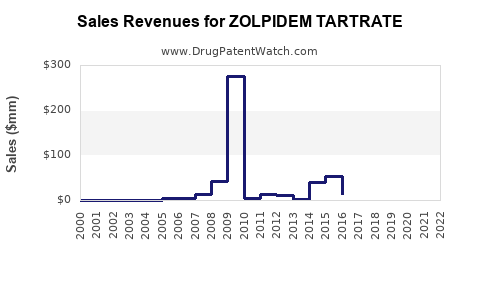
Ambien became one of Sanofi’s largest products during the 1990s and 2000s. U.S. sales reached roughly $2 billion annually before the core patent expired, making zolpidem one of the most commercially important prescription insomnia products of its period.[2]
The product benefited from:
- High primary-care prescribing;
- Broad awareness among physicians and patients;
- A relatively simple oral tablet format;
- Expansion of the insomnia-treatment market;
- Strong branded pricing before generic substitution.
Generic conversion after 2007
The core U.S. Ambien patent expired in 2007. FDA-approved generic versions entered the market, causing rapid substitution and a sharp fall in branded revenue.[3] Once pharmacies and payers had multiple approved suppliers, price competition became the primary market force.
The post-expiry pattern was typical for a small-molecule product:
- Generic entry reduced the branded product’s market share.
- Wholesale and reimbursement prices declined.
- Pharmacy benefit managers increased generic substitution.
- Sanofi’s revenue moved away from the original immediate-release product.
- Remaining value migrated toward extended-release and alternative delivery products.
Mature generic phase
Zolpidem now generates economic value through aggregate prescription volume rather than a single high-margin brand. Generic manufacturers compete on manufacturing scale, supply reliability, wholesaler relationships, and formulary access.
Public company filings generally do not report zolpidem revenue as a separate line item because generic products are grouped within broader portfolios. This limits the reliability of market-size estimates based only on company reports. Commercial data providers such as IQVIA and Symphony Health are more suitable for current prescription and revenue estimates, but their detailed datasets are proprietary.
When did zolpidem lose U.S. market exclusivity?
The original immediate-release Ambien franchise lost practical U.S. exclusivity after the expiry of the core patent in 2007. FDA records show generic zolpidem tartrate approvals beginning after that period, with multiple manufacturers entering the tablet market.[3]
Exclusivity timeline
| Milestone |
Commercial effect |
| 1990s |
Ambien expands as a major branded insomnia product |
| 2007 |
Core U.S. patent expiry and generic entry |
| 2008 onward |
Rapid branded share and price erosion |
| 2010s |
Broader generic supply and mature low-price market |
| 2013 |
FDA requires lower recommended doses for some patients because of next-morning impairment risk |
| 2020s |
Generic market remains established; differentiated formulations retain limited branded value |
FDA dose changes in 2013 affected the commercial positioning of zolpidem. The agency required labeling changes and lower recommended doses, particularly because women clear zolpidem more slowly on average and may have higher next-morning blood concentrations.[4]
What patents protect zolpidem tartrate products?
The original immediate-release formulation is no longer protected by a commercially meaningful blocking patent estate in the United States. Patent protection for later products focused on formulation, release profile, route of administration, or dosing rather than on the basic active ingredient.
Immediate-release tablets
The original Ambien patent estate covered zolpidem-related composition and use claims. Those rights expired before the current generic market was established. Generic manufacturers can now market standard immediate-release zolpidem tartrate tablets subject to FDA approval and applicable labeling requirements.
Extended-release products
Ambien CR used a modified-release design intended to provide an initial effect followed by continued drug release. Its patent protection extended beyond the core immediate-release product and delayed or complicated generic competition for the extended-release segment.
The commercial value of extended-release protection was narrower than the original Ambien franchise because:
- The patient population was smaller;
- Generic immediate-release tablets provided a lower-cost alternative;
- Payers could use step therapy or substitution;
- The formulation was more difficult to differentiate clinically.
Sublingual and low-dose products
Intermezzo and similar sublingual products targeted middle-of-the-night awakening. Their patents and regulatory exclusivity were directed to dosage strength, delivery route, and product design. These products occupied a niche rather than replacing the broad immediate-release market.
Orange Book status
The FDA Orange Book is the controlling source for current listed patents, expiration dates, and reference-listed drug status.[5] For mature zolpidem products, Orange Book listings have greater relevance to specific formulations than to the active ingredient as a whole.
The key commercial distinction is between:
- Standard zolpidem tartrate tablets, where generic competition is established;
- Extended-release products, where formulation patents historically delayed competition;
- Sublingual or oral spray products, where route and dosage-form claims may provide narrower protection.
What is the Orange Book status of Ambien, Ambien CR, and Intermezzo?
Ambien, Ambien CR, and Intermezzo are legacy reference-listed drugs or branded products with different formulation histories. Their patent positions should not be treated as interchangeable.
| Product |
Dosage form |
Patent relevance |
Current market effect |
| Ambien |
Immediate-release tablet |
Core product patents expired |
Broad generic substitution |
| Ambien CR |
Extended-release tablet |
Modified-release formulation patents were more relevant |
More limited generic competition historically |
| Intermezzo |
Sublingual tablet |
Route, strength, and dosing claims |
Niche product economics |
| Generic zolpidem |
Multiple forms |
Approval depends on product-specific regulatory requirements |
Low-price, high-substitution market |
Orange Book listings can change as patents expire, are delisted, or cease to block approval. A current freedom-to-operate review must therefore use the latest FDA listing rather than historical patent summaries.[5]
Which companies are challenging zolpidem patents?
The major patent challenge occurred during the transition from branded Ambien to generic zolpidem. Generic manufacturers, including large suppliers such as Teva, Mylan, Sandoz, and other FDA-approved applicants, participated in the post-expiry market.
Paragraph IV litigation was more commercially relevant for extended-release or differentiated products than for the basic immediate-release tablet. A Paragraph IV certification asserts that a listed patent is invalid, unenforceable, or not infringed. If the first eligible applicant makes a valid Paragraph IV challenge, the Hatch-Waxman framework can provide a 180-day period of generic exclusivity.[6]
For standard zolpidem tartrate tablets, the market has progressed beyond the principal patent-risk phase. Current entrants face manufacturing, FDA approval, controlled-substance compliance, and price competition rather than a major unresolved patent barrier.
What patent litigation and settlement agreements affect zolpidem?
The highest-value litigation period involved the transition from Ambien to generic products and disputes concerning later-release formulations. These disputes typically addressed:
- Infringement of formulation claims;
- Validity of modified-release patents;
- Paragraph IV certifications;
- Launch timing;
- Potential 180-day generic exclusivity;
- Settlement terms governing the date of market entry.
Historical settlements may have accelerated or delayed generic launch dates, but they do not materially restore exclusivity for standard immediate-release zolpidem today. Any current transaction involving a specific extended-release or sublingual product requires review of the relevant ANDA litigation docket and settlement agreement.
What formulation patents protect zolpidem products?
Formulation patents are the principal remaining source of differentiated intellectual property.
Extended-release formulations
Extended-release claims may cover:
- Bilayer or multilayer tablet architecture;
- Immediate-release and sustained-release portions;
- Release-rate profiles;
- Coating systems;
- Particle-size distributions;
- Excipients and compression methods;
- Dissolution specifications.
These claims can delay generic approval if the proposed product falls within the patent scope. They do not necessarily prevent generic immediate-release zolpidem from competing with the extended-release product.
Sublingual formulations
Sublingual products may be protected by claims directed to:
- Rapid dissolution;
- Absorption through oral mucosa;
- Low-dose delivery;
- Tablet composition;
- Taste masking;
- Use after nighttime awakening.
The commercial barrier is stronger when formulation claims are supported by distinct clinical labeling and the generic applicant must demonstrate product-specific bioequivalence.
Oral spray products
Oral spray products can involve device, formulation, dose-delivery, and administration claims. These rights may be more relevant to product-specific competition than to the broader zolpidem market.
Does zolpidem tartrate face biosimilar risk?
No. Zolpidem tartrate is a small-molecule drug, not a biologic. Biosimilar pathways do not apply. Competition occurs through abbreviated new drug applications, generic substitution, and product-specific bioequivalence requirements under the Hatch-Waxman framework.[6]
The practical risks are generic-entry risks:
- Additional ANDA approvals;
- Price reductions;
- Supplier exits followed by re-entry;
- Manufacturing shortages;
- Changes in wholesaler purchasing;
- State substitution rules;
- Controlled-substance quota and compliance requirements.
What is the FDA regulatory status of zolpidem?
FDA-approved zolpidem products remain available for insomnia under prescription-only labeling. FDA has imposed safety-related labeling requirements concerning next-day impairment, dosing, and patient-specific risk factors.[1,4]
The regulatory environment limits aggressive commercial expansion. Manufacturers must manage:
- Schedule IV controlled-substance requirements;
- Abuse, misuse, and dependence warnings;
- Safe-prescribing controls;
- Dose restrictions;
- Product-specific bioequivalence standards;
- Manufacturing and quality obligations;
- Advertising restrictions for prescription medicines.
The FDA has not treated zolpidem as a biologic, novel molecular entity, or major unmet-need therapy. Its regulatory value is therefore concentrated in approved product access and manufacturing reliability.
What generic entry risks exist for zolpidem tartrate?
Generic entry risk is high for immediate-release tablets and moderate for differentiated formulations.
| Product segment |
Generic-entry risk |
Pricing outlook |
| Immediate-release tablets |
Very high |
Continued price pressure |
| Extended-release tablets |
Moderate to high |
Dependent on formulation patents and approvals |
| Sublingual tablets |
Moderate |
Narrower market, potentially higher unit economics |
| Oral spray |
Product-specific |
Depends on device and formulation barriers |
| New abuse-deterrent or novel delivery formats |
Lower initially |
Requires clinical and regulatory differentiation |
A new entrant in immediate-release zolpidem would need a low-cost supply chain and reliable access to controlled-substance manufacturing capacity. Patent clearance alone would not create a strong commercial position.
How does zolpidem compare with competing insomnia drugs?
Zolpidem competes with generic sedative-hypnotics, orexin receptor antagonists, melatonin-related products, and off-label medicines.
| Drug class |
Examples |
Commercial position |
| Zolpidem |
Ambien, generic zolpidem |
Low-cost, high-volume generic |
| Benzodiazepines |
Temazepam, triazolam |
Generic, controlled substances, safety concerns |
| Orexin antagonists |
Suvorexant, lemborexant, daridorexant |
Branded differentiation and higher pricing |
| Melatonin-receptor agonist |
Ramelteon |
Branded or generic niche |
| Sedating antidepressants |
Doxepin and others |
Often lower-cost alternatives |
| OTC sleep products |
Doxylamine, diphenhydramine, melatonin |
Consumer-driven, nonprescription competition |
Orexin antagonists have the strongest branded competitive position because they offer a newer mechanism and can command higher prices. Zolpidem retains an advantage in affordability, prescriber familiarity, and generic availability.
How strong is the zolpidem patent estate?
The patent estate is weak for the active ingredient and conventional immediate-release tablets, but stronger on a product-by-product basis for specialized delivery systems.
| IP category |
Strength today |
Business implication |
| Active ingredient |
Low |
No meaningful composition-of-matter barrier |
| Immediate-release tablet |
Low |
Broad generic competition |
| Extended-release formulation |
Moderate historically |
Formulation-specific review required |
| Sublingual delivery |
Moderate in limited claims |
Niche protection possible |
| Oral spray/device |
Product-specific |
Device and formulation claims may matter |
| Manufacturing process |
Low to moderate |
May affect supply but rarely blocks all generic entry |
| Method of use |
Limited |
Labeling and enforceability depend on claim scope |
Method-of-use patents may cover particular dosing schedules, administration timing, or patient populations. Their commercial value is constrained when generic labels omit patented indications or when physicians can prescribe the product for unprotected uses.
What is the geographic coverage of zolpidem IP?
U.S. core patents have expired, but patent status differs by jurisdiction. European and other national rights may have followed different filing, opposition, supplementary protection, and enforcement timelines.
For international licensing or launch planning, the relevant review includes:
- National patent registers;
- Patent Cooperation Treaty filings;
- European Patent Office prosecution and opposition records;
- Local regulatory exclusivity;
- National substitution rules;
- Controlled-substance import and distribution requirements.
The geographic commercial opportunity is generally greater in markets where generic penetration is lower, reimbursement is favorable, or branded sleep products retain physician preference. The United States remains the most developed generic market and therefore offers limited pricing power for standard tablets.
What licensing deals affect zolpidem tartrate?
Zolpidem’s major licensing value was created during the branded development and commercialization period. Current licensing opportunities are more likely to involve:
- Regional rights to branded or specialty formulations;
- Co-development of oral spray or sublingual products;
- Contract manufacturing;
- Authorized generic arrangements;
- Portfolio acquisitions involving insomnia products.
The standard immediate-release molecule has limited standalone licensing value because multiple approved competitors can supply it. A licensor would need a differentiated formulation, geographic advantage, manufacturing asset, or commercial platform to justify premium economics.
What revenue exposure does zolpidem create for pharmaceutical companies?
For branded pharmaceutical companies, direct revenue exposure is low unless the company owns a differentiated formulation. For generic manufacturers, zolpidem contributes volume but usually has limited gross-margin protection.
Revenue sensitivity is determined by:
- Number of approved competitors;
- Average selling price;
- Prescription share;
- Dosage-form mix;
- Wholesaler inventory;
- API and finished-dose costs;
- FDA supply disruptions;
- Controlled-substance quota availability.
Sanofi’s historic exposure was material before generic entry. Today, zolpidem is more likely to be financially relevant as one product within a generic portfolio than as a standalone growth driver.
Key Takeaways
- Zolpidem tartrate is a mature, generic-dominated insomnia drug.
- The original Ambien franchise lost core U.S. exclusivity in 2007.
- Standard immediate-release tablets have low patent risk and high price pressure.
- Extended-release, sublingual, and oral spray products can retain formulation-specific IP.
- Zolpidem has no biosimilar risk because it is a small-molecule drug.
- FDA safety labeling, Schedule IV controls, and next-day impairment concerns shape the market.
- Historical branded revenue was substantial, but current economics depend on volume, manufacturing efficiency, and product differentiation.
- The strongest commercial opportunities are in specialized delivery systems, regional markets, and supply-chain execution rather than in the core molecule.
FAQs About Zolpidem Tartrate Market and Patent Risk
When did generic Ambien first enter the U.S. market?
Generic zolpidem entered the U.S. market after expiry of the core Ambien patent in 2007, with subsequent FDA approvals expanding the supplier base.[3]
Is Ambien CR still protected by patents?
Any remaining protection must be assessed against the current Orange Book listings and specific product claims. Historical extended-release patents were more commercially relevant than the expired immediate-release Ambien patents.[5]
Can a company launch generic zolpidem without a Paragraph IV challenge?
Yes. A generic applicant can use a certification pathway that does not require challenging an unexpired listed patent, depending on the reference product, patent status, and proposed labeling. For products with no blocking listed patents, ordinary ANDA approval is generally the relevant pathway.[6]
Is zolpidem tartrate a controlled substance in Europe?
Control status differs by country. U.S. federal law classifies zolpidem as Schedule IV, while foreign scheduling and dispensing rules require jurisdiction-specific review.[1]
Which insomnia drug has stronger commercial growth potential than zolpidem?
Orexin receptor antagonists generally have stronger branded growth potential because they are newer products with differentiated mechanisms and higher pricing. Zolpidem has greater generic volume but lower unit economics.
References
-
U.S. Food and Drug Administration. (2023). Ambien prescribing information. FDA.
-
Sanofi-Aventis. (2007). Annual report 2006. Sanofi-Aventis.
-
U.S. Food and Drug Administration. (2024). Drugs@FDA: FDA-approved drugs and generic zolpidem approvals. FDA.
-
U.S. Food and Drug Administration. (2013). FDA drug safety communication: FDA approves new label changes and dosing for zolpidem products and recommends lower dose for women. FDA.
-
U.S. Food and Drug Administration. (2024). Approved drug products with therapeutic equivalence evaluations: Orange Book. FDA.
-
U.S. Congress. (1984). Drug Price Competition and Patent Term Restoration Act of 1984, Pub. L. No. 98-417.