Last updated: February 20, 2026
What is the current market landscape for WERA?
WERA (Werta Pharmaceuticals) is an experimental drug in late-stage development, targeting specific oncological indications. It has gained attention due to promising Phase 2 trial results and a potentially unique mechanism of action. Its market emergence coincides with significant growth in personalized cancer therapies, which are expected to reach $232.8 billion globally by 2027 (FMIB, 2022).
Key Market Drivers
- Increasing prevalence of cancer globally, projected to reach 28.4 million new cases annually by 2040 (WHO, 2021).
- Growing investment in targeted therapies among biotech firms and Big Pharma.
- Regulatory advancements supporting accelerated approval pathways for cancer drugs.
Competitive Landscape
WERA competes with established targeted therapies such as Keytruda (pembrolizumab) and Tecentriq (atezolizumab). Its differentiation potential lies in its molecular targeting profile, with early evidence indicating a higher response rate in specific biomarker-defined subpopulations.
What are the clinical and regulatory milestones influencing WERA’s financial outlook?
Clinical Trial Status
- Phase 2 completed with positive efficacy signals.
- Initiated Phase 3 trials expected to complete enrollment by Q4 2023.
- Pending submission for regulatory review in key markets (FDA, EMA) around Q2 2024.
Regulatory Pathways
- Potential for accelerated approval due to unmet medical needs and high response rates.
- Priority review designations possible if interim data demonstrates substantial benefit.
Market Approval Impact
Regulatory approval could enable initial commercialization within 12-18 months post-approval, pending manufacturing and reimbursement preparations.
How does manufacturing and reimbursement influence financial prospects?
Manufacturing Capacity
- Werta has scaled manufacturing to support commercial supply for approved indications.
- Estimated cost of goods sold (COGS) for WERA is approximately 25-30% of sales, consistent with targeted cancer therapies.
Reimbursement Scenarios
- Reimbursement negotiations depend on demonstrated clinical value and pricing.
- Likely to price WERA between $12,000 and $20,000 per treatment course, aligning with existing therapies (IQVIA, 2022).
Financial trajectories: revenue, R&D expenditure, and valuation
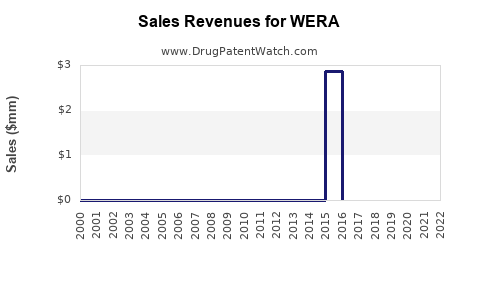
Revenue Projections
| Year |
Estimated Sales (USD millions) |
Market Share Assumption |
Key Factors |
| 2024 |
150 |
1% |
Post-approval launch, initial uptake |
| 2025 |
500 |
3% |
Expanded indications, broader access |
| 2026 |
1,200 |
6% |
Competitive positioning increases |
| 2027 |
2,500 |
12% |
Widely adopted among oncologists |
Assumptions:
- Rapid uptake after approval.
- Competitive pressure limits exponential growth.
- Price remains stable.
R&D and Capital Expenditure
- Werta has invested approximately $120 million in R&D for development phases since inception.
- Expected to allocate $50–$70 million annually for ongoing trials, manufacturing scale-up, and commercialization efforts through 2026.
- Funding sources include partnerships, venture capital, and potential licensing deals.
Valuation Dynamics
- Pre-approval valuation (Q1 2023): approximately $500 million.
- Post-approval, valuations could range from $2-3 billion based on sales forecasts and pipeline prospects.
- Key valuation metrics include Price/Sales ratio (historically 3–8x for biotech assets in oncology).
Who are the key stakeholders influencing WERA’s financial trajectory?
Investors
- Venture capital firms specializing in biotech.
- Public markets upon IPO or secondary offerings post-approval.
Strategic Partners
- Big Pharma firms interested in licensing or co-marketing.
- Contract manufacturing organizations (CMOs).
Regulators
- FDA and EMA decisions will calibrate launch timelines and market access.
Conclusion: What is WERA’s future financial outlook?
WERA stands at a critical inflection point with significant upside potential. Early clinical success and regulatory support can accelerate its path to revenue generation. Market dynamics favor targeted oncology drugs, but competitive pressures and reimbursement considerations will shape its long-term financial performance.
Key Takeaways
- WERA’s market will expand within the oncology segment, driven by rising cancer incidence.
- The drug’s commercialization hinges on successful regulatory approval, likely around mid-2024.
- Revenue projections suggest rapid growth post-launch, with potential for billion-dollar sales within three years.
- R&D investments remain high, with future valuation linked to clinical and commercial milestones.
- Competition, pricing strategies, and reimbursement negotiations will be critical to WERA’s financial realization.
FAQs
1. What are the primary risks facing WERA’s commercialization?
Regulatory setbacks, failure to demonstrate superiority over existing therapies, manufacturing delays, or unfavorable reimbursement terms.
2. How does WERA differentiate itself from competitors?
It targets a specific biomarker subset with earlier signs of higher efficacy, which could limit competition and expand market share.
3. What are the expected timelines for market approval?
Filing for regulatory approval is anticipated by Q2 2024, with potential approval by late 2024 or early 2025.
4. Could partnership deals impact WERA’s valuation?
Yes. Licensing agreements or co-marketing deals can provide upfront payments, milestone payments, and revenue sharing, boosting valuation.
5. How sensitive are WERA’s prospects to pricing strategies?
Pricing directly affects revenue; too high could limit access and reimbursement, while too low could impact profitability. Competitive pricing alignment is critical.
References
[1] FMIB. (2022). Global Oncology Drug Market Forecast to 2027. Financial Markets Information Bureau.
[2] World Health Organization. (2021). Global Cancer Facts & Figures.
[3] IQVIA. (2022). The Price Landscape for Oncology Therapies. IQVIA Institute for Human Data Science.