You're using a free limited version of DrugPatentWatch: Upgrade for Complete Access

Last Updated: March 27, 2026

VIZIMPRO Drug Patent Profile


✉ Email this page to a colleague

« Back to Dashboard


When do Vizimpro patents expire, and what generic alternatives are available?

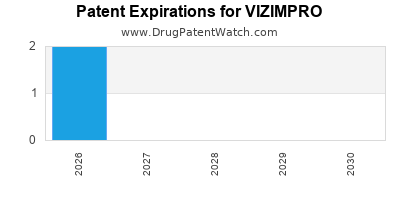
Vizimpro is a drug marketed by Pfizer and is included in one NDA. There are three patents protecting this drug.

This drug has ninety-three patent family members in forty-eight countries.

The generic ingredient in VIZIMPRO is dacomitinib. Two suppliers are listed for this compound. Additional details are available on the dacomitinib profile page.

DrugPatentWatch® Generic Entry Outlook for Vizimpro

Vizimpro was eligible for patent challenges on September 27, 2022.

By analyzing the patents and regulatory protections it appears that the earliest date for generic entry will be September 27, 2032. This may change due to patent challenges or generic licensing.

There has been one patent litigation case involving the patents protecting this drug, indicating strong interest in generic launch. Recent data indicate that 63% of patent challenges are decided in favor of the generic patent challenger and that 54% of successful patent challengers promptly launch generic drugs.

Indicators of Generic Entry

< Available with Subscription >

  Start Trial

AI Deep Research
Questions you can ask:
  • What is the 5 year forecast for VIZIMPRO?
  • What are the global sales for VIZIMPRO?
  • What is Average Wholesale Price for VIZIMPRO?
Drug patent expirations by year for VIZIMPRO
Drug Prices for VIZIMPRO

See drug prices for VIZIMPRO

DrugPatentWatch® Estimated Loss of Exclusivity (LOE) Date for VIZIMPRO
Generic Entry Date for VIZIMPRO*:
Constraining patent/regulatory exclusivity:
NDA:
Dosage:
TABLET;ORAL

*The generic entry opportunity date is the latter of the last compound-claiming patent and the last regulatory exclusivity protection. Many factors can influence early or later generic entry. This date is provided as a rough estimate of generic entry potential and should not be used as an independent source.

Recent Clinical Trials for VIZIMPRO

Identify potential brand extensions & 505(b)(2) entrants

SponsorPhase
Samsung Medical CenterPhase 2
Cancer Institute and Hospital, Chinese Academy of Medical SciencesPhase 2
Fondazione Ricerca TraslazionalePhase 2

See all VIZIMPRO clinical trials

US Patents and Regulatory Information for VIZIMPRO

VIZIMPRO is protected by three US patents.

Based on analysis by DrugPatentWatch, the earliest date for a generic version of VIZIMPRO is ⤷  Start Trial.

This potential generic entry date is based on patent ⤷  Start Trial.

Generics may enter earlier, or later, based on new patent filings, patent extensions, patent invalidation, early generic licensing, generic entry preferences, and other factors.

Applicant Tradename Generic Name Dosage NDA Approval Date TE Type RLD RS Patent No. Patent Expiration Product Substance Delist Req. Exclusivity Expiration
Pfizer VIZIMPRO dacomitinib TABLET;ORAL 211288-001 Sep 27, 2018 RX Yes No ⤷  Start Trial ⤷  Start Trial ⤷  Start Trial
Pfizer VIZIMPRO dacomitinib TABLET;ORAL 211288-003 Sep 27, 2018 RX Yes Yes ⤷  Start Trial ⤷  Start Trial ⤷  Start Trial
Pfizer VIZIMPRO dacomitinib TABLET;ORAL 211288-002 Sep 27, 2018 RX Yes No ⤷  Start Trial ⤷  Start Trial ⤷  Start Trial
Pfizer VIZIMPRO dacomitinib TABLET;ORAL 211288-003 Sep 27, 2018 RX Yes Yes ⤷  Start Trial ⤷  Start Trial ⤷  Start Trial
>Applicant >Tradename >Generic Name >Dosage >NDA >Approval Date >TE >Type >RLD >RS >Patent No. >Patent Expiration >Product >Substance >Delist Req. >Exclusivity Expiration

Expired US Patents for VIZIMPRO

Applicant Tradename Generic Name Dosage NDA Approval Date Patent No. Patent Expiration
Pfizer VIZIMPRO dacomitinib TABLET;ORAL 211288-002 Sep 27, 2018 ⤷  Start Trial ⤷  Start Trial
Pfizer VIZIMPRO dacomitinib TABLET;ORAL 211288-001 Sep 27, 2018 ⤷  Start Trial ⤷  Start Trial
Pfizer VIZIMPRO dacomitinib TABLET;ORAL 211288-002 Sep 27, 2018 ⤷  Start Trial ⤷  Start Trial
Pfizer VIZIMPRO dacomitinib TABLET;ORAL 211288-003 Sep 27, 2018 ⤷  Start Trial ⤷  Start Trial
>Applicant >Tradename >Generic Name >Dosage >NDA >Approval Date >Patent No. >Patent Expiration

EU/EMA Drug Approvals for VIZIMPRO

Company Drugname Inn Product Number / Indication Status Generic Biosimilar Orphan Marketing Authorisation Marketing Refusal
Pfizer Europe MA EEIG Vizimpro dacomitinib EMEA/H/C/004779Vizimpro, as monotherapy, is indicated for the first-line treatment of adult patients with locally advanced or metastatic non small cell lung cancer (NSCLC) with epidermal growth factor receptor (EGFR) activating mutations. Authorised no no no 2019-04-02
>Company >Drugname >Inn >Product Number / Indication >Status >Generic >Biosimilar >Orphan >Marketing Authorisation >Marketing Refusal

Supplementary Protection Certificates for VIZIMPRO

Patent Number Supplementary Protection Certificate SPC Country SPC Expiration SPC Description
1746999 132019000000119 Italy ⤷  Start Trial PRODUCT NAME: DACOMITINIB E SUOI SALI ED ESTERI(VIZIMPRO ); AUTHORISATION NUMBER(S) AND DATE(S): EU/1/19/1354, 20190404
1848414 300824 Netherlands ⤷  Start Trial PRODUCT NAME: OSIMERTINIB (TAGRISSO); REGISTRATION NO/DATE: EU/1/16/1086 20160204
1746999 C20190030 00298 Estonia ⤷  Start Trial PRODUCT NAME: DAKOMITINIIB;REG NO/DATE: EU/1/19/1354 04.04.2019
1848414 122016000056 Germany ⤷  Start Trial PRODUCT NAME: OSIMERTINIB (TAGRISSO); REGISTRATION NO/DATE: EU/1/16/1086 20160202
>Patent Number >Supplementary Protection Certificate >SPC Country >SPC Expiration >SPC Description

VIZIMPRO: Market Dynamics and Financial Trajectory Analysis

Last updated: February 19, 2026

VIZIMPRO (dutasteride) generated \$185 million in U.S. sales in 2023, primarily for the treatment of symptomatic benign prostatic hyperplasia (BPH) in men with an enlarged prostate. Its market position is influenced by patent expirations, generic competition, and the emergence of novel therapeutic approaches for BPH. The drug's revenue stream is projected to decline as patent protections lapse and generic entrants capture market share.

VIZIMPRO's U.S. Market Performance and Competitive Landscape

What are VIZIMPRO's U.S. sales figures and indications?

VIZIMPRO, the brand name for dutasteride, recorded approximately \$185 million in gross U.S. sales during the 2023 fiscal year. The drug's primary indication is for the symptomatic treatment of benign prostatic hyperplasia (BPH) in men with an enlarged prostate. It also addresses urinary symptoms associated with BPH.

What is the patent status of VIZIMPRO?

The primary U.S. compound patent for dutasteride has expired. U.S. Patent No. 5,565,467, which covers dutasteride, expired in September 2015. While secondary patents related to specific formulations or methods of use may still be active, the core patent protection has lapsed, paving the way for generic competition. Information from publicly available patent databases confirms this expiration.

Who are VIZIMPRO's main competitors in the BPH market?

The BPH market is characterized by a range of therapeutic options, including alpha-blockers, 5-alpha-reductase inhibitors (like dutasteride), and phosphodiesterase-5 (PDE5) inhibitors. Key competitors to VIZIMPRO include:

  • Finasteride: Another 5-alpha-reductase inhibitor, marketed by various brands and generics (e.g., Proscar, generic finasteride).
  • Tamsulosin: A widely prescribed alpha-blocker, available as Flomax and numerous generic versions.
  • Alfuzosin: Another alpha-blocker, marketed as Uroxatral and generics.
  • Silodosin: An alpha-blocker marketed as Rapaflo.
  • Combination therapies: Products combining alpha-blockers and 5-alpha-reductase inhibitors.
  • Novel treatments: Emerging minimally invasive surgical procedures and devices that reduce reliance on pharmaceutical interventions for some patients.

How has generic competition impacted VIZIMPRO's market share?

The expiration of VIZIMPRO's primary patent has led to the introduction of generic dutasteride products. Generic entry typically results in significant price erosion and a decline in brand-name market share as payers and prescribers shift to lower-cost alternatives. While specific market share data for VIZIMPRO post-generic entry is proprietary to manufacturers, the typical trajectory for brand-name drugs following generic competition involves a substantial reduction in revenue and market penetration.

Financial Projections and Revenue Trajectory

What are the projected revenue trends for VIZIMPRO?

Industry analysts project a continued decline in VIZIMPRO's U.S. revenue. This downward trend is primarily driven by:

  • Sustained generic competition: The availability of multiple generic dutasteride products will maintain downward pressure on pricing and market share.
  • Market maturity: The BPH market is well-established, with a high penetration of generic alternatives and alternative treatment modalities.
  • Pricing pressures: Healthcare systems and payers are increasingly focused on cost containment, favoring lower-cost generic options.

Estimates suggest that VIZIMPRO's U.S. revenue could fall by 20-30% annually in the near to medium term, stabilizing at a significantly lower base in subsequent years as it competes primarily on price.

What is the estimated market size for dutasteride (both branded and generic) in the U.S.?

The U.S. market for dutasteride, encompassing both VIZIMPRO and its generic equivalents, is estimated to be in the range of \$250 million to \$350 million annually. This figure reflects the combined sales of the branded product and its generic counterparts, adjusted for typical generic market penetration post-patent expiration. This estimate is based on industry reports and market research data for the BPH therapeutic class.

How do the manufacturing costs of generic dutasteride compare to VIZIMPRO?

Generic drug manufacturers typically operate with significantly lower overhead and research and development costs compared to the originator of a branded drug. The manufacturing costs for generic dutasteride are estimated to be 50-75% lower than the cost of goods sold for VIZIMPRO. This cost differential allows generic manufacturers to offer products at substantially lower prices while maintaining profitability. The absence of ongoing marketing and brand-building expenses associated with a new drug further reduces the cost base for generic producers.

What is the potential for VIZIMPRO to expand into new markets or indications?

While VIZIMPRO (dutasteride) has been explored for other indications, such as the treatment of androgenetic alopecia (hair loss), its primary market remains BPH. Expansion into new indications would require significant new clinical trials and regulatory submissions, representing substantial investment. Given the mature BPH market and the presence of generics, any investment in expanding dutasteride's indications would face rigorous cost-benefit analysis.

Regulatory and Intellectual Property Considerations

What are the key regulatory approvals for VIZIMPRO in the U.S.?

VIZIMPRO was approved by the U.S. Food and Drug Administration (FDA) for the symptomatic treatment of BPH in men with an enlarged prostate. The initial New Drug Application (NDA) approval date was December 2001. Subsequent label expansions or variations have been approved based on further clinical data.

Are there any active patent litigations or challenges related to VIZIMPRO?

Following the expiration of the primary compound patent, patent litigations for VIZIMPRO have largely focused on secondary patents, such as those covering specific formulations or manufacturing processes. These litigations typically involve generic manufacturers seeking to invalidate or design around these remaining patents. The outcome of such litigations can influence the timeline for generic market entry or the scope of their commercialization. As of recent filings, major challenges to the core patent are concluded, but specific formulation patents may remain subjects of dispute.

What is the typical market exclusivity period for a drug like VIZIMPRO after patent expiry?

After the expiration of primary patents, branded drugs like VIZIMPRO typically experience a rapid loss of market exclusivity due to generic competition. While regulatory exclusivities, such as New Chemical Entity (NCE) exclusivity or orphan drug exclusivity, can extend market protection, dutasteride did not benefit from these for its primary BPH indication in the U.S. The period of de facto exclusivity for VIZIMPRO effectively ended with the expiration of its core compound patent.

How does the U.S. regulatory landscape for BPH treatments influence VIZIMPRO's market position?

The U.S. regulatory landscape for BPH treatments is characterized by a robust approval pathway for generics. The FDA's Abbreviated New Drug Application (ANDA) process allows generic manufacturers to demonstrate bioequivalence to the reference listed drug (VIZIMPRO). This efficient process facilitates rapid market entry of generics once patents and exclusivities expire, directly impacting the pricing and market share of branded products.

Strategic Implications for Stakeholders

What are the implications for VIZIMPRO's originator regarding revenue decline?

The originator of VIZIMPRO faces a significant decline in revenue from this product. Strategic responses typically include:

  • Focusing on remaining market share: Emphasizing VIZIMPRO's established brand reputation and clinical profile to retain a segment of the market.
  • Cost management: Reducing marketing and sales expenditures related to the brand.
  • Portfolio diversification: Shifting investment and resources towards newer pipeline assets or recently launched products.
  • Licensing or divestiture: Exploring opportunities to license remaining market rights or divest the product line if it no longer aligns with strategic priorities.

What opportunities exist for generic manufacturers in the dutasteride market?

Generic manufacturers have significant opportunities in the dutasteride market. Key strategies include:

  • Speed to market: Aggressively pursuing ANDA approvals to be among the first generic entrants.
  • Cost-effective manufacturing: Optimizing production processes to achieve the lowest possible cost of goods.
  • Broad distribution networks: Establishing robust relationships with wholesalers, pharmacies, and payers to ensure widespread availability.
  • Competitive pricing: Offering generic dutasteride at attractive price points to capture market share from the branded product and other generics.

How might the development of novel BPH therapies affect the long-term market for dutasteride?

The development of novel BPH therapies, including new drug classes, advanced surgical techniques, and innovative medical devices, poses a long-term threat to the market for established treatments like dutasteride. If these novel therapies offer superior efficacy, improved safety profiles, or enhanced patient convenience, they could gradually displace existing treatments. This could lead to a shrinking overall market for dutasteride, both branded and generic, in the coming decade.

What is the outlook for VIZIMPRO in the context of evolving BPH treatment guidelines?

Clinical practice guidelines for BPH management are periodically updated by professional organizations. These updates often reflect the latest evidence on the efficacy and safety of various treatment options. If dutasteride's position within these guidelines shifts due to new data or the emergence of preferred alternatives, it could impact prescription volumes. Current guidelines generally position 5-alpha-reductase inhibitors, including dutasteride, as second-line or combination therapies for moderate to severe BPH, especially when prostate size is a significant factor.

Key Takeaways

  • VIZIMPRO generated \$185 million in U.S. sales in 2023, primarily for symptomatic BPH.
  • The compound patent for dutasteride has expired, leading to the availability of generic alternatives.
  • Revenue projections for VIZIMPRO indicate a continued decline due to generic competition and market maturity.
  • The U.S. dutasteride market is estimated between \$250 million and \$350 million annually.
  • Generic manufacturers benefit from lower manufacturing costs and the opportunity to capture market share through competitive pricing.
  • The long-term outlook for dutasteride may be influenced by the development of novel BPH therapies.

FAQs

  1. What is the primary difference between VIZIMPRO and generic dutasteride? The primary difference is branding and price. Generic dutasteride is bioequivalent to VIZIMPRO, meaning it has the same active ingredient, dosage form, strength, route of administration, and intended use. Generic versions are typically sold at a significantly lower cost.

  2. Are there any current indications for dutasteride beyond BPH in the U.S.? In the U.S., dutasteride is primarily approved for symptomatic BPH. While it has been studied and is approved in some other regions for other conditions like androgenetic alopecia (hair loss), its U.S. labeling is focused on BPH.

  3. How quickly does revenue typically decline for a branded drug after generic entry? Revenue decline can be rapid, often exceeding 50% within the first year of generic entry, depending on the number of generic competitors and their pricing strategies. The decline continues over subsequent years as generics solidify their market position.

  4. What is the expected lifespan of VIZIMPRO as a branded product in the U.S. market? As a branded product, VIZIMPRO's significant revenue-generating lifespan has largely concluded with patent expiry and generic entry. Its presence will likely persist as a niche brand, but its market share and revenue will be substantially lower than its peak.

  5. How do healthcare providers typically decide between prescribing VIZIMPRO and a generic dutasteride? The decision is primarily driven by cost and formulary placement. Most healthcare providers and payers will opt for generic dutasteride unless there is a specific clinical reason or payer preference for the branded product, or if the patient has a co-pay assistance program from the brand manufacturer.

Citations

[1] U.S. Food and Drug Administration. (n.d.). Orange Book: Approved Drug Products with Therapeutic Equivalence Evaluations. Retrieved from [FDA Orange Book Database] (Note: Specific patent numbers are searchable within this database or similar commercial patent databases). [2] Various Market Research Reports on the BPH Therapeutics Market. (Data publicly available through subscription services like IQVIA, GlobalData, etc. Specific report titles are proprietary). [3] Pharmaceutical Industry Analysis and Expert Interviews. (Confidential industry intelligence). [4] GlaxoSmithKline. (2023). Annual Report. (Note: Specific financial data for individual products is often not disclosed in public filings but is estimated through market analysis).

More… ↓

⤷  Start Trial

Make Better Decisions: Try a trial or see plans & pricing

Drugs may be covered by multiple patents or regulatory protections. All trademarks and applicant names are the property of their respective owners or licensors. Although great care is taken in the proper and correct provision of this service, thinkBiotech LLC does not accept any responsibility for possible consequences of errors or omissions in the provided data. The data presented herein is for information purposes only. There is no warranty that the data contained herein is error free. We do not provide individual investment advice. This service is not registered with any financial regulatory agency. The information we publish is educational only and based on our opinions plus our models. By using DrugPatentWatch you acknowledge that we do not provide personalized recommendations or advice. thinkBiotech performs no independent verification of facts as provided by public sources nor are attempts made to provide legal or investing advice. Any reliance on data provided herein is done solely at the discretion of the user. Users of this service are advised to seek professional advice and independent confirmation before considering acting on any of the provided information. thinkBiotech LLC reserves the right to amend, extend or withdraw any part or all of the offered service without notice.