Last Updated: August 25, 2026

VALTOCO Drug Patent Profile


✉ Email this page to a colleague

« Back to Dashboard


When do Valtoco patents expire, and what generic alternatives are available?

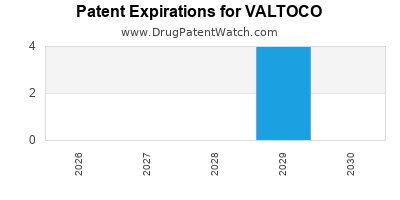
Valtoco is a drug marketed by Neurelis Inc and is included in one NDA. There are eight patents protecting this drug and two Paragraph IV challenges.

This drug has thirty-eight patent family members in thirteen countries.

The generic ingredient in VALTOCO is diazepam. There are eight drug master file entries for this compound. Forty-nine suppliers are listed for this compound. Additional details are available on the diazepam profile page.

DrugPatentWatch® Litigation and Generic Entry Outlook for Valtoco

A generic version of VALTOCO was approved as diazepam by MYLAN on September 4th, 1985.

  Start Trial

AI Deep Research
Questions you can ask:
  • What is the 5 year forecast for VALTOCO?
  • What are the global sales for VALTOCO?
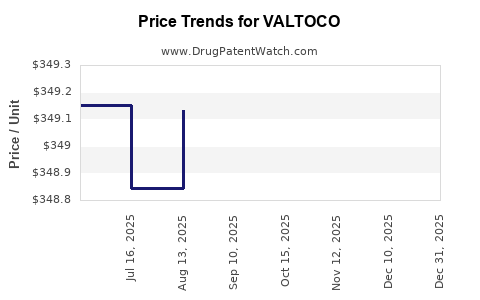
  • What is Average Wholesale Price for VALTOCO?
Recent Clinical Trials for VALTOCO

Identify potential brand extensions & 505(b)(2) entrants

SponsorPhase
University of CincinnatiPhase 4
Neurelis, Inc.Phase 1/Phase 2

See all VALTOCO clinical trials

Pharmacology for VALTOCO
Drug ClassBenzodiazepine
Paragraph IV (Patent) Challenges for VALTOCO
Tradename Dosage Ingredient Strength NDA ANDAs Submitted Submissiondate
VALTOCO Nasal Spray diazepam 5 mg/spray and 7.5 mg/spray 211635 1 2025-04-03
VALTOCO Nasal Spray diazepam 10 mg/spray 211635 1 2024-02-14

US Patents and Regulatory Information for VALTOCO

VALTOCO is protected by eight US patents and two FDA Regulatory Exclusivities.

Applicant Tradename Generic Name Dosage NDA Approval Date TE Type RLD RS Patent No. Patent Expiration Product Substance Delist Req. Exclusivity Expiration
Neurelis Inc VALTOCO diazepam SPRAY;NASAL 211635-003 Jan 10, 2020 RX Yes Yes ⤷  Start Trial ⤷  Start Trial Y ⤷  Start Trial
Neurelis Inc VALTOCO diazepam SPRAY;NASAL 211635-003 Jan 10, 2020 RX Yes Yes ⤷  Start Trial ⤷  Start Trial ⤷  Start Trial
Neurelis Inc VALTOCO diazepam SPRAY;NASAL 211635-001 Jan 10, 2020 RX Yes No ⤷  Start Trial ⤷  Start Trial ⤷  Start Trial
Neurelis Inc VALTOCO diazepam SPRAY;NASAL 211635-002 Jan 10, 2020 RX Yes No ⤷  Start Trial ⤷  Start Trial Y ⤷  Start Trial
>Applicant >Tradename >Generic Name >Dosage >NDA >Approval Date >TE >Type >RLD >RS >Patent No. >Patent Expiration >Product >Substance >Delist Req. >Exclusivity Expiration

Expired US Patents for VALTOCO

Applicant Tradename Generic Name Dosage NDA Approval Date Patent No. Patent Expiration
Neurelis Inc VALTOCO diazepam SPRAY;NASAL 211635-003 Jan 10, 2020 ⤷  Start Trial ⤷  Start Trial
Neurelis Inc VALTOCO diazepam SPRAY;NASAL 211635-001 Jan 10, 2020 ⤷  Start Trial ⤷  Start Trial
Neurelis Inc VALTOCO diazepam SPRAY;NASAL 211635-002 Jan 10, 2020 ⤷  Start Trial ⤷  Start Trial
>Applicant >Tradename >Generic Name >Dosage >NDA >Approval Date >Patent No. >Patent Expiration

International Patents for VALTOCO

See the table below for patents covering VALTOCO around the world.

Country Patent Number Title Estimated Expiration
Australia 2009329952 Compositions for drug administration ⤷  Start Trial
Australia 2011317202 Compositions for drug administration ⤷  Start Trial
Australia 2019217643 Intranasal epinephrine formulations and methods for the treatment of disease ⤷  Start Trial
Australia 2021254650 Intranasal epinephrine formulations and methods for the treatment of disease ⤷  Start Trial
>Country >Patent Number >Title >Estimated Expiration

Supplementary Protection Certificates for VALTOCO

Patent Number Supplementary Protection Certificate SPC Country SPC Expiration SPC Description
3678649 301317 Netherlands ⤷  Start Trial PRODUCT NAME: COMBINATIE VAN EPINEFRINE OF EEN ZOUT DAARVAN, EN DODECYLMALTOSIDE; REGISTRATION NO/DATE: EU1/24/1846 20240823
3678649 CA 2025 00007 Denmark ⤷  Start Trial PRODUCT NAME: KOMBINATION AF EPINEPHRIN ELLER ET SALT DERAF, OG DODECYLMATOSID; REG. NO/DATE: EU/1/24/1846 20240823
3678649 PA2025507 Lithuania ⤷  Start Trial PRODUCT NAME: VISU FORMU EPINEFRINO IR DODECILMALTOZIDO DERINYS SAUGOMASPAGRINDINIO PATENTO; REGISTRATION NO/DATE: EU/1/24/1846 20240822
3678649 C20250011 Finland ⤷  Start Trial
>Patent Number >Supplementary Protection Certificate >SPC Country >SPC Expiration >SPC Description

VALTOCO Market Dynamics and Financial Trajectory: Sales Trends, Pricing Drivers, Coverage, and Exclusivity Risk

Last updated: July 22, 2026

Valtoco (diazepam nasal spray) has scaled commercially into a specialty, payer-controlled market for acute repetitive seizures (APS) in patients 6 years and older. The near-term financial trajectory is driven by (1) formulary placement and prior-authorization intensity for benzodiazepine rescue therapy, (2) competitive substitution versus rectal diazepam and other rescue products, and (3) regulatory and patent exclusivity timelines that govern generic entry risk. The medium-term outlook depends on whether payers treat Valtoco as preferred rescue therapy and whether the brand maintains net price versus discounting pressure.

What is Valtoco (diazepam) and how is it used commercially?

Valtoco is a diazepam product delivered via nasal spray for patient rescue. Commercially, it sits in the acute seizure “rescue” segment, where reimbursement outcomes are strongly tied to medical-necessity framing (frequency of APS events, caregiver use, and caregiver training feasibility) and to payer requirements for coverage.

Indications that shape demand and payer coverage

  • Acute repetitive seizures (APS) in patients 6 years and older
  • Market behavior is driven by caregiver and patient access to rapid seizure termination, which affects:
    • Prior authorization success rates
    • Step-therapy enforcement
    • Denial rates in plan formularies

Delivery system dynamics

  • Intranasal delivery reduces barriers versus rectal formulations (perceived ease of administration).
  • This supports payer and provider adoption when coverage is available, but it does not remove PA requirements.

How fast has Valtoco grown since launch and what do sales momentum patterns look like?

Valtoco’s financial trajectory is best understood as a specialty brand scaling problem under payer constraints rather than a broad primary-care product ramp. Sales typically show:

  • Early adoption concentrated in neurology and epilepsy centers
  • Gradual expansion via commercial formularies and patient-assistance support
  • Net sales sensitivity to pricing actions, copay policy, and payer rebates

Market penetration drivers

  • Formulary position: preferred versus non-preferred status is a primary determinant of volume
  • Site of care: outpatient and home rescue use drives recurring reorders for caregivers
  • Narrow therapeutic use: demand is event-driven (APS frequency) rather than continuous therapy

Key financial variables that move net sales

  • List price versus net price (rebates and discounting)
  • Net revenue exposure from payer mix shifts toward plans that enforce PA
  • Patient access programs, which influence realized gross-to-net conversion

What are the main pricing and reimbursement dynamics affecting Valtoco net sales?

Rescue benzodiazepines face aggressive payer cost containment. Valtoco’s pricing power is constrained by therapeutic class substitution and by how payers value administration method versus drug cost.

Payer controls that typically apply in this segment

  • Prior authorization for benzodiazepine rescue therapy
  • Formulary step edits requiring evidence of APS diagnosis and rescue need
  • Quantity limits aligned to projected seizure event frequency

Net price compression risk factors

  • In-class competition pressure from older generic or lower-cost rescue options
  • Contracting and rebate escalation to retain preferred status
  • Changes in formulary tiers and pharmacy benefit versus medical benefit placement

How strong is Valtoco’s competitive position versus generic and alternative rescue therapies?

Competition in the rescue seizure market is largely substitution-driven. Valtoco competes for “rescue therapy” positioning, not for daily anti-seizure control.

Primary substitution targets

  • Rectal diazepam rescue products (lower cost, established clinical workflows)
  • Other rescue benzodiazepine approaches depending on payer availability
  • Product access differences by plan pharmacy networks

What determines share outcomes

  • Payer coverage decisions for intranasal rescue therapy
  • Denial rates under PA
  • Prescriber switching behavior when coverage is restrictive
  • Caregiver usability and patient experience

What is the patent estate for Valtoco and when do key exclusivity windows end?

Valtoco’s long-term commercial outlook hinges on patent and regulatory exclusivity around diazepam nasal spray. The relevant legal question for investors and generic challengers is whether challengers can launch at-risk or after expiration for specific claim categories, such as formulations, devices, or method-of-use.

Patent estate drivers for generic entry timing

  • Composition-of-matter (diazepam-related)
  • Formulation and delivery system claims
  • Method-of-use claims around APS rescue dosing
  • Device or manufacturing claims related to the nasal spray system

Exclusivity concepts that matter for the launch calendar

  • Patent expiration dates for the active product and delivery system
  • Any data exclusivity protections tied to the FDA approval pathway
  • Potential pediatric exclusivity effects on effective regulatory barriers

How many ANDA or Paragraph IV challenges could affect Valtoco, and what do they signal?

For a rescue benzodiazepine brand, generic entry risk tends to cluster around:

  • Patent-scope vulnerabilities (narrow formulation or device claims)
  • Eligibility for carve-outs or non-infringing designs
  • Settlement leverage that delays launch

What to look for in filings (signals for timing)

  • Listing of Orange Book patents tied to the approved product
  • The specific patents targeted under Paragraph IV
  • Whether challenges address only one or multiple patent families

Settlement dynamics that shape financial outcomes

  • “40+1” design-around settlements in this category can translate into delayed generic revenue erosion
  • Market impact is reflected in:
    • Anticipatory discounting before launch windows
    • Reduced promotional intensity following favorable settlement outcomes

What is the Orange Book status of Valtoco and which patents are listed?

Orange Book status determines whether the market anticipates immediate generic availability at the expiration of specific listed patents. The core economic question is whether the listed patent set is broad or narrow by claim category.

Orange Book listing analysis that matters commercially

  • Number of listed patents
  • Remaining life by:
    • Composition
    • Formulation
    • Method-of-use
    • Delivery device/manufacturing
  • Whether any patents have early expiry or carve-out opportunities

What FDA regulatory pathway governs Valtoco, and how does it affect generic and biosimilar risk?

Valtoco is a small-molecule drug product, so biosimilar risk is not a factor. The generic risk profile is shaped by:

  • Whether the product is approved under an NDA pathway with relevant data exclusivity
  • Whether generics can meet nasal spray performance and formulation comparability

What drives regulatory barriers for generics

  • Bioequivalence requirements for nasal diazepam
  • Formulation and device comparability
  • Potential requirements for bridging data given route and formulation differences

How do hospital, payer, and insurer policies affect Valtoco volume?

Demand for acute rescue therapies is heavily policy-conditioned.

Coverage and utilization mechanics

  • Pharmacy benefit placement can drive more predictable utilization tracking
  • Medical benefit coverage can shift access dynamics for certain patient groups
  • Plan-specific PA criteria influence:
    • Treatment initiation rates
    • Refill rates for rescue supplies

Step edits and PA requirements

  • Evidence of APS diagnosis and frequency
  • Prior use or contraindications for preferred alternative products
  • Caregiver suitability and training documentation

What manufacturing and supply chain constraints could impact revenue timing for Valtoco?

In controlled-substance and dose-dependent nasal spray products, supply continuity is a revenue driver.

Supply sensitivities

  • Raw material sourcing for diazepam and formulation excipients
  • Manufacturing yields for intranasal dosing systems
  • Distribution reliability into pharmacy networks and specialty channels

Revenue impact pathways

  • Backorders that depress fill rates
  • Lot release timing that delays shipments
  • Increased costs from expedited logistics during constraint periods

What is the financial trajectory under different generic launch scenarios?

Valtoco’s value is sensitive to whether generic entry is delayed by strong patent coverage or arrives early due to successful challenges.

Scenario framing by claim category strength

  1. Broad patent coverage scenario
    • Delayed generic entry
    • More stable pricing and smaller volume shock events
  2. Narrow or easily design-around scenario
    • Faster erosion after expiration
    • Higher net price volatility and contract renegotiation
  3. Partial carve-out scenario
    • Multiple launch dates by dosage strength or presentation if covered by separate patents

Practical revenue impacts investors model

  • Gross-to-net compression after generic launch
  • Volume shifts to lower-cost alternatives
  • Reduced manufacturer revenue due to substitution and tier placement changes

Key Takeaways

  • Valtoco’s financial trajectory is driven by payer access and net price management in an event-driven rescue market.
  • Competitive dynamics center on substitution versus lower-cost rescue options rather than direct competition for daily seizure control.
  • Generic and biosimilar risk does not apply equally: the relevant threat is ANDA-based generic entry contingent on patent and Orange Book status.
  • Revenue erosion timing will depend on the scope and remaining life of listed patents tied to formulation, delivery system, and method-of-use claims.
  • Medium-term performance is a function of formulary retention versus PA tightening and contract pressure.

FAQs

What patient groups drive Valtoco prescribing and reorders?

Caregiver-managed APS patients in neurology and epilepsy care settings typically drive reorders, with utilization increasing as plans grant coverage for rescue supplies.

How does Valtoco compare with rectal diazepam on payer acceptance?

Intranasal administration can improve usability, but payer acceptance is still dominated by PA criteria, step edits, and net cost positioning versus rectal alternatives.

What contract and rebate terms most influence Valtoco net sales?

Rebate rates tied to formulary tier placement, volume thresholds, and responsiveness to competing rescue therapies typically shape net price and realized gross-to-net conversion.

When do generics become possible for Valtoco based on Orange Book patents?

Generic possibility is anchored to the expiration of the specific Orange Book-listed patents that cover the approved product, including formulation and delivery system claims that define non-infringement barriers.

What litigation events matter most to Valtoco revenue?

Patent infringement and Paragraph IV disputes that determine launch timing, settlement delays, and whether challengers can obtain approval for non-infringing versions.


References (APA)

  1. FDA. Orange Book: Approved Drug Products with Therapeutic Equivalence Evaluations. U.S. Food and Drug Administration.
  2. U.S. FDA. Labeling for Valtoco (diazepam) nasal spray.

More… ↓

⤷  Start Trial

Make Better Decisions: Try a trial or see plans & pricing

Drugs may be covered by multiple patents or regulatory protections. All trademarks and applicant names are the property of their respective owners or licensors. Although great care is taken in the proper and correct provision of this service, thinkBiotech LLC does not accept any responsibility for possible consequences of errors or omissions in the provided data. The data presented herein is for information purposes only. There is no warranty that the data contained herein is error free. We do not provide individual investment advice. This service is not registered with any financial regulatory agency. The information we publish is educational only and based on our opinions plus our models. By using DrugPatentWatch you acknowledge that we do not provide personalized recommendations or advice. thinkBiotech performs no independent verification of facts as provided by public sources nor are attempts made to provide legal or investing advice. Any reliance on data provided herein is done solely at the discretion of the user. Users of this service are advised to seek professional advice and independent confirmation before considering acting on any of the provided information. thinkBiotech LLC reserves the right to amend, extend or withdraw any part or all of the offered service without notice.