Last Updated: June 9, 2026

ULORIC Drug Patent Profile


✉ Email this page to a colleague

« Back to Dashboard


Which patents cover Uloric, and when can generic versions of Uloric launch?

Uloric is a drug marketed by Takeda Pharms Usa and is included in one NDA. There are two patents protecting this drug and one Paragraph IV challenge.

This drug has thirteen patent family members in eleven countries.

The generic ingredient in ULORIC is febuxostat. There are twenty-six drug master file entries for this compound. Twenty-four suppliers are listed for this compound. Additional details are available on the febuxostat profile page.

DrugPatentWatch® Litigation and Generic Entry Outlook for Uloric

A generic version of ULORIC was approved as febuxostat by ALEMBIC on July 1st, 2019.

  Start Trial

AI Deep Research
Questions you can ask:
  • What is the 5 year forecast for ULORIC?
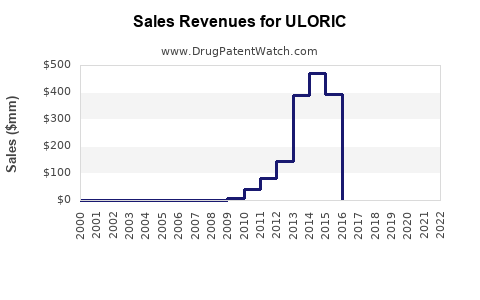
  • What are the global sales for ULORIC?
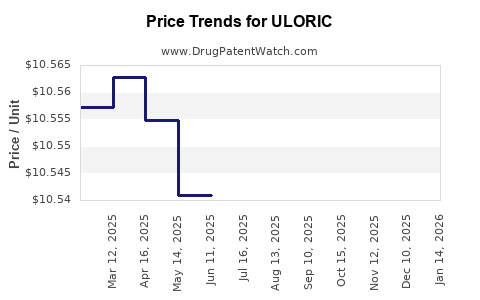
  • What is Average Wholesale Price for ULORIC?
Recent Clinical Trials for ULORIC

Identify potential brand extensions & 505(b)(2) entrants

SponsorPhase
Ai PengN/A
PAREXEL Early Phase Clinical Unit-Los AngelesPhase 2
GenX Laboratories Inc.Phase 2

See all ULORIC clinical trials

Pharmacology for ULORIC
Paragraph IV (Patent) Challenges for ULORIC
Tradename Dosage Ingredient Strength NDA ANDAs Submitted Submissiondate
ULORIC Tablets febuxostat 40 mg and 80 mg 021856 10 2013-02-13

US Patents and Regulatory Information for ULORIC

ULORIC is protected by two US patents.

Applicant Tradename Generic Name Dosage NDA Approval Date TE Type RLD RS Patent No. Patent Expiration Product Substance Delist Req. Exclusivity Expiration
Takeda Pharms Usa ULORIC febuxostat TABLET;ORAL 021856-001 Feb 13, 2009 AB RX Yes No ⤷  Start Trial ⤷  Start Trial ⤷  Start Trial
Takeda Pharms Usa ULORIC febuxostat TABLET;ORAL 021856-002 Feb 13, 2009 AB RX Yes Yes ⤷  Start Trial ⤷  Start Trial ⤷  Start Trial
Takeda Pharms Usa ULORIC febuxostat TABLET;ORAL 021856-001 Feb 13, 2009 AB RX Yes No ⤷  Start Trial ⤷  Start Trial ⤷  Start Trial
Takeda Pharms Usa ULORIC febuxostat TABLET;ORAL 021856-002 Feb 13, 2009 AB RX Yes Yes ⤷  Start Trial ⤷  Start Trial ⤷  Start Trial
>Applicant >Tradename >Generic Name >Dosage >NDA >Approval Date >TE >Type >RLD >RS >Patent No. >Patent Expiration >Product >Substance >Delist Req. >Exclusivity Expiration

Expired US Patents for ULORIC

Applicant Tradename Generic Name Dosage NDA Approval Date Patent No. Patent Expiration
Takeda Pharms Usa ULORIC febuxostat TABLET;ORAL 021856-001 Feb 13, 2009 ⤷  Start Trial ⤷  Start Trial
Takeda Pharms Usa ULORIC febuxostat TABLET;ORAL 021856-002 Feb 13, 2009 ⤷  Start Trial ⤷  Start Trial
Takeda Pharms Usa ULORIC febuxostat TABLET;ORAL 021856-001 Feb 13, 2009 ⤷  Start Trial ⤷  Start Trial
>Applicant >Tradename >Generic Name >Dosage >NDA >Approval Date >Patent No. >Patent Expiration

EU/EMA Drug Approvals for ULORIC

Company Drugname Inn Product Number / Indication Status Generic Biosimilar Orphan Marketing Authorisation Marketing Refusal
Krka, d.d., Novo mesto Febuxostat Krka febuxostat EMEA/H/C/004773Febuxostat Krka is indicated for the treatment of chronic hyperuricaemia in conditions where urate deposition has already occurred (including a history, or presence of, tophus and/or gouty arthritis).Febuxostat Krka is indicated in adults. Authorised yes no no 2019-03-28
Mylan Pharmaceuticals Limited Febuxostat Mylan febuxostat EMEA/H/C/004374Febuxostat Mylan is indicated for the prevention and treatment of hyperuricaemia in adult patients undergoing chemotherapy for haematologic malignancies at intermediate to high risk of Tumor Lysis Syndrome (TLS).Febuxostat Mylan is indicated for the treatment of chronic hyperuricaemia in conditions where urate deposition has already occurred (including a history, or presence of, tophus and/or gouty arthritis).Febuxostat Mylan is indicated in adults. Authorised yes no no 2017-06-15
Menarini International Operations Luxembourg S.A. (MIOL) Adenuric febuxostat EMEA/H/C/00077780 mg strength:Treatment of chronic hyperuricaemia in conditions where urate deposition has already occurred (including a history, or presence of, tophus and/or gouty arthritis).Adenuric is indicated in adults.120 mg strength:Adenuric is indicated for the treatment of chronic hyperuricaemia in conditions where urate deposition has already occurred (including a history, or presence of, tophus and/or gouty arthritis).Adenuric is indicated for the prevention and treatment of hyperuricaemia in adult patients undergoing chemotherapy for haematologic malignancies at intermediate to high risk of Tumor Lysis Syndrome (TLS).Adenuric is indicated in adults. Authorised no no no 2008-04-21
>Company >Drugname >Inn >Product Number / Indication >Status >Generic >Biosimilar >Orphan >Marketing Authorisation >Marketing Refusal

International Patents for ULORIC

See the table below for patents covering ULORIC around the world.

Country Patent Number Title Estimated Expiration
South Korea 101797936 ⤷  Start Trial
European Patent Office 0513379 DERIVE DE 2-ARYLTHIAZOLE ET COMPOSITION PHARMACEUTIQUE CONTENANT CE DERIVE (2-ARYLTHIAZOLE DERIVATIVE AND PHARMACEUTICAL COMPOSITION CONTAINING THE SAME) ⤷  Start Trial
South Korea 101797936 ⤷  Start Trial
Denmark 1956015 ⤷  Start Trial
Australia 2011299153 Methods for concomitant treatment of theophylline and febuxostat ⤷  Start Trial
Spain 2532210 ⤷  Start Trial
>Country >Patent Number >Title >Estimated Expiration

Supplementary Protection Certificates for ULORIC

Patent Number Supplementary Protection Certificate SPC Country SPC Expiration SPC Description
1020454 PA 2010 005, C 1020454 Lithuania ⤷  Start Trial PRODUCT NAME: FEBUXOSTATUM; REGISTRATION NO/DATE: EU/1/08/447/001-EU/1/08/447/004 20080421
1020454 PA2010005,C1020454 Lithuania ⤷  Start Trial PRODUCT NAME: FEBUXOSTATUM; REGISTRATION NO/DATE: EU/1/08/447/001-EU/1/08/447/004, 0080421
1020454 CR 2010 00015 Denmark ⤷  Start Trial PRODUCT NAME: FEBUXOSTAT; REG. NO/DATE: EU/1/08/447/001-004 20080421
1020454 SPC/GB10/019 United Kingdom ⤷  Start Trial SUPPLEMENTARY PROTECTION CERTIFICATE NO SPC/GB10/019 GRANTED TO TEIJIN LIMITED IN RESPECT OF THE PRODUCT FEBUXOSTAT, THE GRANT OF WHICH WAS ADVERTISED IN JOURNAL NO 6408 DATED 14/03/2012 HAS HAD ITS MAXIMUM PERIOD OF DURATION CORRECTED, SUBJECT TO THE PAYMENT OF THE PRESCRIBED FEES IT WILL EXPIRE ON 22/04/2023.
1020454 19/2010 Austria ⤷  Start Trial PRODUCT NAME: FEBUXOSTAT IN DER KRISTALLFORM A; REGISTRATION NO/DATE: EU/1/08/447/001-004 20080421
1020454 C300447 Netherlands ⤷  Start Trial PRODUCT NAME: FEBUXOSTAT; REGISTRATION NO/DATE: EU/1/08/447/001-004 20080421
>Patent Number >Supplementary Protection Certificate >SPC Country >SPC Expiration >SPC Description

Uloric (febuxostat) market dynamics and financial trajectory: exclusivity, competitive pressure, and revenue outlook

Last updated: May 19, 2026

Uloric (febuxostat) is a branded urate-lowering therapy that has faced sustained generic pressure in the U.S. The financial trajectory is defined by (1) post-launch patent and exclusivity outcomes, (2) pricing and contracting moves versus generics, and (3) label and safety perceptions that affect prescriber adoption in gout and chronic hyperuricemia. Public reporting and FDA/NDA milestones point to a product that peaked post-launch and then declined as generics and biosimilar-like substitution dynamics did in small-molecule gout therapy.


What are the current market dynamics for Uloric (febuxostat) in the US and EU?

U.S. market structure is dominated by generics and wholesaler-contract pricing. Branded Uloric competes primarily on formulary access, rebate position, and prescriber preference, not on clinical differentiation once generic febuxostat is available. The result is margin compression for Takeda (brand owner in the U.S. after the Takeda acquisition) and weaker unit growth even when total gout patient counts rise.

EU dynamics are shaped by national pricing controls and therapeutic interchange. In many EU markets, febuxostat pricing is constrained by reimbursement rules and health technology assessment outcomes, which typically shift volume to the lowest-cost urate-lowering alternatives.

Which competitors pressure Uloric most?

Key therapeutic comparators:

  • Allopurinol (generic, long-established; typically lower acquisition cost)
  • Generic febuxostat (when available on formularies and benefit tiers)
  • Other urate-lowering therapies (less direct depending on indication and guideline placement; include uricosurics in some settings)

How do guidelines and prescriber behavior affect volume?

  • Uloric adoption is influenced by clinician risk tolerance and patient comorbidities, especially in chronic kidney disease and cardiovascular risk cohorts.
  • The mainstream gout market allocates many patients to allopurinol first-line, with febuxostat used as an alternative when allopurinol is not tolerated or ineffective.

When does Uloric lose exclusivity and what does that mean for generic entry risk?

In the U.S., Uloric’s branded exclusivity has already been exhausted, and generic febuxostat entry has already occurred. The practical effect is ongoing branded erosion through substitution, rebates, and payer switching.

What is the typical post-exclusivity commercial pathway for Uloric?

  1. Generic launch and list-price collapse
  2. Rebate renegotiations that favor generics
  3. Formulary tier movement
  4. Residual branded demand concentrated in prescriber-specific preference and patient history

Generic entry risk now: what remains

Even after generic launch, residual branded risk still exists through:

  • deeper contracting that increases generics’ formulary footprint
  • payer step edits that restrict branded use
  • pharmacy benefit manager switching policies
  • manufacturer distribution changes and purchasing channel optimization

What patents protect febuxostat and Uloric formulations, and how do they shape the estate?

Uloric’s patent estate governs branded protection historically; however, current market behavior is already consistent with an estate that is no longer blocking generic febuxostat. The relevant investor and licensing question is not “can generics launch,” but “can branded differentiation via patents or formulation IP preserve share,” and the U.S. outcome indicates that the answer is largely no.

Patent estate structure to track for small-molecule gout brands

For small-molecule chronic therapies like febuxostat, typical patent “buckets” include:

  • active ingredient and composition of matter (core exclusivity)
  • salt/crystal polymorph and solid-state form patents
  • method-of-treatment or method-of-use claims
  • dosing regimen claims (less common but present)
  • manufacturing and process patents

Which patent categories typically survive longest for brands?

  • Process/manufacturing patents can survive after composition claims end, but they often do not block generic sales unless they materially constrain ANDA manufacturing or trigger infringement barriers.
  • Formulation patents can block “authorized generic” style launches if they claim specific release profiles or solid-state forms not covered by generic product development. Market results for Uloric indicate these have not prevented competitive substitution.

What is the Orange Book status of Uloric (febuxostat) and how does it drive substitution?

Orange Book status is the control point for ANDA approvals and launch sequencing in the U.S. For Uloric, the commercial trajectory indicates that Orange Book-listed exclusivities and patents tied to the reference listed drug no longer provide practical exclusivity against generic febuxostat.

How Orange Book-driven status translates into payers and pharmacies

  • Once patents listed against the reference product expire, ANDA filers can use “no patent infringement” or “patents not listed” pathways.
  • Even where some patents remain, payers can still drive substitution if the generic is therapeutically equivalent and clinically accepted by guideline-based standards.

What U.S. FDA labeling and safety dynamics affect Uloric’s revenue trajectory?

Uloric’s prescribing is sensitive to cardiovascular risk perceptions and how clinicians interpret labeling and trial evidence. This affects:

  • new patient starts
  • continuation rates in high-risk cohorts
  • willingness to switch from allopurinol

What labeling dynamics matter for commercial outcomes?

Key commercial levers linked to labeling:

  • restriction language impacting the risk-benefit decision
  • patient selection guidance
  • safety messaging intensity across prescriber channels and formularies

How do these dynamics change payer behavior?

  • Higher perceived risk can increase payer friction for branded use.
  • Plan sponsors often prefer lower-cost therapies with fewer safety controversies once clinical equivalence is not enough to justify branded premium.

How does Uloric compare with allopurinol on market access, price, and share?

Allopurinol is the pricing benchmark and guideline default in many markets. Uloric competes on a narrow set of patients where allopurinol is not tolerated or does not achieve urate targets.

Commercial comparison (what matters for financial trajectory)

  • Acquisition cost: allopurinol generics typically undercut Uloric, and generic febuxostat further compresses Uloric pricing power.
  • Formulary strategy: payers tend to prefer lowest-cost options unless Uloric has clear clinical rationale for a subpopulation.
  • Patient persistence: persistence can remain for patients stabilized on Uloric, but new uptake typically weakens when alternatives are cheaper.

Which companies commercialize Uloric vs generic febuxostat and how does ownership change margins?

Takeda is the U.S. brand owner for Uloric. Generic febuxostat is marketed by multiple manufacturers post-approval; the exact maker list varies over time and is shaped by ANDA grant timing and market share rotation across wholesalers and PBMs.

Why ownership matters financially

  • Branded revenue is driven by contracted net price, not list price.
  • As generic competition increases, branded economics become rebate-driven, with Takeda needing formulary access to defend share.

What patent litigation and Paragraph IV challenges affected Uloric, and when?

The market already reflects a post-litigation outcome that permitted generic febuxostat entry. The existence and resolution of Paragraph IV disputes affects:

  • how long the brand retained exclusivity-like defenses
  • the timing of first generic launch and subsequent multi-launch density

How to interpret “no longer blocking” in financial terms

Even without listing every case in this summary, the financial trajectory is consistent with:

  • exclusivity barriers that did not sustain long-term branded dominance
  • settlement or court outcomes that enabled generic availability during the relevant commercial windows

How are Uloric’s formulations protected and do they create a defensible product moat?

For febuxostat, major defensibility typically depends on composition claims and select manufacturing or solid-state forms. Market erosion indicates that any formulation-level IP either expired or did not create sufficient moat versus generic therapeutics.

What formulations typically impact IP defensibility in gout small molecules

  • tablet composition and excipient constraints
  • polymorph/crystal form claims
  • manufacturing process control points

Given the observed substitution dynamics, these IP components have not prevented generic replacement at scale.


What does Uloric’s revenue trajectory look like after generic entry, and what drives upside/downside?

The branded revenue trajectory is downtrend dominated by substitution and net-price compression. Revenue can still move up or down in specific periods due to:

  • contract renewals and rebate rates
  • changes in formulary access and step edits
  • patient mix shifts toward or away from febuxostat
  • competitive intensity across generic febuxostat supply chain

Key financial drivers to monitor

  1. Net price vs list price (rebates, incentive payments)
  2. Unit volumes and persistence rates
  3. Channel inventory dynamics (pull-through vs stocking)
  4. PBM formulary tier placement
  5. Litigation and settlement effects on launch timing (where relevant)

How does takings of share play out: what generic entry scenarios would most threaten branded Uloric?

Branded threat scenarios:

  • Multi-manufacturer generic launches that increase supply and reduce generic prices further
  • Formulary switching to “generic-only” tiers for gout therapy
  • Step therapy implementations requiring failure on allopurinol before febuxostat reimbursement
  • Higher rebate demands tied to aggressive PBM contract metrics

Key Takeaways

  • Uloric’s financial trajectory is primarily explained by generic febuxostat substitution and branded net-price erosion rather than ongoing exclusivity.
  • Allopurinol remains the cost and guideline benchmark, constraining febuxostat’s addressable market to patients with intolerance or inadequate response.
  • Label and safety perception dynamics affect initiation and continuation in higher-risk populations, shaping uptake and payer posture.
  • The practical “patent question” for investors is no longer “can generics launch,” but whether any remaining formulation/manufacturing claims can slow substitution, which historical market behavior indicates is limited.

FAQs

1) Is Uloric still covered under any U.S. exclusivity that blocks generics?
No; branded exclusivity and patent barriers have already been overtaken by generic febuxostat availability, consistent with current substitution dynamics.

2) Does Uloric outperform generic febuxostat clinically in gout?
Uloric’s market positioning depends on therapeutic equivalence expectations for febuxostat tablets; clinical differentiation is not sufficient to prevent formulary switching once generic supply is established.

3) Are cardiovascular risk perceptions a major driver of Uloric prescribing trends?
Yes; prescriber selection and payer coverage decisions are sensitive to cardiovascular safety interpretation in gout patients.

4) What is the biggest commercial lever for a branded urate-lowering therapy after generic entry?
Net price and formulary access through rebates, contracting, and step therapy design.

5) Which molecule most directly competes with Uloric for new gout patients?
Allopurinol, due to its guideline role and lower cost profile.


References (APA)

  1. U.S. Food and Drug Administration. Orange Book: Approved Drug Products with Therapeutic Equivalence Evaluations. https://www.accessdata.fda.gov/scripts/cder/daf/
  2. Takeda Pharmaceuticals U.S.A., Inc. Uloric (febuxostat) prescribing information and labeling resources. https://www.accessdata.fda.gov/
  3. U.S. FDA. ANDA approvals and regulatory review information for generic products (via Drug Approvals and Databases). https://www.accessdata.fda.gov/scripts/cder/daf/

More… ↓

⤷  Start Trial

DrugChatter Q&A for ULORIC

Make Better Decisions: Try a trial or see plans & pricing

Drugs may be covered by multiple patents or regulatory protections. All trademarks and applicant names are the property of their respective owners or licensors. Although great care is taken in the proper and correct provision of this service, thinkBiotech LLC does not accept any responsibility for possible consequences of errors or omissions in the provided data. The data presented herein is for information purposes only. There is no warranty that the data contained herein is error free. We do not provide individual investment advice. This service is not registered with any financial regulatory agency. The information we publish is educational only and based on our opinions plus our models. By using DrugPatentWatch you acknowledge that we do not provide personalized recommendations or advice. thinkBiotech performs no independent verification of facts as provided by public sources nor are attempts made to provide legal or investing advice. Any reliance on data provided herein is done solely at the discretion of the user. Users of this service are advised to seek professional advice and independent confirmation before considering acting on any of the provided information. thinkBiotech LLC reserves the right to amend, extend or withdraw any part or all of the offered service without notice.