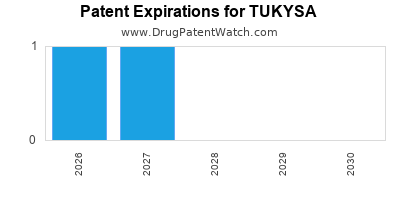
Last Updated: August 10, 2026

TUKYSA Drug Patent Profile


✉ Email this page to a colleague

« Back to Dashboard


Which patents cover Tukysa, and what generic alternatives are available?

Tukysa is a drug marketed by Seagen and is included in one NDA. There are seven patents protecting this drug.

This drug has one hundred and eighty-seven patent family members in forty-four countries.

The generic ingredient in TUKYSA is tucatinib. One supplier is listed for this compound. Additional details are available on the tucatinib profile page.

DrugPatentWatch® Generic Entry Outlook for Tukysa

Tukysa was eligible for patent challenges on April 17, 2024.

By analyzing the patents and regulatory protections it appears that the earliest date for generic entry will be January 19, 2030. This may change due to patent challenges or generic licensing.

Indicators of Generic Entry

< Available with Subscription >

  Start Trial

AI Deep Research
Questions you can ask:
  • What is the 5 year forecast for TUKYSA?
  • What are the global sales for TUKYSA?
  • What is Average Wholesale Price for TUKYSA?
Summary for TUKYSA
International Patents:187
US Patents:7
Applicants:1
NDAs:1
Finished Product Suppliers / Packagers: 1
Raw Ingredient (Bulk) Api Vendors: 59
Clinical Trials: 17
Patent Applications: 1,131
Drug Prices: Drug price information for TUKYSA
What excipients (inactive ingredients) are in TUKYSA?TUKYSA excipients list
DailyMed Link:TUKYSA at DailyMed
DrugPatentWatch® Estimated Loss of Exclusivity (LOE) Date for TUKYSA
Generic Entry Date for TUKYSA*:
Constraining patent/regulatory exclusivity:

TREATMENT OF ADULT PATIENTS WITH RAS WILD-TYPE, HER2-POSITIVE UNRESECTABLE OR METASTATIC COLORECTAL CANCER THAT HAS PROGRESSED FOLLOWING TREATMENT WITH FLUOROPYRIMIDINE-, OXALIPLATIN-, AND IRINOTECAN-BASED CHEMOTHERAPY

NDA:
Dosage:

TABLET;ORAL

*The generic entry opportunity date is the latter of the last compound-claiming patent and the last regulatory exclusivity protection. Many factors can influence early or later generic entry. This date is provided as a rough estimate of generic entry potential and should not be used as an independent source.

Recent Clinical Trials for TUKYSA

Identify potential brand extensions & 505(b)(2) entrants

SponsorPhase
RemeGen Co., Ltd.Phase 1/Phase 2
Jonathan RiessPhase 1
National Cancer Institute (NCI)Phase 1

See all TUKYSA clinical trials

US Patents and Regulatory Information for TUKYSA

TUKYSA is protected by seven US patents and three FDA Regulatory Exclusivities.

Based on analysis by DrugPatentWatch, the earliest date for a generic version of TUKYSA is ⤷  Start Trial.

This potential generic entry date is based on TREATMENT OF ADULT PATIENTS WITH RAS WILD-TYPE, HER2-POSITIVE UNRESECTABLE OR METASTATIC COLORECTAL CANCER THAT HAS PROGRESSED FOLLOWING TREATMENT WITH FLUOROPYRIMIDINE-, OXALIPLATIN-, AND IRINOTECAN-BASED CHEMOTHERAPY.

Generics may enter earlier, or later, based on new patent filings, patent extensions, patent invalidation, early generic licensing, generic entry preferences, and other factors.

Applicant Tradename Generic Name Dosage NDA Approval Date TE Type RLD RS Patent No. Patent Expiration Product Substance Delist Req. Exclusivity Expiration
Seagen TUKYSA tucatinib TABLET;ORAL 213411-001 Apr 17, 2020 RX Yes No ⤷  Start Trial ⤷  Start Trial ⤷  Start Trial
Seagen TUKYSA tucatinib TABLET;ORAL 213411-002 Apr 17, 2020 RX Yes Yes ⤷  Start Trial ⤷  Start Trial ⤷  Start Trial
Seagen TUKYSA tucatinib TABLET;ORAL 213411-001 Apr 17, 2020 RX Yes No ⤷  Start Trial ⤷  Start Trial Y Y ⤷  Start Trial
Seagen TUKYSA tucatinib TABLET;ORAL 213411-001 Apr 17, 2020 RX Yes No ⤷  Start Trial ⤷  Start Trial Y ⤷  Start Trial
>Applicant >Tradename >Generic Name >Dosage >NDA >Approval Date >TE >Type >RLD >RS >Patent No. >Patent Expiration >Product >Substance >Delist Req. >Exclusivity Expiration

EU/EMA Drug Approvals for TUKYSA

Company Drugname Inn Product Number / Indication Status Generic Biosimilar Orphan Marketing Authorisation Marketing Refusal
Seagen B.V. Tukysa tucatinib EMEA/H/C/005263Tukysa is indicated in combination with trastuzumab and capecitabine for the treatment of adult patients with HER2‑positive locally advanced or metastatic breast cancer who have received at least 2 prior anti‑HER2 treatment regimens. Authorised no no no 2021-02-11
>Company >Drugname >Inn >Product Number / Indication >Status >Generic >Biosimilar >Orphan >Marketing Authorisation >Marketing Refusal

International Patents for TUKYSA

When does loss-of-exclusivity occur for TUKYSA?

Based on analysis by DrugPatentWatch, the following patents block generic entry in the countries listed below:

Australia

Patent: 12322039
Estimated Expiration: ⤷  Start Trial

Patent: 17210499
Estimated Expiration: ⤷  Start Trial

Patent: 19200243
Estimated Expiration: ⤷  Start Trial

Brazil

Patent: 2014009092
Estimated Expiration: ⤷  Start Trial

Patent: 2020010643
Estimated Expiration: ⤷  Start Trial

Canada

Patent: 52058
Estimated Expiration: ⤷  Start Trial

Patent: 14454
Estimated Expiration: ⤷  Start Trial

Chile

Patent: 14000930
Estimated Expiration: ⤷  Start Trial

China

Patent: 3998023
Estimated Expiration: ⤷  Start Trial

Patent: 8498465
Estimated Expiration: ⤷  Start Trial

Patent: 4886853
Estimated Expiration: ⤷  Start Trial

Colombia

Patent: 60547
Estimated Expiration: ⤷  Start Trial

Costa Rica

Patent: 140228
Estimated Expiration: ⤷  Start Trial

Croatia

Patent: 0171578
Estimated Expiration: ⤷  Start Trial

Cyprus

Patent: 19837
Estimated Expiration: ⤷  Start Trial

Denmark

Patent: 65990
Estimated Expiration: ⤷  Start Trial

European Patent Office

Patent: 65990
Estimated Expiration: ⤷  Start Trial

Hungary

Patent: 35247
Estimated Expiration: ⤷  Start Trial

Israel

Patent: 2103
Estimated Expiration: ⤷  Start Trial

Japan

Patent: 44514
Estimated Expiration: ⤷  Start Trial

Patent: 14528484
Estimated Expiration: ⤷  Start Trial

Patent: 16027062
Estimated Expiration: ⤷  Start Trial

Lithuania

Patent: 65990
Estimated Expiration: ⤷  Start Trial

Malaysia

Patent: 9072
Estimated Expiration: ⤷  Start Trial

Mexico

Patent: 3970
Estimated Expiration: ⤷  Start Trial

Patent: 14004551
Estimated Expiration: ⤷  Start Trial

Montenegro

Patent: 913
Estimated Expiration: ⤷  Start Trial

New Zealand

Patent: 4942
Patent: Solid dispersions of a erb2 (her2) inhibitor
Estimated Expiration: ⤷  Start Trial

Norway

Patent: 21029
Estimated Expiration: ⤷  Start Trial

Philippines

Patent: 014500799
Patent: SOLID DISPERSIONS OF A ERB2 (HER2) INHIBITOR
Estimated Expiration: ⤷  Start Trial

Poland

Patent: 65990
Estimated Expiration: ⤷  Start Trial

Portugal

Patent: 65990
Estimated Expiration: ⤷  Start Trial

Russian Federation

Patent: 48448
Patent: ТВЕРДАЯ ДИСПЕРСИЯ (SOLID DISPERSION)
Estimated Expiration: ⤷  Start Trial

Patent: 14119283
Patent: ТВЕРДАЯ ДИСПЕРСИЯ
Estimated Expiration: ⤷  Start Trial

Patent: 18107710
Patent: ТВЕРДАЯ ДИСПЕРСИЯ
Estimated Expiration: ⤷  Start Trial

San Marino

Patent: 01700499
Estimated Expiration: ⤷  Start Trial

Serbia

Patent: 608
Patent: ČVRSTA DISPERZIJA (SOLID DISPERSION)
Estimated Expiration: ⤷  Start Trial

Singapore

Patent: 201401459Y
Patent: SOLID DISPERSIONS OF A ERB2 (HER2) INHIBITOR
Estimated Expiration: ⤷  Start Trial

Slovenia

Patent: 65990
Estimated Expiration: ⤷  Start Trial

South Africa

Patent: 1606123
Patent: PHARMACEUTICAL COMPOSITIONS OF A ERB2 (HER2) INHIBITOR
Estimated Expiration: ⤷  Start Trial

South Korea

Patent: 2000312
Estimated Expiration: ⤷  Start Trial

Patent: 140075798
Estimated Expiration: ⤷  Start Trial

Spain

Patent: 50608
Estimated Expiration: ⤷  Start Trial

Taiwan

Patent: 1330876
Patent: Solid dispersion
Estimated Expiration: ⤷  Start Trial

Patent: 1728323
Patent: Solid dispersion
Estimated Expiration: ⤷  Start Trial

Patent: 2131902
Patent: Solid dispersion
Estimated Expiration: ⤷  Start Trial

Patent: 94769
Estimated Expiration: ⤷  Start Trial

Patent: 22189
Estimated Expiration: ⤷  Start Trial

Patent: 88733
Estimated Expiration: ⤷  Start Trial

Ukraine

Patent: 1383
Patent: ТВЕРДА ДИСПЕРСІЯ (SOLID DISPERSION)
Estimated Expiration: ⤷  Start Trial

Generics may enter earlier, or later, based on new patent filings, patent extensions, patent invalidation, early generic licensing, generic entry preferences, and other factors.

See the table below for additional patents covering TUKYSA around the world.

Country Patent Number Title Estimated Expiration
Australia 2018258663 Treatment of HER2 positive cancers ⤷  Start Trial
Australia 2022241509 Treatment of HER2 positive cancers ⤷  Start Trial
Brazil 112019022280 tratamento de cânceres de her2 positivo ⤷  Start Trial
Canada 3060407 TRAITEMENT DES CANCERS POSITIFS A HER2 (TREATMENT OF HER2 POSITIVE CANCERS) ⤷  Start Trial
>Country >Patent Number >Title >Estimated Expiration

Supplementary Protection Certificates for TUKYSA

Patent Number Supplementary Protection Certificate SPC Country SPC Expiration SPC Description
1971601 C01971601/01 Switzerland ⤷  Start Trial PRODUCT NAME: TUCATINIB; REGISTRATION NO/DATE: SWISSMEDIC-ZULASSUNG 67798 07.05.2020
1971601 301113 Netherlands ⤷  Start Trial PRODUCT NAME: TUCATINIB, DESGEWENST IN DE VORM VAN EEN FARMACEUTISCH AANVAARDBAAR ZOUT OF SOLVAAT; REGISTRATION NO/DATE: 67798 20200507
1971601 CA 2021 00025 Denmark ⤷  Start Trial PRODUCT NAME: TUCATINIB, EVENTUELT I FORM AF ET FARMACEUTISK ACCEPTABELT SALT ELLER SOLVAT DERAF; NAT. REG. NO/DATE: EU/1/20/1526 20210212; FIRST REG. NO/DATE: CH 67798 20200507
1971601 LUC00217 Luxembourg ⤷  Start Trial PRODUCT NAME: TUCATINIB EVENTUELLEMENT SOUS FORME D'UN SEL OU SOLVATE PHARMACEUTIQUEMENT ACCEPTABLE; AUTHORISATION NUMBER AND DATE: EU/1/20/1526 20210212
>Patent Number >Supplementary Protection Certificate >SPC Country >SPC Expiration >SPC Description

Tukysa Market Dynamics, Financial Trajectory, Patent Exclusivity, and Generic Risk

Last updated: August 4, 2026

Tukysa, the branded name for tucatinib, became a strategic oncology asset for Seagen and Pfizer through its use in HER2-positive breast cancer and HER2-positive colorectal cancer. Product sales increased from about $70 million in 2020 to approximately $354 million in 2023. Growth has been driven by the HER2CLIMB regimen, central nervous system activity, and expansion into colorectal cancer. The principal commercial risk is competition from Enhertu, Kadcyla, Perjeta, and other HER2-directed therapies rather than immediate generic substitution.

How large is the Tukysa market?

Tukysa addresses HER2-positive cancers, a commercially important segment of oncology with established antibody, antibody-drug conjugate, and tyrosine kinase inhibitor competition.

The breast cancer indication is for Tukysa in combination with trastuzumab and capecitabine for patients with unresectable or metastatic HER2-positive breast cancer, including patients with brain metastases, after at least one prior anti-HER2-based regimen in the metastatic setting. The FDA approved this indication on April 17, 2020.[1]

The colorectal indication was approved on January 19, 2023, for adult patients with unresectable or metastatic HER2-positive colorectal cancer who have received prior chemotherapy based on fluoropyrimidine, oxaliplatin, and irinotecan, and prior anti-VEGF and anti-EGFR therapy when appropriate.[2]

What clinical attributes support Tukysa demand?

Tukysa has several commercial advantages:

  • It is an oral, selective HER2 tyrosine kinase inhibitor.
  • It has activity in patients with brain metastases, an important unmet need in HER2-positive breast cancer.
  • The HER2CLIMB regimen demonstrated an overall survival benefit in previously treated metastatic breast cancer.
  • It is used with trastuzumab and capecitabine rather than as a stand-alone treatment.
  • It offers a treatment option after disease progression on multiple HER2-directed therapies.

Its limitations include diarrhea, palmar-plantar erythrodysesthesia, nausea, hepatotoxicity, and the burden of administering a three-drug regimen. Enhertu and Kadcyla are delivered intravenously but can offer stronger positioning in earlier lines of treatment.

How have Tukysa sales changed over time?

Seagen reported rapid sales growth after launch. The product benefited from its initial breast cancer approval and the expanded colorectal indication.

Fiscal year Tukysa net product sales Approximate year-over-year change Primary commercial driver
2020 $70 million New launch Initial metastatic breast cancer uptake
2021 $212 million 203% HER2CLIMB adoption and broader physician use
2022 $304 million 43% Continued breast cancer expansion
2023 $354 million 16% Mature breast cancer demand and colorectal launch

Sources: Seagen annual reports and Form 10-K filings.[3-6]

The trajectory shows a transition from launch-stage growth to a more mature branded oncology product. The 2023 growth rate was lower than in the first two full commercial years, which indicates a larger revenue base and increasing competitive pressure. The colorectal indication added market reach but has a narrower eligible population and later-line positioning than the breast cancer indication.

What is Tukysa’s revenue exposure for Pfizer?

Pfizer acquired Seagen in March 2024 in a transaction valued at approximately $43 billion.[7] Tukysa became part of Pfizer’s Global Oncology portfolio, alongside established products and pipeline programs in breast, prostate, hematologic, and other cancers.

Tukysa is strategically relevant because it provides:

  1. A commercial product with recurring oncology revenue.
  2. An oral HER2 therapy with central nervous system positioning.
  3. Combination potential with other HER2-directed medicines.
  4. A platform for additional tumor-specific or sequencing strategies.

The principal financial exposure is concentrated in HER2-positive breast cancer. The colorectal indication is commercially useful but is unlikely by itself to offset major erosion in breast cancer if newer antibody-drug conjugates displace Tukysa in treatment sequencing.

How does Tukysa compare with competing HER2 drugs?

Tukysa competes within a treatment landscape that includes antibody-drug conjugates, monoclonal antibodies, and oral kinase inhibitors.

Product Active ingredient Company Modality Main competitive position
Tukysa Tucatinib Pfizer Oral HER2 TKI Later-line breast cancer, brain metastases, colorectal cancer
Enhertu Trastuzumab deruxtecan Daiichi Sankyo/AstraZeneca Antibody-drug conjugate Broad HER2-positive and HER2-low breast cancer use
Kadcyla Ado-trastuzumab emtansine Roche Antibody-drug conjugate Adjuvant and metastatic HER2-positive breast cancer
Perjeta Pertuzumab Roche Monoclonal antibody Earlier-line combination treatment
Nerlynx Neratinib Puma Biotechnology Pan-HER TKI Extended adjuvant breast cancer and later-line use
Tykerb Lapatinib GSK HER2/EGFR TKI Older later-line breast cancer regimen
Margenza Margetuximab MacroGenics Monoclonal antibody Later-line HER2-positive breast cancer

Enhertu is the most important competitive threat. Its efficacy and expanding use across HER2 expression levels can move patients earlier in the treatment pathway, reducing the population reaching Tukysa. Tukysa retains a distinct position in patients with brain metastases and in combination regimens supported by HER2CLIMB data.

What is the FDA regulatory status of Tukysa?

The FDA approved Tukysa under the traditional approval pathway for metastatic HER2-positive breast cancer in 2020.[1] The colorectal indication was approved in 2023 based on the MOUNTAINEER study.[2]

Regulatory milestone Date
FDA approval for HER2-positive metastatic breast cancer April 17, 2020
FDA approval for HER2-positive metastatic colorectal cancer January 19, 2023
Seagen acquired by Pfizer March 2024

The label requires monitoring of liver function and management of diarrhea. Tucatinib is metabolized primarily through CYP2C8 and CYP3A pathways, creating drug-interaction considerations. Its adverse-event profile and oral administration affect prescribing decisions, particularly when compared with intravenous antibody-drug conjugates.

What patents protect Tukysa?

Tukysa’s U.S. intellectual-property position includes composition, pharmaceutical formulation, and method-of-use protection. The core compound is associated with U.S. Patent No. 10,272,083, assigned to Seagen-related entities and originating from the tucatinib development program.[8]

The relevant patent categories are:

Composition-of-matter patents

Composition patents protect tucatinib and related chemical compounds. These patents generally provide the strongest protection because a competing product cannot lawfully market the same active ingredient before expiration unless it successfully challenges the patent or obtains a license.

Formulation patents

Formulation protection can cover pharmaceutical compositions, dosage forms, excipients, and stability characteristics. Formulation patents are less comprehensive than composition patents because a generic applicant may attempt to design around them while preserving the same active ingredient.

Method-of-use patents

Method patents can cover use of tucatinib in HER2-positive breast cancer, colorectal cancer, brain metastases, treatment combinations, or particular patient populations. Their value depends on whether the patented use is commercially important and whether the prescribing and reimbursement environment makes induced infringement litigation practical.

The FDA Orange Book is the controlling public source for listed patents and their use codes. The commercial patent horizon extends into the early 2030s based on the listed core-patent estate, subject to patent-term adjustment, patent-term extension, pediatric exclusivity, and the scope of any later-issued patents.[9]

When does Tukysa lose exclusivity?

Tukysa’s five-year new chemical entity exclusivity began on the April 17, 2020 approval date and generally prevented the filing of an abbreviated new drug application until April 2024.[1,10]

That regulatory exclusivity does not itself determine the earliest commercial generic entry date. Patent challenges, litigation, settlement agreements, court rulings, and any 180-day first-filer exclusivity can materially change the timing.

Exclusivity element Indicative timing or status
Five-year new chemical entity exclusivity April 17, 2020 to April 17, 2025
Earliest standard ANDA filing window April 17, 2024
Core patent horizon Early 2030s, based on listed patent protection
Generic launch before patent expiry Possible only through challenge, settlement, license, or successful design-around
Biosimilar pathway Not applicable because tucatinib is a small molecule

The colorectal approval may provide separate regulatory protection only to the extent that FDA grants a qualifying period of new clinical investigation exclusivity for the relevant supplemental application. Such protection is indication-specific and does not necessarily block generic entry for all approved uses.

Are generic companies challenging Tukysa?

As of June 2024, no publicly reported Paragraph IV litigation or major ANDA challenge had established a generic entry date for tucatinib. The absence of a public challenge does not eliminate future risk. Once the NCE filing bar expired in April 2024, ANDA activity became more plausible.

A generic applicant would likely evaluate:

  • The validity and enforceability of the composition patent.
  • Whether listed method-of-use patents can be carved out.
  • The commercial value of the breast cancer and colorectal indications.
  • The ability to design around formulation claims.
  • The risk of a launch before patent expiry.
  • The potential for a settlement with Pfizer.

The strongest barrier is likely the composition-of-matter estate. Method-of-use patents may influence the timing and scope of a launch but generally provide narrower protection.

What patent litigation and settlement risks affect Tukysa?

No significant publicly reported Tukysa patent settlement had been announced through June 2024. A future Paragraph IV dispute could involve:

  1. Invalidity challenges based on obviousness, anticipation, written description, or enablement.
  2. Non-infringement arguments directed to specific formulation or use claims.
  3. Carve-out labeling for unpatented indications.
  4. A negotiated entry date before the latest patent expiry.
  5. Authorized-generic or licensing provisions.

For Pfizer, the commercial value of settlement depends on the size of Tukysa revenue at the time of challenge. For a generic company, the expected value depends on whether the market supports a launch before the early-2030s patent horizon.

How strong is the Tukysa patent estate?

Tukysa has a commercially meaningful patent estate, but its strength is uneven across claim types.

Protection type Relative strength Commercial implication
Tucatinib composition High Main barrier to substitutable generic entry
Tablet and formulation claims Medium May support litigation but can be vulnerable to design-around strategies
Breast cancer methods Medium to high Important where the labeled regimen is widely prescribed
Colorectal cancer methods Medium Narrower population and later approval reduce stand-alone value
CNS or biomarker-specific methods Variable Value depends on claim scope and clinical adoption

The estate is stronger than a product protected only by method patents, but it is not immune to invalidity attacks. Revenue concentration in one therapeutic class also creates competitive risk that patent protection cannot solve.

What licensing deals shaped Tukysa development?

Tucatinib was developed through the Cascadian Therapeutics program. Seattle Genetics acquired Cascadian in 2018 for approximately $614 million, gaining control of tucatinib and related development assets.[11]

Seagen later became the commercial sponsor and secured the FDA approvals. Pfizer’s 2024 acquisition of Seagen transferred the Tukysa commercial and intellectual-property position to Pfizer.

The transaction history indicates that tucatinib was acquired before approval, with much of its value realized through clinical development, regulatory approval, and commercial launch rather than through a post-approval licensing arrangement.

What generic launch scenarios exist for Tukysa?

Three scenarios are commercially relevant.

Scenario 1: Patent-protected launch after the early 2030s

This is the base case if Pfizer maintains the core patent estate and no successful Paragraph IV challenge accelerates entry.

Scenario 2: Earlier entry through Paragraph IV litigation

A first-filing generic could challenge composition or formulation patents. A successful invalidity or non-infringement ruling could produce entry years before the nominal patent expiry.

Scenario 3: Negotiated settlement

Pfizer could permit entry on an agreed date in exchange for a release of patent claims. Settlement terms could include a licensed generic, restrictions on launch timing, or limitations tied to particular indications.

The economic impact of generic entry would likely be rapid because oral oncology products can face substantial price erosion once multiple ANDA-approved competitors enter.

Key Takeaways

  • Tukysa sales rose from approximately $70 million in 2020 to $354 million in 2023.
  • Pfizer acquired Tukysa through its $43 billion acquisition of Seagen in March 2024.
  • The product’s core commercial differentiation is activity in HER2-positive disease involving the brain.
  • Enhertu is the most significant competitive threat because of its expanding efficacy and earlier-line use.
  • Tucatinib’s five-year NCE exclusivity began in April 2020, with the ANDA filing bar ending in April 2024.
  • The core patent estate extends into the early 2030s based on publicly listed protection.
  • No major public Paragraph IV litigation or settlement had established a generic launch date through June 2024.
  • Tukysa is a small molecule, so biosimilar competition is not relevant.
  • Future erosion risk depends more on Enhertu displacement and treatment sequencing than on immediate generic entry.

FAQs About Tukysa Market and Patent Risk

What is Tukysa used for?

Tukysa is used with trastuzumab and capecitabine for certain patients with unresectable or metastatic HER2-positive breast cancer and HER2-positive metastatic colorectal cancer.

Is Tukysa a biologic or a small molecule?

Tukysa contains tucatinib, an orally administered small-molecule tyrosine kinase inhibitor. Generic, rather than biosimilar, competition is the relevant substitution risk.

Does Tukysa work against brain metastases?

Yes. Tucatinib has clinical evidence in patients with HER2-positive breast cancer and brain metastases, which is a central part of its market positioning.

Who owns Tukysa?

Pfizer owns Tukysa following its acquisition of Seagen in March 2024. Seagen previously acquired Cascadian Therapeutics, the company developing tucatinib, in 2018.

When could a generic version of Tukysa launch?

A generic could potentially launch before the early-2030s patent horizon if a Paragraph IV challenge succeeds or Pfizer reaches a settlement permitting earlier entry. Without an accelerated entry agreement or court victory, patent protection remains the main barrier.

References

  1. U.S. Food and Drug Administration. (2020, April 17). FDA approves tucatinib with trastuzumab and capecitabine for unresectable advanced or metastatic HER2-positive breast cancer. https://www.fda.gov

  2. U.S. Food and Drug Administration. (2023, January 19). FDA grants accelerated approval to tucatinib with trastuzumab for colorectal cancer. https://www.fda.gov

  3. Seagen Inc. (2021). 2020 annual report and Form 10-K. U.S. Securities and Exchange Commission. https://www.sec.gov

  4. Seagen Inc. (2022). 2021 annual report and Form 10-K. U.S. Securities and Exchange Commission. https://www.sec.gov

  5. Seagen Inc. (2023). 2022 annual report and Form 10-K. U.S. Securities and Exchange Commission. https://www.sec.gov

  6. Seagen Inc. (2024). 2023 annual report and Form 10-K. U.S. Securities and Exchange Commission. https://www.sec.gov

  7. Pfizer Inc. (2023). Pfizer completes acquisition of Seagen. https://www.pfizer.com

  8. U.S. Patent and Trademark Office. (n.d.). U.S. Patent No. 10,272,083. https://patents.google.com

  9. U.S. Food and Drug Administration. (n.d.). Approved drug products with therapeutic equivalence evaluations: Orange Book. https://www.accessdata.fda.gov/scripts/cder/ob/

  10. U.S. Food and Drug Administration. (n.d.). Approved drug product exclusivity information. https://www.fda.gov

  11. Seattle Genetics, Inc. (2018). Seattle Genetics to acquire Cascadian Therapeutics. https://www.sec.gov

More… ↓

⤷  Start Trial

Make Better Decisions: Try a trial or see plans & pricing

Drugs may be covered by multiple patents or regulatory protections. All trademarks and applicant names are the property of their respective owners or licensors. Although great care is taken in the proper and correct provision of this service, thinkBiotech LLC does not accept any responsibility for possible consequences of errors or omissions in the provided data. The data presented herein is for information purposes only. There is no warranty that the data contained herein is error free. We do not provide individual investment advice. This service is not registered with any financial regulatory agency. The information we publish is educational only and based on our opinions plus our models. By using DrugPatentWatch you acknowledge that we do not provide personalized recommendations or advice. thinkBiotech performs no independent verification of facts as provided by public sources nor are attempts made to provide legal or investing advice. Any reliance on data provided herein is done solely at the discretion of the user. Users of this service are advised to seek professional advice and independent confirmation before considering acting on any of the provided information. thinkBiotech LLC reserves the right to amend, extend or withdraw any part or all of the offered service without notice.