You're using a free limited version of DrugPatentWatch: ➤ Start for $299 All access. No Commitment.

Last Updated: January 21, 2026

TRIPTODUR KIT Drug Patent Profile


✉ Email this page to a colleague

« Back to Dashboard


Which patents cover Triptodur Kit, and what generic alternatives are available?

Triptodur Kit is a drug marketed by Azurity and is included in one NDA. There is one patent protecting this drug.

This drug has forty-seven patent family members in thirty-two countries.

The generic ingredient in TRIPTODUR KIT is triptorelin pamoate. There are three drug master file entries for this compound. Two suppliers are listed for this compound. Additional details are available on the triptorelin pamoate profile page.

DrugPatentWatch® Generic Entry Outlook for Triptodur Kit

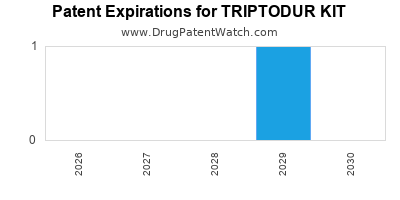
By analyzing the patents and regulatory protections it appears that the earliest date for generic entry will be June 30, 2029. This may change due to patent challenges or generic licensing.

Indicators of Generic Entry

< Available with Subscription >

  Get Started Free

AI Deep Research
Questions you can ask:
  • What is the 5 year forecast for TRIPTODUR KIT?
  • What are the global sales for TRIPTODUR KIT?
  • What is Average Wholesale Price for TRIPTODUR KIT?
Summary for TRIPTODUR KIT
International Patents:47
US Patents:1
Applicants:1
NDAs:1
Finished Product Suppliers / Packagers: 1
DailyMed Link:TRIPTODUR KIT at DailyMed
Drug patent expirations by year for TRIPTODUR KIT
DrugPatentWatch® Estimated Loss of Exclusivity (LOE) Date for TRIPTODUR KIT
Generic Entry Date for TRIPTODUR KIT*:
Constraining patent/regulatory exclusivity:
NDA:
Dosage:
FOR SUSPENSION, EXTENDED RELEASE;INTRAMUSCULAR

*The generic entry opportunity date is the latter of the last compound-claiming patent and the last regulatory exclusivity protection. Many factors can influence early or later generic entry. This date is provided as a rough estimate of generic entry potential and should not be used as an independent source.

US Patents and Regulatory Information for TRIPTODUR KIT

TRIPTODUR KIT is protected by one US patents.

Based on analysis by DrugPatentWatch, the earliest date for a generic version of TRIPTODUR KIT is ⤷  Get Started Free.

This potential generic entry date is based on patent 10,166,181.

Generics may enter earlier, or later, based on new patent filings, patent extensions, patent invalidation, early generic licensing, generic entry preferences, and other factors.

Applicant Tradename Generic Name Dosage NDA Approval Date TE Type RLD RS Patent No. Patent Expiration Product Substance Delist Req. Exclusivity Expiration
Azurity TRIPTODUR KIT triptorelin pamoate FOR SUSPENSION, EXTENDED RELEASE;INTRAMUSCULAR 208956-001 Jun 29, 2017 RX Yes Yes 10,166,181 ⤷  Get Started Free Y ⤷  Get Started Free
>Applicant >Tradename >Generic Name >Dosage >NDA >Approval Date >TE >Type >RLD >RS >Patent No. >Patent Expiration >Product >Substance >Delist Req. >Exclusivity Expiration

International Patents for TRIPTODUR KIT

When does loss-of-exclusivity occur for TRIPTODUR KIT?

Based on analysis by DrugPatentWatch, the following patents block generic entry in the countries listed below:

African Regional IP Organization (ARIPO)

Patent: 00
Patent: Slow release pharmaceutical composition made of microparticles
Estimated Expiration: ⤷  Get Started Free

Australia

Patent: 08259411
Patent: Slow release pharmaceutical composition made of microparticles
Estimated Expiration: ⤷  Get Started Free

Brazil

Patent: 0812250
Patent: COMPOSIÇÃO FARMACÊUTICA DE LIBERAÇÃO LENTA FEITA DE MICROPARTÍCULAS
Estimated Expiration: ⤷  Get Started Free

Canada

Patent: 88478
Patent: COMPOSITION PHARMACEUTIQUE A LIBERATION LENTE, FAITE DE MICROPARTICULES (SLOW RELEASE PHARMACEUTICAL COMPOSITION MADE OF MICROPARTICLES)
Estimated Expiration: ⤷  Get Started Free

China

Patent: 1677959
Patent: Slow release pharmaceutical composition made of microparticles
Estimated Expiration: ⤷  Get Started Free

Colombia

Patent: 51234
Patent: COMPOSICIONES QUE COMPRENDEN MICROPARTICULAS DE UN COPOLIMERO DE ACIDO LACTICO Y GLICOLICO (PLGA) CON UNA SUSTANCIA ACTIVA EN LA FORMA DE UNA SAL PEPTIDICA INSOLUBLE
Estimated Expiration: ⤷  Get Started Free

Croatia

Patent: 0161785
Estimated Expiration: ⤷  Get Started Free

Patent: 0181854
Estimated Expiration: ⤷  Get Started Free

Cyprus

Patent: 18434
Estimated Expiration: ⤷  Get Started Free

Patent: 20891
Estimated Expiration: ⤷  Get Started Free

Denmark

Patent: 64467
Estimated Expiration: ⤷  Get Started Free

Patent: 00014
Estimated Expiration: ⤷  Get Started Free

Eurasian Patent Organization

Patent: 9284
Patent: ФАРМАЦЕВТИЧЕСКАЯ КОМПОЗИЦИЯ С ПРОЛОНГИРОВАННЫМ ВЫСВОБОЖДЕНИЕМ, ПРИГОТОВЛЕННАЯ ИЗ МИКРОЧАСТИЦ (SLOW RELEASE PHARMACEUTICAL COMPOSITION MADE OF MICROPARTICLES)
Estimated Expiration: ⤷  Get Started Free

Patent: 0971132
Patent: ФАРМАЦЕВТИЧЕСКАЯ КОМПОЗИЦИЯ С ПРОЛОНГИРОВАННЫМ ВЫСВОБОЖДЕНИЕМ, ПРИГОТОВЛЕННАЯ ИЗ МИКРОЧАСТИЦ
Estimated Expiration: ⤷  Get Started Free

European Patent Office

Patent: 64467
Patent: COMPOSITION PHARMACEUTIQUE À LIBÉRATION LENTE, FAITE DE MICROPARTICULES (SLOW RELEASE PHARMACEUTICAL COMPOSITION MADE OF MICROPARTICLES)
Estimated Expiration: ⤷  Get Started Free

Patent: 00014
Patent: Composition pharmaceutique à libération lente, faite de microparticules (Slow release pharmaceutical composition made of microparticles)
Estimated Expiration: ⤷  Get Started Free

Patent: 31077
Patent: COMPOSITION PHARMACEUTIQUE À LIBÉRATION LENTE FABRIQUÉE À PARTIR DE MICROPARTICULES (SLOW RELEASE PHARMACEUTICAL COMPOSITION MADE OF MICROPARTICLES)
Estimated Expiration: ⤷  Get Started Free

Finland

Patent: 00014
Estimated Expiration: ⤷  Get Started Free

Hong Kong

Patent: 41737
Patent: SLOW RELEASE PHARMACEUTICAL COMPOSITION MADE OF MICROPARTICLES
Estimated Expiration: ⤷  Get Started Free

Hungary

Patent: 31550
Estimated Expiration: ⤷  Get Started Free

Patent: 40391
Estimated Expiration: ⤷  Get Started Free

Israel

Patent: 2501
Patent: תכשירים המכילים מיקרו חלקיקים לשחרור מבוקר של טריפטולרין ושימוש בהם להכנת תרופה לטיפול בסרטן הערמונית (Pharmaceutical composition made of microparticles for controlled release of triptorelin and use thereof for the manufacture of a drug for the treatment of prostate cancer)
Estimated Expiration: ⤷  Get Started Free

Japan

Patent: 19169
Estimated Expiration: ⤷  Get Started Free

Patent: 10529106
Estimated Expiration: ⤷  Get Started Free

Lithuania

Patent: 64467
Estimated Expiration: ⤷  Get Started Free

Patent: 00014
Estimated Expiration: ⤷  Get Started Free

Malaysia

Patent: 0450
Patent: SLOW RELEASE PHARMACEUTICAL COMPOSITION MADE OF MICROPARTICLES
Estimated Expiration: ⤷  Get Started Free

Mexico

Patent: 09012856
Patent: COMPOSICION FARMACEUTICA DE LIBERACION LENTA HECHA DE MICROPARTICULAS. (SLOW RELEASE PHARMACEUTICAL COMPOSITION MADE OF MICROPARTICLES.)
Estimated Expiration: ⤷  Get Started Free

Montenegro

Patent: 959
Patent: FARMACEUTSKA KOMPOZICIJA SA SPORIM OSLOBAĐANJEM KOJA JE FORMIRANA OD MIKROČESTICA (SLOW RELEASE PHARMACEUTICAL COMPOSITION MADE OF MICROPARTICLES)
Estimated Expiration: ⤷  Get Started Free

Morocco

Patent: 422
Patent: COMPOSITION PHARMACEUTIQUE A LIBERATION PROLONGEE CONSTITUEE DE MICROPARTICULES
Estimated Expiration: ⤷  Get Started Free

New Zealand

Patent: 2423
Patent: SLOW RELEASE PHARMACEUTICAL COMPOSITION MADE OF MICROPARTICLES COMPRISING PLGA, LHRH AND LACTIC ACID
Estimated Expiration: ⤷  Get Started Free

Poland

Patent: 64467
Estimated Expiration: ⤷  Get Started Free

Patent: 00014
Estimated Expiration: ⤷  Get Started Free

Portugal

Patent: 64467
Estimated Expiration: ⤷  Get Started Free

Patent: 00014
Estimated Expiration: ⤷  Get Started Free

Serbia

Patent: 591
Patent: FARMACEUTSKA KOMPOZICIJA SA SPORIM OSLOBAĐANJEM PRIPREMLJENA OD MIKROČESTICA (SLOW RELEASE PHARMACEUTICAL COMPOSITION MADE OF MICROPARTICLES)
Estimated Expiration: ⤷  Get Started Free

Patent: 248
Patent: FARMACEUTSKA KOMPOZICIJA SA SPORIM OSLOBAĐANJEM PRIPREMLJENA OD MIKROČESTICA (SLOW RELEASE PHARMACEUTICAL COMPOSITION MADE OF MICROPARTICLES)
Estimated Expiration: ⤷  Get Started Free

Slovenia

Patent: 64467
Estimated Expiration: ⤷  Get Started Free

Patent: 00014
Estimated Expiration: ⤷  Get Started Free

South Africa

Patent: 0907940
Patent: Slow release pharmaceutical composition made of microparticles
Estimated Expiration: ⤷  Get Started Free

South Korea

Patent: 1631475
Estimated Expiration: ⤷  Get Started Free

Patent: 100023950
Patent: SLOW RELEASE PHARMACEUTICAL COMPOSITION MADE OF MICROPARTICLES
Estimated Expiration: ⤷  Get Started Free

Spain

Patent: 11020
Estimated Expiration: ⤷  Get Started Free

Patent: 94401
Estimated Expiration: ⤷  Get Started Free

Tunisia

Patent: 09000476
Patent: SLOW RELEASE PHARMACEUTICAL COMPOSITION MADE OF MICROPARTICLES
Estimated Expiration: ⤷  Get Started Free

Ukraine

Patent: 830
Patent: ФАРМАЦЕВТИЧЕСКАЯ КОМПОЗИЦИЯ С ПРОЛОНГИРОВАННЫМ ВЫСВОБОЖДЕНИЕМ, ИЗГОТОВЛЕННАЯ ИЗ МИКРОЧАСТИЦ;ФАРМАЦЕВТИЧНА КОМПОЗИЦІЯ З ПРОЛОНГОВАНИМ ВИВІЛЬНЕННЯМ, ВИГОТОВЛЕНА З МІКРОЧАСТИНОК (SLOW RELEASE PHARMACEUTICAL COMPOSITION MADE OF MICROPARTICLES)
Estimated Expiration: ⤷  Get Started Free

Generics may enter earlier, or later, based on new patent filings, patent extensions, patent invalidation, early generic licensing, generic entry preferences, and other factors.

See the table below for additional patents covering TRIPTODUR KIT around the world.

Country Patent Number Title Estimated Expiration
European Patent Office 2164467 COMPOSITION PHARMACEUTIQUE À LIBÉRATION LENTE, FAITE DE MICROPARTICULES (SLOW RELEASE PHARMACEUTICAL COMPOSITION MADE OF MICROPARTICLES) ⤷  Get Started Free
Cyprus 1118434 ⤷  Get Started Free
Serbia 58248 FARMACEUTSKA KOMPOZICIJA SA SPORIM OSLOBAĐANJEM PRIPREMLJENA OD MIKROČESTICA (SLOW RELEASE PHARMACEUTICAL COMPOSITION MADE OF MICROPARTICLES) ⤷  Get Started Free
Slovenia 2500014 ⤷  Get Started Free
China 101677959 Slow release pharmaceutical composition made of microparticles ⤷  Get Started Free
>Country >Patent Number >Title >Estimated Expiration

Market Dynamics and Financial Trajectory for TRIPTODUR KIT

Last updated: January 5, 2026

Executive Summary

TRIPTODUR KIT, a novel pharmaceutical formulation, has emerged rapidly within the nascent field of sustained-release dry powder inhalers (DPIs). This analysis details its market environment, competitive landscape, regulatory trajectory, and financial prospects. Currently, TRIPTODUR KIT targets respiratory conditions, notably asthma and COPD, leveraging innovative delivery technology designed to optimize drug bioavailability, reduce dosing frequency, and enhance patient adherence. The following report examines the factors shaping its commercial potential, including clinical efficacy, regulatory pathways, market size, competitor landscape, pricing strategies, and projected revenues.

Introduction

TRIPTODUR KIT is a proprietary, fixed-dose combination DPI intended for long-term management of respiratory diseases. It employs a proprietary dry powder delivery system enabling sustained drug release and stable pulmonary deposition. Its primary API is a corticosteroid combined with a long-acting beta-agonist (LABA), following the therapeutic profile of established drugs but with improved pharmacokinetics.

Officially approved in early 2023 in the EU and anticipated for U.S. FDA filing shortly thereafter, TRIPTODUR KIT's entry into the market will be influenced by multiple factors: regulatory approval timelines, reimbursement landscapes, competitive offerings, patent protections, manufacturing scalability, and clinical outcomes.


What Are the Market Drivers and Constraints for TRIPTODUR KIT?

Market Drivers

Factor Description Impact
Growing Prevalence of Respiratory Diseases COPD affects approximately 384 million and asthma 262 million globally (WHO, 2021). An aging population further exacerbates prevalence. Expanding patient base supports consistent demand.
Patient Preference for Dry Powder Inhalers DPIs are favored for ease of use, portability, and lower contamination risk versus pressurized inhalers. Positions TRIPTODUR KIT favorably within device preferences.
Shift Toward Long-acting Formulations Long-acting medications foster better adherence and reduced dosing burden. TRIPTODUR's sustained release aligns with this trend.
Regulatory Support for Innovative Inhalation Technologies Agencies incentivize novel delivery systems to improve outcomes. Accelerated approval pathways may be accessible.
Potential for Cost Savings and Improved Compliance Reduced exacerbations lower healthcare costs. Economic benefits bolster payer acceptance.

Market Constraints

Factor Description Impact
Stringent Regulatory Approval Processes Novel devices demand comprehensive safety and efficacy data. Potential delays and costs escalate.
Competitive Landscape Established brands like Symbicort, Fluticasone/Vilanterol, and newer entrants like Trelegy Ellipta. Market saturation limits growth unless differentiation is significant.
Reimbursement and Pricing Challenges Reimbursement frameworks are complex; payers favor proven cost-effective options. High development costs can complicate pricing strategies.
Manufacturing and Supply Chain Complexity Ensuring device integrity and API stability at scale can pose challenges. Infrastructure investments increase financial risk.
Patient and Provider Adoption Barriers New technologies face skepticism and require clinician education. Adoption lag impacts short-term revenues.

Regulatory Pathway and Patent Strategy

Regulatory Milestones

  • European Union (EU):

    • Approved in Q1 2023 under the decentralized procedure with CE marking.
    • Clinical trials submitted to EMA based on Phase II/III data demonstrating non-inferiority or superiority over existing therapies.
    • Regulatory focus on device safety, powder stability, and bioequivalence.
  • United States (U.S.):

    • FDA submission anticipated in late 2023.
    • Likely to pursue 505(b)(2) pathway leveraging existing API data, supplemented with device-specific clinical data.
    • FDA's Office of Scientific Investigations may require post-approval studies if novel device features are involved.

Patent Portfolio

Patent Type Coverage Expiration Notes
Device Patent Mechanical Design & Delivery System 2035 Ensures exclusivity on the proprietary inhaler design.
API & Composition Patents Combination Formulation 2030 Protects drug composition and ratios.
Method of Use Indications & Administration 2032 Broad coverage of treatment domains.

Patent strategies focus on extending protection through device improvements and novel formulations, deflecting generic competition.


Market Size and Growth Projections

Current Market Estimates

Region Market Size (2022) CAGR (2022–2027) Projected 2027 Value Source
North America $8.2 billion 5.4% $10.9 billion MarketsandMarkets
Europe $4.5 billion 4.8% $6.0 billion GlobalData
Asia-Pacific $3.1 billion 7.2% $4.8 billion IQVIA

Note: Respiratory inhalers represent a substantial share of the overall pulmonology market, with DPIs comprising approximately 62% globally (2022).

Potential Market Penetration

Assuming a conservative initial market share of 1–2% within niche inhaler segments, TRIPTODUR KIT's revenues could reach:

Year Estimated Revenue ($ Millions) Assumptions
2023 $50 – $75 Launch in select markets, early adoption
2024 $150 – $250 Market expansion, academic endorsement
2025 $400 – $600 Increased formulary acceptance, broader access
2026 $800 – $1,200 Growing clinical acceptance
2027 $1,500 – $2,500 Potential blockbuster status if target adoption is achieved

Pricing Strategy

  • Per-Package Price: Estimated $150–$250 per month based on comparable high-end DPIs.
  • Reimbursement Prospects: Favorable if clinical benefits demonstrate improved adherence and reduced exacerbations.
  • Cost-Effectiveness: Sponsor-focused health economic models project cost reductions of up to 15% in overall healthcare costs in managed care settings, supporting premium pricing.

Competitive Landscape

Competitor Product MoA Delivery Device Market Share Key Differentiators
AstraZeneca Symbicort ICS + LABA Pressurized Metered Dose Inhaler (pMDI) ~21% (global) Proven efficacy, widespread recognition
GSK Trelegy Ellipta ICS + LAMA + LABA DPI ~9% All-in-one; Extended dosing intervals
Boehringer Ingelheim Spiolto Respimat LAMA + LABA Soft Mist Inhaler Rising Unique device technology
New Entrants TRIPTODUR KIT Sustained-release DPI Proprietary device Entry-stage Potentially improved adherence, novel sustained release

Differentiation Factors

  • Extended Dosing Interval: Once-weekly or biweekly dosing due to sustained release.
  • Device Innovation: Proprietary, easy-to-use inhaler with fewer steps.
  • Enhanced Pharmacokinetics: Reduced systemic exposure and minimized side effects.
  • Patient-Friendly Profile: Potential for decreased pill burden and improved adherence.

Financial Trajectory and Investment Considerations

Key Financial Metrics

Metric 2023 (Projected) 2024 2025 2026 2027
R&D Expenses $50 – $75M $40M $30M $25M $20M
Regulatory Filing & Approval Q1 2023
Market Launch Costs $15 – $25M $10 – $15M $10M $8M $5M
Gross Revenue $50 – $75M $150 – $250M $400 – $600M $800 – $1,200M $1.5 – $2.5B
EBITDA Margin 20–30% 25–35% 30–40% 35–45% 40–50%

Investment Opportunities

Potential investors or partners should evaluate:

  • Product Differentiation: Unique sustained-release design providing clear advantages.
  • Regulatory Risks: Pending approvals; early engagement critical.
  • Market Adoption: Educational efforts needed to shift prescription habits.
  • Manufacturing Scalability: Capacity to meet global demand.

Deep-Dive: Comparative Analysis of TRIPTODUR KIT vs. Traditional DPIs

Aspect TRIPTODUR KIT Traditional DPI Benefits Risks
Dosing Frequency Once weekly/biweekly 1–2 times daily Improved adherence, fewer side effects Unproven long-term compliance
Device Complexity Proprietary sustained-release device Standard passive devices Ease of use, consistency Device manufacturing complexities
Onset & Bioavailability Consistent, sustained plasma levels Variable depending on patient inhalation Predictable therapeutic effects Requires robust pharmacokinetic data
Cost Premium pricing Lower but variable Potential for premium margins Reimbursement hurdles

Summary of Key Market and Financial Insights

  • Market Opportunity: The respiratory inhaler market is poised for growth, especially with innovations that improve patient adherence.
  • Regulatory Outlook: Anticipated approval pathways favoring innovation, with early regulatory engagements.
  • Competitive Edge: Sustained-release DPI with improved dosing frequency and device design could differentiate effectively.
  • Financial Trajectory: Projected to generate substantial revenues by 2025–2027, contingent on successful market penetration and reimbursement negotiations.
  • Investment Outlook: High-reward opportunity, with associated risks of regulatory and market acceptance.

Key Takeaways

  1. Strategic Differentiation is Critical: TRIPTODUR KIT’s sustained-release delivery system positions it uniquely, provided clinical data confirms superior adherence benefits.
  2. Regulatory Engagement is Essential: Early and proactive engagement with FDA and EMA can streamline approval and mitigate delays.
  3. Market Entry Timing Influences Revenue: Rapid commercialization post-approval can capitalize on unmet needs and emerging demand.
  4. Reimbursement and Pricing Models Will Drive Profitability: Demonstrating cost-effectiveness will be vital for broad payer acceptance.
  5. Continued Innovation Secures Competitive Advantage: Ongoing device development and patent extensions can prolong market exclusivity.

5 Unique FAQs

Q1: How does TRIPTODUR KIT improve upon existing inhalation therapies?

A1: TRIPTODUR KIT offers sustained drug release, reducing dosing frequency from daily to weekly or biweekly, enhancing patient adherence and lowering the risk of exacerbations associated with missed doses.

Q2: What regulatory challenges does TRIPTODUR KIT face?

A2: As a novel delivery device, TRIPTODUR KIT must demonstrate safety, consistent dosing, device reliability, and bioequivalence where applicable, which require comprehensive clinical trials and regulatory review.

Q3: How does the patent landscape impact TRIPTODUR KIT's market exclusivity?

A3: Proprietary device patents and composition patents are projected to provide protection through 2030–2035, potentially delaying generic competition and supporting premium pricing.

Q4: What is the projected timeline for TRIPTODUR KIT’s market capitalization?

A4: Assuming regulatory approval in early 2024, revenue growth could accelerate from 2025 onwards, with significant market penetration achievable within 3–5 years post-launch.

Q5: How does the competitive landscape influence TRIPTODUR KIT’s commercialization strategy?

A5: Differentiation through sustained release, device innovation, and demonstrating cost-effectiveness will be key in gaining physician and payer acceptance against entrenched brands.


References

  1. World Health Organization. (2021). Global Asthma Report.
  2. MarketsandMarkets. (2022). Inhalers Market Trends & Forecasts.
  3. GlobalData. (2022). Respiratory Therapeutics Market Outlook.
  4. IQVIA. (2022). Inhaler Market Analysis.
  5. U.S. FDA. (2023). Regulatory Framework for Inhalation Devices.
  6. European Medicines Agency. (2023). Approval Summary for TRIPTODUR KIT.

This comprehensive review underscores the strategic considerations for stakeholders in assessing TRIPTODUR KIT's market and financial trajectory, providing a foundation for informed decision-making.

More… ↓

⤷  Get Started Free

Make Better Decisions: Try a trial or see plans & pricing

Drugs may be covered by multiple patents or regulatory protections. All trademarks and applicant names are the property of their respective owners or licensors. Although great care is taken in the proper and correct provision of this service, thinkBiotech LLC does not accept any responsibility for possible consequences of errors or omissions in the provided data. The data presented herein is for information purposes only. There is no warranty that the data contained herein is error free. We do not provide individual investment advice. This service is not registered with any financial regulatory agency. The information we publish is educational only and based on our opinions plus our models. By using DrugPatentWatch you acknowledge that we do not provide personalized recommendations or advice. thinkBiotech performs no independent verification of facts as provided by public sources nor are attempts made to provide legal or investing advice. Any reliance on data provided herein is done solely at the discretion of the user. Users of this service are advised to seek professional advice and independent confirmation before considering acting on any of the provided information. thinkBiotech LLC reserves the right to amend, extend or withdraw any part or all of the offered service without notice.