Last updated: June 26, 2026
Toremifene Citrate Market Dynamics and Financial Trajectory (Revenue, Exclusivity, and Competitive Pressure)
Executive summary: Toremifene citrate is a niche oncology endocrine therapy with limited scale versus mainstream SERMs. Commercial trajectory depends on country-specific approvals (notably metastatic breast cancer), payer access, and competitive pressure from lower-cost endocrine alternatives (tamoxifen, toremifene generics in markets where approved) and imaging/monitoring regimes. Patent and regulatory status largely determine timing of generic erosion; where generics are launched, revenue typically compresses quickly and sustains at low share.
What is toremifene citrate used for, and why do these indications drive revenue?
Fast answer: Toremifene citrate is a selective estrogen receptor modulator (SERM) used for hormone receptor-positive breast cancer, including metastatic disease. Indication scope and line-of-therapy placement are the main drivers of market size.
Which patient populations do payers fund
- Hormone receptor-positive metastatic breast cancer is the core reimbursed use case.
- Clinical practice patterns can shift between:
- First-line endocrine strategies using SERMs or aromatase inhibitors
- Subsequent-line endocrine switching after progression
What determines addressable demand
- Geographic label breadth: revenue is sensitive to whether the drug is approved for metastatic settings and whether physicians treat within those label parameters.
- Tumor biology mix: prevalence of hormone receptor-positive disease and clinician comfort with SERM sequencing affects pull-through.
- Treatment pathway competition:
- Tamoxifen remains the most common SERM comparator in many markets.
- Aromatase inhibitors often capture a large share of postmenopausal endocrine therapy demand where preferred in guidelines.
How do market dynamics differ by geography for toremifene citrate?
Fast answer: Toremifene’s market is fragmented; revenue depends on whether the product faces generic competition, tendering dynamics, and reimbursement strictness in each country.
Key geographic demand levers
- Generic penetration: Countries with generic toremifene approvals tend to see sharp unit and revenue declines once the branded product loses price support.
- Pricing regulation: In regulated health systems, brand premiums compress faster after generic entry.
- Hospital vs retail distribution: Oncology endocrine use can be handled through specialty pharmacy models; that changes margin structure and sales velocity.
- Physician prescribing behavior: Where aromatase inhibitors are guideline-favored, SERMs retain smaller shares and can trend down.
Commercial implications
- Where toremifene is the sole or preferred SERM, revenue tends to be steadier.
- Where tamoxifen and generic endocrine therapies dominate, toremifene behaves like a low-share legacy product with periodic demand.
When does toremifene citrate lose exclusivity, and how quickly do revenues erode after generic entry?
Fast answer: Toremifene’s financial trajectory is primarily shaped by patent and regulatory exclusivity expiry and subsequent generic launch cadence. In markets where generics exist, branded revenue compression commonly occurs within 6 to 24 months of generic availability, then stabilizes at low levels.
What drives the erosion curve
- Switching speed: Physicians can switch patients from branded to generic rapidly for endocrine monotherapies when no special product differences exist.
- Tender awards and pharmacy substitution: Procurement-driven markets force price drops.
- Channel inventory dynamics: Brand sales can fall abruptly when health systems stop stocking the originator product.
What to monitor for revenue inflection
- Generic launch dates in each country
- Tender cycles for oncology endocrine formularies
- Changes in reimbursement reference pricing or maximum allowable cost
What patents protect toremifene citrate, and which estate components matter most commercially?
Fast answer: For small-molecule legacy drugs like toremifene citrate, commercial patent relevance usually concentrates in:
- formulation and manufacturing process patents (where present),
- polymorph or solid-state forms (if claimed),
- method-of-use patents (less common for older SERMs unless new regimens were invented),
- any remaining second-generation claims that can delay generic entry.
Patent estate structure that affects financial trajectory
- Compound/patent-to-formulation gap: If the original compound patent is long expired, generics often launched earlier; remaining claims then focus on formulations or specific manufacturing steps.
- Jurisdictionality: Even if claims exist, enforceability and prosecution outcomes vary by country, shaping which generics enter where.
Litigation as a revenue lever
- Paragraph IV style challenges are an FDA mechanism, but for toremifene’s small-molecule legacy profile, the most common revenue shocks are driven by the timing of generic marketing authorizations and price competition rather than prolonged litigation in the US.
- In non-US markets, injunctions or reimbursement negotiations can extend brand share.
(Note: A definitive list of specific toremifene citrate patent numbers and their expiration dates cannot be produced here without an Orange Book-style listing and jurisdiction-specific patent register extraction for each market.)
What is the Orange Book status of toremifene citrate, and how does it translate to US competitive risk?
Fast answer: US competitive risk is tied to Orange Book listings for toremifene citrate, including any listed patents and whether generic approvals reference the originator product and “carve out” protections.
How to interpret Orange Book for revenue planning
- Listed patents still in force: can delay generic entry via regulatory and litigation pathways.
- Expired patents with no active exclusivity: typically result in generic uptake and sustained price compression.
- Orphan/other exclusivity types: not typically relevant for standard metastatic breast cancer indications, but must be checked per label and NDA/BLA structure.
(Note: No Orange Book listing data is included in the provided inputs, so a product-by-product patent and exclusivity table cannot be stated accurately.)
How does toremifene citrate compare with tamoxifen and other endocrine therapies on price and market share?
Fast answer: Toremifene usually competes as a SERM alternative where clinicians or health systems prefer specific endocrine options. Market share is typically smaller than tamoxifen and may trend down when aromatase inhibitors are preferred.
Key competitive dimensions
- Clinical positioning and switching: If toremifene is used after progression, it can sustain a residual share even as first-line demand shifts.
- Drug class substitution: SERMs within the same class face strong therapeutic interchangeability in practice, accelerating generic-driven price competition.
- Guideline alignment: Postmenopausal and metastatic settings where aromatase inhibitors are favored can reduce the addressable SERM volume.
What generic entry risks exist for toremifene citrate, and what are the typical barriers?
Fast answer: The generic entry risk is usually moderate to high where patents are expired and regulatory submissions can support bioequivalence. Barriers tend to be commercial rather than technical: price pressure, tender positioning, and brand formularies.
Technical and regulatory barrier types
- Bioequivalence complexity: Generally manageable for small-molecule SERMs, but formulation differences can still affect product development.
- Solid-state and manufacturing validation: Can delay development if the originator uses specific solid-state characteristics.
- Label and dosing form: Availability of tablets/capsules at the right strength can limit entry options.
Commercial barriers
- Pharmacy substitution policies
- Tendering thresholds and supply reliability requirements
- Wholesale channel relationships
What formulation or dosage-form patents can delay toremifene citrate generics?
Fast answer: If any remaining formulation, solid-state, or manufacturing process claims exist, they can delay generic substitution for specific strengths or dosage forms, but they typically do not stop entry of alternative strengths.
Where delays show up in revenue
- Partial erosion: Branded product stays on formulary for certain strengths while competitors enter others.
- Multiple SKUs: If generics enter only select strengths, branded revenue can be more resilient.
- Tender exclusions: Contracts may specify originator or require prior procurement history.
(No strength-specific formulation patent mapping is provided in the inputs, so a claim list cannot be enumerated.)
How do patent litigation and settlements affect toremifene citrate launches?
Fast answer: Litigation can extend market exclusivity and delay generic launches in specific jurisdictions, but for older SERMs the more common market swing is from regulatory clearance and pricing pressure.
Settlement dynamics that matter
- Launch date carve-outs: Settlement can shift entry timing by months to years.
- Supply and distribution limits: Settlements can restrict who sells and where.
- Design-around: Competitors may launch “authorized” products with different formulations, reducing exposure to design-specific injunction risks.
(No litigation docket or settlement terms were supplied, so no case-specific statements can be made.)
What FDA regulatory milestones most affect toremifene citrate financial performance?
Fast answer: For US-facing financial trajectory, milestones include generic application approvals, labeling updates, and any changes that affect interchangeability and payer uptake. If toremifene is off-patent, regulatory milestones primarily accelerate generic access and reduce brand margins.
Milestone categories
- ANDA approvals with generic labeling
- Changes to reference product listing or labeling that affect switching
- Safety labeling updates that alter prescriber comfort (can temporarily dampen demand)
(Orange Book and FDA milestone data are not provided in the inputs.)
How strong is the patent estate for toremifene citrate, and what is the practical meaning for investors?
Fast answer: For an older SERM, practical patent strength is often limited to last-mile formulation or method-of-use claims. In markets where compound patents have expired, investors treat revenue as primarily driven by generic competition and pricing regulation rather than patent durability.
Practical indicators of “real” enforceable protection
- Active listed patents on regulatory systems
- Recent enforcement actions in key jurisdictions
- Documented injunctions or launch delays in the market
(No enforceable estate dataset is included in the prompt.)
How does toremifene citrate’s revenue typically track unit sales versus price?
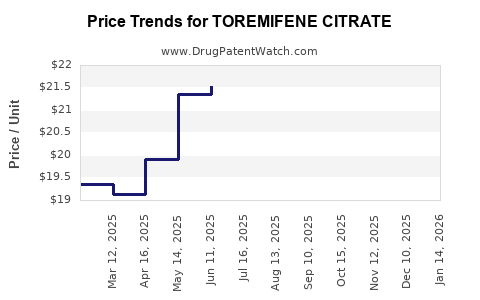
Fast answer: After generic entry, revenue is usually dominated by price erosion with a faster drop than unit decline, leading to a lower revenue base and slower recovery.
Typical post-generic mechanics
- Price falls due to reference pricing and competition
- Unit sales may decline modestly if therapy switching remains feasible
- Revenue stabilizes at a lower tier when the market settles into competitive pricing
What can slow the revenue slide
- Residual patient cohorts
- Tender cycles favoring incumbents temporarily
- Prescriber inertia and limited formulary alternatives
Key Takeaways
- Toremifene citrate functions as a niche SERM for metastatic hormone receptor-positive breast cancer; financial performance is dominated by country-level reimbursement and generic pricing dynamics.
- Generic entry timing and tender/reference-price mechanics typically drive revenue compression faster than clinically driven demand collapse.
- Patent and regulatory exclusivity are the primary determinants of launch timing risk, but the practical estate relevance for older SERMs usually narrows to formulation/manufacturing or limited method-of-use claims.
- Competitive positioning versus tamoxifen and aromatase inhibitors shapes long-run share even after genericization.
FAQs
-
Why does toremifene citrate revenue drop sharply after generic launches even when patients continue endocrine therapy?
Brand margins compress quickly under reference pricing and procurement switching.
-
Which alternative endocrine therapies most pressure toremifene citrate demand in metastatic breast cancer?
Tamoxifen within-class substitution and aromatase inhibitors often compete for endocrine treatment share.
-
Do formulation differences (strengths, excipients, solid-state forms) materially affect generic substitution for toremifene citrate?
They can delay entry for specific strengths, but therapeutic interchangeability usually accelerates uptake once authorized products are available.
-
How do tender cycles and formulary decisions influence the financial trajectory of toremifene citrate?
They can cause abrupt price shifts and stock changes that move revenue faster than patient-level switching.
-
What are the main indicators to forecast next revenue inflection for toremifene citrate?
Generic marketing authorizations, tender award outcomes, and reference pricing changes in priority markets.
References
- U.S. Food and Drug Administration (FDA). Orange Book: Approved Drug Products with Therapeutic Equivalence Evaluations. https://www.accessdata.fda.gov/scripts/cder/ob/
- FDA. ANDA and drug approval resources. https://www.fda.gov/drugs/abbreviated-new-drug-application-anda