Last updated: September 28, 2026
TOBRADEX ST is a mature Alcon ophthalmic antibiotic-steroid product containing tobramycin 0.3% and dexamethasone 0.05%. Its commercial position rests on formulation differentiation, physician familiarity, and Alcon’s ophthalmology distribution network rather than on a high-growth market. Public filings do not disclose standalone TOBRADEX ST revenue, so the product’s financial trajectory must be assessed through market structure, competitive substitution, regulatory status, and Alcon’s broader Vision Care performance.
What is TOBRADEX ST and how does it compare with TOBRADEX?
TOBRADEX ST is a sterile ophthalmic suspension indicated for steroid-responsive inflammatory ocular conditions in which a bacterial infection or risk of infection exists. It combines tobramycin, an aminoglycoside antibiotic, with dexamethasone, a corticosteroid.
TOBRADEX ST differs from conventional TOBRADEX in dexamethasone concentration and formulation characteristics.
| Product |
Active ingredients |
Dosage form |
Key formulation distinction |
Commercial sponsor |
| TOBRADEX ST |
Tobramycin 0.3% and dexamethasone 0.05% |
Ophthalmic suspension |
Viscosity-enhanced suspension using xanthan gum |
Alcon |
| TOBRADEX suspension |
Tobramycin 0.3% and dexamethasone 0.1% |
Ophthalmic suspension |
Conventional suspension |
Alcon and authorized/generic suppliers |
| TOBRADEX ointment |
Tobramycin 0.3% and dexamethasone 0.1% |
Ophthalmic ointment |
Ointment delivery system |
Alcon and generic suppliers |
| Zylet |
Tobramycin 0.3% and loteprednol etabonate 0.5% |
Ophthalmic suspension or gel |
Different corticosteroid and formulation |
Bausch + Lomb |
| Maxitrol |
Neomycin, polymyxin B, and dexamethasone |
Suspension or ointment |
Three-drug antibiotic-steroid combination |
Generic and branded suppliers |
The lower dexamethasone concentration and increased viscosity are important commercial differentiators. The product label states that the formulation is designed to increase ocular surface residence time compared with a conventional suspension [1].
What is the FDA regulatory status of TOBRADEX ST?
TOBRADEX ST is an FDA-approved prescription ophthalmic drug marketed under NDA 021532. The product received U.S. approval in 2008, according to FDA product information and labeling records [1][2].
The approved indication is treatment of inflammatory ocular conditions responsive to corticosteroids where superficial bacterial infection or the risk of bacterial infection exists.
Key regulatory characteristics include:
| Regulatory attribute |
TOBRADEX ST status |
| FDA pathway |
New Drug Application |
| NDA |
021532 |
| Dosage form |
Sterile ophthalmic suspension |
| Active ingredients |
Tobramycin and dexamethasone |
| Prescription status |
Prescription only |
| Pediatric status |
Labeling includes pediatric use limitations and safety considerations |
| Drug class |
Ophthalmic antibiotic-corticosteroid combination |
| Regulatory sponsor |
Alcon Laboratories, Inc. |
| Biosimilar pathway |
Not applicable |
The product carries corticosteroid-related warnings involving elevated intraocular pressure, glaucoma, cataract formation, delayed healing, and secondary infection. Labeling recommends ophthalmic examination when treatment extends beyond 10 days because of the risk of steroid-induced intraocular pressure elevation [1].
When does TOBRADEX ST lose exclusivity?
TOBRADEX ST lost the commercial protection associated with new chemical entity exclusivity long ago. Its present commercial protection depends primarily on formulation and product-specific patent rights, if any remain enforceable, rather than on FDA marketing exclusivity.
The relevant distinction is between:
- Regulatory exclusivity, which is time-limited under the Federal Food, Drug, and Cosmetic Act.
- Patent protection, which may cover formulation, manufacturing, or use.
- Substitutability, which depends on whether a generic is therapeutically and pharmaceutically equivalent to the specific listed product.
The conventional TOBRADEX formulation has long faced generic competition. Generic tobramycin-dexamethasone products generally contain 0.3% tobramycin and 0.1% dexamethasone, while TOBRADEX ST contains 0.05% dexamethasone and a viscosity-enhancing formulation. This difference limits automatic substitution between generic conventional TOBRADEX and TOBRADEX ST.
The commercial result is partial protection rather than full exclusivity. Physicians can prescribe lower-cost generic antibiotic-steroid products, but those products do not necessarily replicate the exact TOBRADEX ST formulation.
What patents protect TOBRADEX ST?
The principal potential protection for TOBRADEX ST is formulation-related. The product’s commercial differentiation includes its xanthan-gum-based viscosity system, particle suspension characteristics, and the combination of tobramycin with a lower concentration of dexamethasone.
Public product information does not establish a currently active, broad patent monopoly that blocks all tobramycin-dexamethasone ophthalmic products. Conventional generic products demonstrate that the underlying active ingredients are not exclusive.
| Potential protection category |
Relevance to TOBRADEX ST |
Competitive effect |
| Active ingredients |
Tobramycin and dexamethasone are established compounds |
Low protection |
| Combination therapy |
Antibiotic-corticosteroid combination |
Limited because similar combinations are generic |
| Dexamethasone concentration |
0.05% concentration differentiates ST from conventional products |
Moderate formulation differentiation |
| Viscosity-enhancing vehicle |
Xanthan-gum-based suspension system |
Potentially stronger product-specific protection |
| Ophthalmic suspension manufacturing |
Particle size, uniformity, sterility, and redispersibility |
Manufacturing barrier, but not necessarily market exclusivity |
| Method of treatment |
Use in inflammatory conditions with bacterial infection risk |
Narrow clinical protection |
| Packaging and device |
Sterile dropper container |
Usually limited patent value |
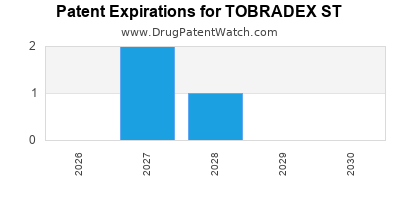
A definitive current patent-expiration table requires a live review of FDA Orange Book listings and the USPTO patent register. Public sources reviewed through June 2024 do not show a major, widely reported Paragraph IV litigation campaign against TOBRADEX ST comparable with litigation involving high-revenue branded drugs.
What is the Orange Book status of TOBRADEX ST?
TOBRADEX ST is associated with FDA’s prescription-drug approval system and an NDA-based product record. Orange Book analysis should distinguish the exact listed drug from other tobramycin-dexamethasone products.
A generic manufacturer seeking an ANDA for exact TOBRADEX ST substitution would need to address the reference product’s active ingredients, strength, dosage form, inactive ingredients where relevant, pharmaceutical equivalence, bioequivalence, and any listed patents. A generic conventional tobramycin-dexamethasone product does not automatically become therapeutically equivalent to TOBRADEX ST solely because it contains the same active ingredients.
The most important practical issue is whether an ANDA applicant can demonstrate equivalence to the ST formulation without infringing any listed formulation patents. If a patent is listed, the applicant could file a Paragraph IV certification, potentially triggering litigation under the Hatch-Waxman framework.
Which companies are challenging TOBRADEX ST?
No major publicly reported Paragraph IV challenge or active federal patent case directed specifically at TOBRADEX ST had been identified through June 2024 in the principal public regulatory and litigation sources.
Competitive pressure comes primarily from products that do not need to challenge TOBRADEX ST directly:
- Generic tobramycin-dexamethasone suspension.
- Generic tobramycin-dexamethasone ointment.
- Maxitrol and generic neomycin-polymyxin B-dexamethasone products.
- Zylet and other loteprednol-based antibiotic-steroid products.
- Standalone ophthalmic antibiotics and corticosteroids.
- Postoperative ophthalmic regimens using fluoroquinolones and steroid products prescribed separately.
This distinction matters. A product can lose market share without a direct patent challenge if physicians prescribe a therapeutically acceptable, lower-cost alternative.
What formulations are protected by TOBRADEX ST?
TOBRADEX ST’s strongest commercial differentiation is its formulation rather than its pharmacologic ingredients.
The product is a suspension containing xanthan gum, which increases viscosity and may extend contact time on the ocular surface. The formulation must maintain sterility, dose uniformity, particle dispersion, acceptable drop size, and physical stability throughout shelf life.
These technical requirements create several manufacturing barriers:
- Sterile ophthalmic production capability.
- Control of suspended-particle size and distribution.
- Reliable redispersion after storage.
- Consistent viscosity across batches.
- Container-closure integrity.
- Preservative performance.
- Stability testing under ophthalmic regulatory standards.
- Demonstration of equivalent drug delivery for an ANDA product.
These barriers can delay generic entry, but they do not provide the same protection as a long-lived composition-of-matter patent. Formulation complexity is a relative barrier and can be overcome by a capable generic manufacturer.
How strong is the TOBRADEX ST patent estate?
The patent estate is best characterized as moderate for formulation differentiation and weak for molecule-level exclusivity.
| Patent-estate dimension |
Assessment |
| Active-ingredient protection |
Weak or expired |
| Combination-product protection |
Limited |
| Formulation protection |
Potentially meaningful |
| Method-of-use protection |
Narrow and clinically difficult to enforce broadly |
| Manufacturing protection |
Moderate operational barrier |
| Generic substitution barrier |
Moderate |
| Long-term exclusivity strength |
Low to moderate |
| Litigation deterrence |
No evidence of broad, high-value litigation through June 2024 |
TOBRADEX ST does not have the profile of a protected specialty medicine with a broad patent thicket. Its defense is more likely to involve formulation-specific development costs, brand preference, formulary positioning, and prescriber familiarity.
What is the market size and competitive landscape for TOBRADEX ST?
TOBRADEX ST operates in the ophthalmic anti-infective and anti-inflammatory market. The segment is mature and fragmented. Demand comes from ophthalmologists, optometrists, cataract surgeons, corneal specialists, and general eye-care providers.
Common use settings include:
- Postoperative inflammation with infection risk.
- Blepharitis-associated inflammation.
- Superficial bacterial infection with steroid-responsive inflammation.
- External ocular inflammation.
- Short-duration treatment where combined therapy is clinically preferred.
The product competes against both combination products and separate antibiotic-plus-steroid prescriptions. Its main economic challenge is that many patients can be treated with low-cost generics, while the clinical value of the viscosity-enhanced formulation may not be sufficient to justify a large price premium in every payer channel.
Alcon’s distribution and sales infrastructure provide an advantage in ophthalmology. Alcon is a major global eye-care company with Surgical and Vision Care businesses, but its public filings do not separately report TOBRADEX ST sales [3]. The company reports at segment and franchise levels rather than by individual mature prescription brand.
What is the financial trajectory of TOBRADEX ST?
TOBRADEX ST is likely a mature, cash-generative product with limited unit growth and declining or stable real revenue depending on pricing, formulary access, and generic substitution. Standalone revenue, gross margin, prescription volume, and geographic sales are not publicly disclosed.
The financial trajectory can be assessed through four drivers:
| Driver |
Effect on TOBRADEX ST |
| Generic competition |
Reduces price and limits volume growth |
| Formulation differentiation |
Supports branded retention and potential premium pricing |
| Ophthalmic surgery volume |
Supports demand in postoperative settings |
| Alcon commercial reach |
Supports continued prescribing and distribution |
A likely lifecycle pattern is:
| Period |
Commercial condition |
| 2008 to early post-launch period |
Adoption based on formulation differentiation and Alcon promotion |
| Mature branded period |
Stable physician awareness and use in selected ophthalmic indications |
| Generic pressure period |
Price competition from conventional tobramycin-dexamethasone products |
| Current stage |
Niche branded product with value concentrated in formulation preference and channel execution |
Alcon’s overall financial performance is not a reliable proxy for TOBRADEX ST. The company’s largest revenue drivers include contact lenses, surgical equipment, intraocular lenses, and newer ophthalmic products. TOBRADEX ST is unlikely to be financially material at consolidated-company scale, although it can remain strategically useful as part of a broader ophthalmic prescription portfolio.
What revenue exposure does TOBRADEX ST create for Alcon?
TOBRADEX ST creates limited direct revenue exposure but broader portfolio value for Alcon.
The product contributes through:
- Prescription revenue in ophthalmic anti-infective therapy.
- Physician and pharmacy relationships.
- Postoperative-care product positioning.
- Cross-selling within Alcon’s ophthalmology portfolio.
- Retention of brand presence in eye-care practices.
The main downside exposure is generic substitution. Because the active ingredients are established and inexpensive, payers and pharmacies can move patients toward generic products when clinical circumstances permit.
The brand’s revenue sensitivity is therefore greater to prescription mix and reimbursement than to changes in the underlying incidence of ocular inflammation. Volume can remain stable while net revenue declines if discounts, rebates, and generic competition increase.
What patent litigation affects TOBRADEX ST?
No significant publicly reported patent litigation involving TOBRADEX ST was identified through June 2024. The absence of high-profile litigation suggests that the product has not generated the same level of ANDA-driven legal conflict as blockbuster oral drugs or biologics.
Potential litigation issues would include:
- Whether an ANDA formulation infringes a listed vehicle or viscosity patent.
- Whether the proposed generic is therapeutically equivalent.
- Whether the generic can use the same dexamethasone strength.
- Whether a formulation patent is valid and enforceable.
- Whether a product-specific patent remains listed in the Orange Book.
- Whether a settlement would delay generic launch.
The more likely risk is ordinary market erosion from non-equivalent but clinically substitutable products rather than a single litigation event.
What generic launch risks exist for TOBRADEX ST?
Generic launch risk is real but uneven.
A direct generic equivalent to TOBRADEX ST would create the greatest price and volume pressure. A generic conventional tobramycin-dexamethasone product creates a different risk because it may substitute clinically without being pharmaceutically identical.
The principal scenarios are:
| Generic scenario |
Timing risk |
Expected commercial effect |
| No direct ST-equivalent ANDA |
Low immediate disruption |
Brand retains formulation niche |
| Direct ANDA approved without litigation delay |
High |
Rapid price erosion and pharmacy substitution |
| Paragraph IV challenge with litigation |
Delayed and uncertain |
Alcon may preserve time but incur legal cost |
| Conventional generic substitution |
Ongoing |
Gradual volume and net-price erosion |
| New branded antibiotic-steroid competitor |
Moderate |
Prescriber-share pressure |
| Separate antibiotic and steroid therapy |
Ongoing |
Limits combination-product demand |
The absence of a direct generic does not eliminate risk. Payers may prefer inexpensive alternatives, and clinicians may prescribe generic conventional products for patients who do not require the specific ST formulation.
How does TOBRADEX ST compare with competing ophthalmic products?
| Product |
Main differentiation |
Generic pressure |
Commercial position |
| TOBRADEX ST |
Viscosity-enhanced tobramycin-dexamethasone suspension |
Moderate |
Branded formulation niche |
| Generic tobramycin-dexamethasone |
Low cost and broad availability |
High |
Main price competitor |
| Zylet |
Loteprednol steroid profile with tobramycin |
Moderate |
Differentiated branded alternative |
| Maxitrol |
Three-drug antibiotic-steroid combination |
High |
Low-cost alternative |
| Prednisolone plus antibiotic |
Flexible prescribing |
High |
Common low-cost strategy |
| Fluoroquinolone plus steroid |
Broad postoperative use |
Moderate to high |
Strong surgical-market competitor |
TOBRADEX ST’s competitive advantage is strongest when physicians value the product’s formulation, dosing convenience, or established use pattern. Its advantage is weakest when treatment decisions are driven mainly by acquisition cost.
What licensing deals involve TOBRADEX ST?
No material standalone licensing transaction for TOBRADEX ST was publicly disclosed through June 2024. The product is associated with Alcon’s ophthalmic portfolio, and its commercial history reflects Alcon’s branded eye-care operations rather than a publicly reported external licensing arrangement.
Alcon became an independent eye-care company after the 2019 completion of its spinoff from Novartis. That corporate transaction affected ownership and reporting structure but did not represent a TOBRADEX ST-specific licensing deal [4].
What is the geographic coverage of TOBRADEX ST?
TOBRADEX ST is primarily relevant to markets where Alcon has regulatory approvals and ophthalmic commercial infrastructure. Product names, strengths, labeling, patent rights, and generic availability vary by jurisdiction.
The United States is the most important market for Orange Book and Paragraph IV analysis. Outside the U.S., relevant issues include:
- National marketing authorizations.
- Local reference-product rules.
- Regional patent expiry.
- Hospital tendering.
- Reimbursement controls.
- Parallel trade.
- Local generic registration.
- Country-specific ophthalmic manufacturing requirements.
U.S. patent status cannot be extrapolated directly to Europe, Canada, Japan, or emerging markets.
Key Takeaways
- TOBRADEX ST is an Alcon prescription ophthalmic suspension containing tobramycin 0.3% and dexamethasone 0.05%.
- Its commercial differentiation comes from the viscosity-enhanced xanthan-gum formulation, not from novel active ingredients.
- Conventional tobramycin-dexamethasone generics create ongoing substitution and pricing pressure.
- Public filings do not disclose standalone TOBRADEX ST revenue or profit.
- The product is mature and likely contributes modest revenue relative to Alcon’s overall business.
- No major publicly reported Paragraph IV litigation targeting TOBRADEX ST was identified through June 2024.
- Direct generic-equivalence risk is lower than ordinary substitution risk only if the ST-specific formulation remains difficult or unattractive to replicate.
- The patent estate is best viewed as formulation-focused, with low molecule-level strength and moderate manufacturing complexity.
- Biosimilar risk does not apply because TOBRADEX ST is a small-molecule ophthalmic combination product.
- Long-term commercial value depends on prescriber preference, payer coverage, Alcon’s distribution, and the absence of a direct equivalent generic.
FAQs About TOBRADEX ST Market and Exclusivity
Is TOBRADEX ST the same as generic tobramycin-dexamethasone?
No. Generic tobramycin-dexamethasone products commonly contain 0.3% tobramycin and 0.1% dexamethasone, while TOBRADEX ST contains 0.05% dexamethasone and a viscosity-enhancing suspension formulation.
Can pharmacies automatically substitute generic TOBRADEX for TOBRADEX ST?
Not necessarily. Automatic substitution depends on FDA therapeutic-equivalence ratings and the exact reference product. A generic conventional suspension is not automatically equivalent to the ST formulation.
Does TOBRADEX ST have biosimilar competition?
No. Biosimilars apply to biological products. TOBRADEX ST is a small-molecule ophthalmic combination product, so any competitive entry would occur through generic-drug or alternative branded-product pathways.
Is TOBRADEX ST still commercially important to Alcon?
It is strategically relevant within Alcon’s ophthalmic prescription portfolio but is unlikely to be material to Alcon’s consolidated revenue. Alcon does not publicly report TOBRADEX ST sales separately.
What is the biggest long-term threat to TOBRADEX ST revenue?
The largest threat is cumulative substitution by low-cost generic antibiotic-steroid products, not necessarily a single patent case. A direct generic equivalent to the ST formulation would create the sharpest revenue risk.
References
-
U.S. Food and Drug Administration. (2023). TOBRADEX ST (tobramycin and dexamethasone ophthalmic suspension) prescribing information. https://www.accessdata.fda.gov
-
U.S. Food and Drug Administration. (2024). Drugs@FDA: TOBRADEX ST, NDA 021532. https://www.accessdata.fda.gov/scripts/cder/daf/
-
Alcon Inc. (2024). 2023 annual report. https://investor.alcon.com
-
Alcon Inc. (2019). Alcon completes separation from Novartis and begins trading as independent company. https://investor.alcon.com