Last Updated: May 11, 2026

TOBRADEX Drug Patent Profile


✉ Email this page to a colleague

« Back to Dashboard


Which patents cover Tobradex, and what generic alternatives are available?

Tobradex is a drug marketed by Novartis, Sandoz, and Harrow Eye. and is included in three NDAs. There are three patents protecting this drug.

The generic ingredient in TOBRADEX is dexamethasone; tobramycin. There are thirty-nine drug master file entries for this compound. Fifteen suppliers are listed for this compound. Additional details are available on the dexamethasone; tobramycin profile page.

DrugPatentWatch® Generic Entry Outlook for Tobradex

Indicators of Generic Entry

< Available with Subscription >

  Start Trial

AI Deep Research
Questions you can ask:
  • What is the 5 year forecast for TOBRADEX?
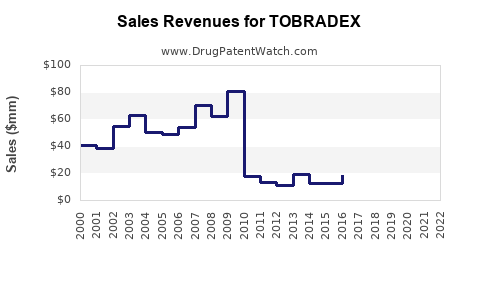
  • What are the global sales for TOBRADEX?
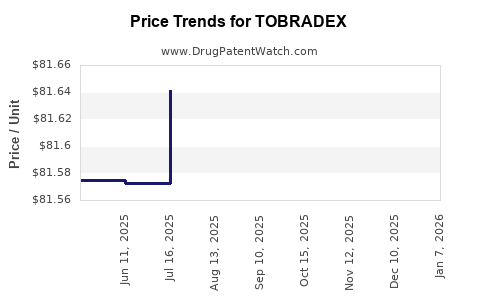
  • What is Average Wholesale Price for TOBRADEX?
Summary for TOBRADEX
Recent Clinical Trials for TOBRADEX

Identify potential brand extensions & 505(b)(2) entrants

SponsorPhase
Kasr El Aini HospitalPHASE4
Umm Al-Qura UniversityNA
Buddhist Tzu Chi General HospitalEarly Phase 1

See all TOBRADEX clinical trials

Pharmacology for TOBRADEX

US Patents and Regulatory Information for TOBRADEX

Applicant Tradename Generic Name Dosage NDA Approval Date TE Type RLD RS Patent No. Patent Expiration Product Substance Delist Req. Exclusivity Expiration
Novartis TOBRADEX dexamethasone; tobramycin OINTMENT;OPHTHALMIC 050616-001 Sep 28, 1988 RX Yes Yes ⤷  Start Trial ⤷  Start Trial ⤷  Start Trial
Harrow Eye TOBRADEX ST dexamethasone; tobramycin SUSPENSION/DROPS;OPHTHALMIC 050818-001 Feb 13, 2009 RX Yes Yes 8,101,582 ⤷  Start Trial Y ⤷  Start Trial
Sandoz TOBRADEX dexamethasone; tobramycin SUSPENSION/DROPS;OPHTHALMIC 050592-001 Aug 18, 1988 AB RX Yes Yes ⤷  Start Trial ⤷  Start Trial ⤷  Start Trial
>Applicant >Tradename >Generic Name >Dosage >NDA >Approval Date >TE >Type >RLD >RS >Patent No. >Patent Expiration >Product >Substance >Delist Req. >Exclusivity Expiration

Expired US Patents for TOBRADEX

Applicant Tradename Generic Name Dosage NDA Approval Date Patent No. Patent Expiration
Novartis TOBRADEX dexamethasone; tobramycin OINTMENT;OPHTHALMIC 050616-001 Sep 28, 1988 5,149,694 ⤷  Start Trial
Sandoz TOBRADEX dexamethasone; tobramycin SUSPENSION/DROPS;OPHTHALMIC 050592-001 Aug 18, 1988 5,149,694 ⤷  Start Trial
>Applicant >Tradename >Generic Name >Dosage >NDA >Approval Date >Patent No. >Patent Expiration

Supplementary Protection Certificates for TOBRADEX

Patent Number Supplementary Protection Certificate SPC Country SPC Expiration SPC Description
1581193 SPC/GB12/047 United Kingdom ⤷  Start Trial PRODUCT NAME: DEXAMETHASONE; REGISTERED: UK EU/1/10/638/001 20100727
1429780 SPC/GB12/058 United Kingdom ⤷  Start Trial PRODUCT NAME: A COMBINATION OF CIPROFLOXACIN AND DEXAMETHASONE, PREFERABLY CIPROFLOXACIN HYDROCHLORIDE AND DEXAMETHASONE; REGISTERED: DK DE/11/3337/001/DC 20120808; UK PL000649/0381-0001 20121003
1429780 13C0012 France ⤷  Start Trial PRODUCT NAME: COMBINAISON DE CIPROFLOXACINE ET DE DEXAMETHASONE, EN PARTICULIER DE CHLORHYDRATE DE CIPROFLOXACINE ET DE DEXAMETHASONE; NAT. REGISTRATION NO/DATE: NL 41308 20121214; FIRST REGISTRATION: 48976 20120808
>Patent Number >Supplementary Protection Certificate >SPC Country >SPC Expiration >SPC Description

TOBRADEX Market Analysis and Financial Projection

Last updated: April 24, 2026

Tobradex (tobramycin + dexamethasone): Market dynamics and financial trajectory

Tobradex (tobramycin/dexamethasone ophthalmic) operates as a mature, branded, product-class franchise in eye infections and ocular inflammation. Market dynamics are shaped by (1) seasonal and acute-demand patterns for bacterial conjunctivitis-like indications, (2) recurring prescription renewals driven by physician preference and patient tolerance, (3) patent/market-entry history that compresses long-run pricing power, and (4) competitive substitution from generics and from alternative steroid-antibiotic fixed combinations. Financial trajectory in most developed markets follows the typical pattern of branded ophthalmic products: peak sales tied to brand strength and formulary position, followed by gradual erosion as copy products gain share, with mid-cycle stabilization when manufacturers defend access through line extensions, bundle positioning, and supply continuity.

What is the product and what segments does it address?

Tobradex is an ophthalmic fixed-dose combination of:

  • Tobramycin (antibiotic)
  • Dexamethasone (corticosteroid)

It is positioned for bacterial ocular infections with inflammation, commonly including forms of infectious conjunctivitis and other anterior segment infections where a steroid is clinically appropriate (e.g., when inflammation requires anti-inflammatory control alongside antibacterial therapy). The commercial story is therefore linked less to oncology-style long-tail usage and more to episodic, physician-driven prescribing in the eye care channel.

How do market dynamics typically evolve for a branded antibiotic-steroid ophthalmic?

Key dynamics that govern Tobradex-style markets:

  1. Channel and prescriber behavior

    • Ophthalmic prescriptions are driven by ophthalmologists and optometrists with established comfort profiles for steroid-antibiotic combinations.
    • Switching is constrained by clinical practice patterns, perceived onset, tolerability, and the need to match steroid potency and antibiotic spectrum with the clinical scenario.
  2. Acute demand with seasonal variation

    • Demand in bacterial eye infection indications tends to track episodic incidence, which can show seasonal patterns (higher conjunctivitis incidence in peak seasons).
    • That creates quarterly volatility but not structural growth.
  3. Generic and therapeutic substitution pressure

    • Fixed combinations are exposed to substitution when patents expire and when generic equivalents achieve pharmacy and payer acceptance.
    • Even when generics do not capture all use, they usually cap long-term branded pricing and limit incremental growth.
  4. Formulary mechanics

    • Ophthalmic brands often face tiering and step edits once generics reach coverage thresholds.
    • Formularies can keep a brand stable for periods but eventually tend toward cost-optimized substitution.
  5. Supply continuity and manufacturing reliability

    • Ophthalmics demand is steady in aggregate but sensitive to availability.
    • Shortages can temporarily boost sales of the available equivalent and shift patient-prescriber preference to alternatives; normalization then returns shares to the baseline.

What does the financial trajectory usually look like (brand lifecycle math)?

For mature ophthalmic combination brands, financial trajectory typically follows:

  • Early growth and consolidation: higher share capture under brand awareness and initial coverage.
  • Plateau: stabilization once prescriber habits form and the product class becomes the default choice for some practitioners.
  • Erosion: steady decline in unit price realization and share as generics enter and therapeutic alternatives (other steroid-antibiotic fixed combinations, antibiotic-only strategies, or different steroid strengths) take use.
  • Defense and mitigation: stabilization attempts through pack strategy, channel agreements, and line/strength positioning when feasible.

Because Tobradex is a long-established product class, its financial trajectory in most markets is consistent with mature branded erosion with partial stabilization tied to ongoing formulary access and clinical preference.

What competitive set pressures Tobradex?

Tobradex competes in the steroid-antibiotic ophthalmic landscape. Competitive pressure typically comes from:

  • Generic versions of tobramycin/dexamethasone
  • Therapeutic alternatives:
    • Other antibiotic-steroid combinations (different antibiotic and/or steroid selection)
    • Indications-driven treatment choices where clinicians adjust steroid use, antibiotic selection, or duration

This competitive structure favors price and access. Once generics are established, branded revenue growth is limited without major formulary advantage or distinct clinical differentiation.

Where does Tobradex sit across the value chain?

Tobradex is commercialized into pharmacies and eye-care channels. Its financial performance is therefore influenced by:

  • Wholesale purchasing cycles and order timing (common to ophthalmic products)
  • Reimbursement coverage and tier placement (drives patient out-of-pocket and prescriber willingness to prescribe brand)
  • Pack size and strength economics (affect ASP and net revenue after rebates)

How do lifecycle events drive short-term inflection?

For Tobradex-type products, the recurring inflection points are:

  • Patent expiry and generic launches (share loss and ASP compression)
  • Regulatory approvals for equivalents (expand substitution pathways)
  • Formulary policy changes (tier migration or prior authorization)
  • Inventory shocks (temporary winners and losers)

These events do not usually create multi-year step-change growth, but they do produce measurable discontinuities in revenue run-rate.

What measurable market signals should be used to track Tobradex’s financial trajectory?

For investment-grade monitoring, the most actionable signals are:

  • Net sales trend (not just revenue; track net of discounts and rebates)
  • Unit volume trend (indicates whether share is being lost to generics or only price is changing)
  • ASP (or price realization) (tracks erosion from substitution)
  • Share of prescriptions within steroid-antibiotic combinations (channel-level stability vs displacement)
  • Channel inventory and wholesaler coverage (highly relevant in ophthalmics during supply disruptions)
  • Formulary position changes in the top reimbursement markets

Even without proprietary internal numbers, these are the levers that determine whether the brand is “holding” or “bleeding.”

What does this imply for the outlook?

Given mature ophthalmic market structure, the outlook is typically constrained by:

  • Ongoing generic competition (cap on branded pricing)
  • Substitution flexibility in ocular surface infections and inflammation management
  • Slow-to-no structural growth absent a new protected use, a new dosing form, or a major guideline shift that restores brand preference

In practical terms, Tobradex’s financial trajectory should be expected to track market incidence and prescribing habits, with revenue dominated by access and pricing defense rather than category expansion.


Key Takeaways

  • Tobradex is a mature branded fixed antibiotic-steroid ophthalmic. Demand is episodic and prescriber-driven, not programmatic or chronic.
  • Market dynamics are dominated by generic substitution, formulary tiering, and competitive alternatives within steroid-antibiotic eye drops.
  • Financial trajectory typically shows plateau then gradual branded erosion, with partial stabilization when formulary access and channel coverage remain favorable.
  • Monitoring net sales, unit volumes, price realization, and prescription share within steroid-antibiotic combinations gives the clearest view of whether Tobradex is losing volume, price, or both.

FAQs

1) Is Tobradex primarily driven by prescriptions for bacterial conjunctivitis-like conditions?

Yes. Its commercial usage is tied to physician treatment of bacterial ocular infections where inflammation control with a steroid is clinically indicated.

2) What most commonly harms branded Tobradex revenue in mature markets?

Generic entry and formulary changes that increase substitution, leading to lower price realization and reduced branded share.

3) Does seasonality materially affect Tobradex sales?

It can. Eye infection incidence often varies seasonally, producing quarterly volatility rather than long-term growth.

4) What is the best indicator of whether Tobradex share is eroding?

Unit volume trend within steroid-antibiotic ophthalmics and prescription share versus generic equivalents.

5) Can Tobradex still outperform the category in a mature phase?

Only if it protects access (coverage, favorable formulary placement) and maintains prescribing preference despite generic availability and competing steroid-antibiotic options.


References

[1] FDA. Tobradex (tobramycin and dexamethasone ophthalmic suspension) prescribing information. U.S. Food and Drug Administration. https://www.accessdata.fda.gov/ (product label entry for Tobradex).
[2] FDA. Drug Approval Reports and labeling database. U.S. Food and Drug Administration. https://www.accessdata.fda.gov/.
[3] Lexicomp/Micromedex. Tobramycin and dexamethasone ophthalmic products: clinical use and dosing references. Wolters Kluwer. https://www.wolterskluwer.com/.

More… ↓

⤷  Start Trial

Make Better Decisions: Try a trial or see plans & pricing

Drugs may be covered by multiple patents or regulatory protections. All trademarks and applicant names are the property of their respective owners or licensors. Although great care is taken in the proper and correct provision of this service, thinkBiotech LLC does not accept any responsibility for possible consequences of errors or omissions in the provided data. The data presented herein is for information purposes only. There is no warranty that the data contained herein is error free. We do not provide individual investment advice. This service is not registered with any financial regulatory agency. The information we publish is educational only and based on our opinions plus our models. By using DrugPatentWatch you acknowledge that we do not provide personalized recommendations or advice. thinkBiotech performs no independent verification of facts as provided by public sources nor are attempts made to provide legal or investing advice. Any reliance on data provided herein is done solely at the discretion of the user. Users of this service are advised to seek professional advice and independent confirmation before considering acting on any of the provided information. thinkBiotech LLC reserves the right to amend, extend or withdraw any part or all of the offered service without notice.