Last updated: September 27, 2026
Synjardy XR is Boehringer Ingelheim and Eli Lilly’s once-daily extended-release combination of empagliflozin and metformin hydrochloride. Its commercial value is tied to the larger Jardiance franchise, not to separately reported product sales. The franchise has expanded rapidly through type 2 diabetes, heart-failure, and chronic-kidney-disease use, while Synjardy XR remains exposed to price pressure from generic metformin, competing SGLT2 inhibitors, GLP-1 therapies, and eventual empagliflozin patent challenges.
Synjardy XR received U.S. approval in 2016. Its main commercial advantages are single-tablet dosing, once-daily administration, and combined SGLT2 and metformin therapy. Its limitations are the absence of separately reported financial results, dependence on empagliflozin patent protection, and weaker clinical differentiation than Jardiance where cardiovascular, heart-failure, and kidney outcome claims drive prescribing.
What is Synjardy XR and how does it work?
Synjardy XR combines:
| Component |
Pharmacologic role |
| Empagliflozin |
Selective SGLT2 inhibitor that increases urinary glucose excretion |
| Metformin hydrochloride extended release |
Reduces hepatic glucose production and improves insulin sensitivity |
The product is indicated, with diet and exercise, to improve glycemic control in adults with type 2 diabetes. It is available in fixed-dose combinations that pair empagliflozin with extended-release metformin. The product is not indicated for type 1 diabetes and carries the class-specific risk of ketoacidosis, including cases with relatively modest blood-glucose levels. Metformin creates additional renal-function and lactic-acidosis restrictions. [1]
Synjardy XR is distinct from Jardiance. Jardiance contains empagliflozin alone and has accumulated the broader cardiovascular, heart-failure, and chronic-kidney-disease evidence base. Synjardy XR’s primary FDA value proposition remains glycemic control through combination therapy.
When did the FDA approve Synjardy XR?
The FDA approved Jardiance in August 2014, Synjardy in August 2015, and Synjardy XR in 2016. The approvals created a product ladder:
| FDA milestone |
Product |
Commercial purpose |
| August 2014 |
Jardiance |
Empagliflozin monotherapy |
| August 2015 |
Synjardy |
Immediate-release empagliflozin/metformin combination |
| 2016 |
Synjardy XR |
Once-daily extended-release combination |
| 2021-2023 |
Jardiance label expansions |
Heart failure and chronic kidney disease growth |
The later Jardiance indication expansions increased the strategic importance of empagliflozin but did not automatically give Synjardy XR the same labeled outcome indications. That distinction affects formulary placement, medical messaging, and the ability to defend premium pricing. [1, 2]
How large is the Jardiance and Synjardy XR market?
Synjardy XR sales are not separately disclosed in the public financial reporting of Eli Lilly or Boehringer Ingelheim. The companies report Jardiance revenue at the franchise level, generally including Jardiance tablets and related empagliflozin products such as Synjardy and Glyxambi.
Eli Lilly reported Jardiance revenue of approximately $5.9 billion in 2024, up from approximately $5.7 billion in 2023. Lilly attributed growth to higher demand and volume, partly offset by pricing and foreign-exchange effects. [2] Boehringer reports the product within its diabetes portfolio and does not publish a standalone Synjardy XR revenue line. [3]
What drives Synjardy XR demand?
The main demand drivers are:
- Growth in type 2 diabetes prevalence and treatment intensity.
- Greater use of SGLT2 inhibitors in patients with cardiovascular or kidney risk.
- Preference for fixed-dose combinations that reduce pill burden.
- Expansion of metformin-plus-SGLT2 treatment after metformin monotherapy.
- Jardiance’s strong physician recognition and outcomes data.
The principal demand constraints are:
- Generic metformin availability at very low cost.
- SGLT2 competition from Farxiga, Invokana, and Steglatro.
- Increasing use of GLP-1 receptor agonists and dual incretin products.
- Coverage restrictions on branded combination products.
- Renal-function limitations and tolerability concerns.
- The absence of separately labeled Synjardy XR cardiovascular and kidney outcome claims comparable to Jardiance.
How does Synjardy XR compare with competing diabetes drugs?
| Product |
Active ingredients |
Formulation |
Main competitive position |
| Synjardy XR |
Empagliflozin/metformin ER |
Once daily |
Fixed-dose SGLT2 plus metformin |
| Synjardy |
Empagliflozin/metformin |
Multiple daily dosing |
Immediate-release combination |
| Xigduo XR |
Dapagliflozin/metformin ER |
Once daily |
Direct combination competitor |
| Invokamet XR |
Canagliflozin/metformin ER |
Once daily |
Earlier SGLT2 combination |
| Glyxambi |
Empagliflozin/linagliptin |
Once daily |
Empagliflozin plus DPP-4 inhibitor |
| Jardiance |
Empagliflozin |
Once daily |
Outcome-led SGLT2 brand |
| Ozempic/Mounjaro |
Semaglutide/tirzepatide |
Injectable |
Higher potency and weight-loss positioning |
Synjardy XR competes most directly with Xigduo XR and other SGLT2/metformin combinations. Jardiance’s cardiovascular and renal evidence strengthens the empagliflozin franchise, but the combination product must still compete against low-cost metformin plus a separately prescribed SGLT2 inhibitor.
What patents protect Synjardy XR and empagliflozin?
The relevant U.S. patent estate has included patents covering empagliflozin, crystalline forms, pharmaceutical compositions, and combination products. The most commercially important protection has generally been the crystalline-form and composition estate rather than the original basic compound patent.
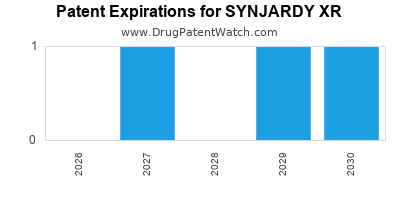
Public Orange Book records should be reviewed by product, strength, and dosage form because listed patents can change through delisting, corrections, patent-term adjustment, or regulatory amendments. The principal protection period associated with empagliflozin products has extended into 2029 for key U.S. patents. [4]
What formulations are protected?
Synjardy XR protection can involve several claim categories:
- Empagliflozin crystalline forms.
- Extended-release metformin matrices.
- Fixed-dose empagliflozin/metformin compositions.
- Dosage strengths and release profiles.
- Manufacturing and tablet-coating processes.
- Methods of treating type 2 diabetes with the combination.
A generic manufacturer may design around a particular formulation claim while still confronting compound, crystal-form, or composition patents. The risk analysis therefore depends on the exact ANDA formulation, not simply on the expiration of one listed patent.
When does Synjardy XR lose exclusivity?
Synjardy XR has already lost regulatory exclusivity periods associated with its original approval. Its remaining commercial protection is primarily patent-based.
| Protection category |
Estimated status |
| Empagliflozin new chemical entity exclusivity |
Expired |
| Synjardy clinical-investigation exclusivity |
Expired |
| Synjardy XR clinical-investigation exclusivity |
Expired |
| Core formulation and crystalline-form patents |
Extend into the late 2020s |
| Key expected U.S. patent exposure |
Approximately 2029, subject to patent-specific adjustment and litigation |
The earliest lawful generic entry date cannot be determined from the drug’s approval date alone. It depends on which patents are listed in the Orange Book, whether an ANDA applicant files Paragraph IV certifications, whether the patent owner sues within 45 days, and whether a settlement establishes an earlier entry date.
What is the Orange Book status of Synjardy XR?
The FDA Orange Book lists patent information for approved Synjardy XR strengths and dosage forms. Orange Book-listed patents can trigger the 30-month stay under the Hatch-Waxman Act when a branded sponsor brings infringement litigation after receiving a Paragraph IV notice. [4, 5]
The commercial importance of the listing is substantial:
- A Paragraph IV filing can create the first credible generic-entry threat.
- Litigation can delay approval or establish a negotiated launch date.
- A patent challenge may target only selected strengths or formulations.
- Approval of an ANDA does not guarantee immediate market entry if a court injunction or settlement applies.
No broad generic replacement for Synjardy XR had displaced the branded product in the U.S. market through the latest publicly available product and financial reporting reviewed for this analysis. The absence of a public launch does not eliminate Paragraph IV risk because ANDA filings and settlement terms may remain confidential until litigation or FDA approval makes them public.
Which companies are challenging Synjardy XR patents?
The principal potential challengers are generic manufacturers with diabetes portfolios, including large U.S. and international ANDA filers. Publicly disclosed patent disputes have focused heavily on empagliflozin and Jardiance-related patents. A challenger may attack the same patent estate through an ANDA for Synjardy XR, Jardiance, or another empagliflozin product.
Relevant challenger profiles include:
- Large generic companies seeking high-volume SGLT2 products.
- Contract manufacturers with controlled-release tablet capability.
- Companies pursuing fixed-dose diabetes combinations.
- International manufacturers using U.S. Paragraph IV strategies.
Because a generic company can select a non-infringing formulation, patent litigation may develop differently for Synjardy XR than for Jardiance monotherapy.
What patent litigation and settlement risks affect Synjardy XR?
The principal legal risks are:
- Paragraph IV certification against listed empagliflozin or combination patents.
- ANDA litigation over crystalline-form claims.
- Challenges to obviousness, enablement, written description, or infringement.
- Patent-term-adjustment disputes.
- Settlement agreements that permit entry before nominal patent expiration.
- At-risk generic launch before final judgment.
A settlement could preserve substantial brand revenue while allowing limited early entry. The economic effect depends on the launch date, whether the generic receives 180-day exclusivity, and whether multiple manufacturers enter simultaneously.
There is no reliable basis to treat the 2029 patent horizon as a guaranteed full-market monopoly. Patent validity, claim scope, litigation outcomes, and settlement terms determine the actual loss-of-exclusivity date.
How strong is the Synjardy XR patent estate?
The estate is commercially meaningful but less secure than a single, recently launched innovative drug with multiple independent patents and active clinical exclusivity.
Strengths
- Empagliflozin has a large commercial base that supports sustained patent enforcement.
- Crystalline-form and formulation claims can create technical barriers.
- Extended-release metformin manufacturing adds process complexity.
- The combination is protected across multiple dosage strengths and product configurations.
- The Jardiance franchise generates substantial resources for litigation and lifecycle management.
Weaknesses
- Regulatory exclusivity has expired.
- Metformin is generic and easy to source.
- SGLT2 combination products can be redesigned.
- Clinical differentiation is weaker than Jardiance’s outcome-based positioning.
- A successful challenge to a central empagliflozin patent could accelerate price erosion across several products.
Overall, Synjardy XR has a moderate-to-strong remaining branded position before patent expiry, but its practical barrier is more dependent on formulation and empagliflozin patents than on regulatory exclusivity.
What generic launch scenarios exist for Synjardy XR?
Scenario 1: Entry near the late-2020s patent horizon
This is the baseline commercial scenario if key patents remain valid and no settlement permits earlier entry. Price erosion would begin after patent expiry, with larger reductions once several manufacturers enter.
Scenario 2: Settlement-based early entry
A settlement could permit one or more generic launches before the final listed patent expiry. The brand may retain a substantial share if the settlement limits the number of entrants or grants an authorized-generic arrangement.
Scenario 3: Successful Paragraph IV challenge
A court decision invalidating or narrowing a key patent could bring entry materially earlier. The impact would extend beyond Synjardy XR to other empagliflozin products that rely on the same patent family.
Scenario 4: Formulation-specific entry
A generic could launch only selected strengths or a technically differentiated extended-release product. This would create partial, rather than immediate, erosion of Synjardy XR revenue.
How will the financial trajectory develop?
Synjardy XR’s trajectory should be modeled as part of the Jardiance franchise:
| Period |
Expected commercial condition |
| 2024-2026 |
Continued franchise growth supported by SGLT2 outcomes and broad diabetes use |
| 2026-2028 |
Increasing payer pressure, rebate competition, and GLP-1 substitution |
| 2028-2029 |
Elevated Paragraph IV and settlement risk |
| Around 2029 |
Potential U.S. generic entry against key empagliflozin protections |
| Post-entry |
Rapid price compression, varying by number of entrants and formulation coverage |
The largest revenue exposure is not Synjardy XR alone. It is the combined Jardiance franchise, including monotherapy and other empagliflozin combinations. A successful patent challenge could therefore affect multiple branded products at once.
Eli Lilly’s total Jardiance revenue is a useful upper-bound indicator for franchise exposure, but it is not a proxy for Synjardy XR sales. The product’s individual contribution remains undisclosed. [2] Boehringer’s co-commercialization economics and internal revenue allocation are also not reported at a product-specific level. [3]
How do licensing and commercialization rights affect Synjardy XR?
Boehringer Ingelheim and Eli Lilly developed and commercialized empagliflozin through their diabetes alliance. The partnership has enabled global commercialization, regulatory expansion, and coordinated patent enforcement. The principal commercial issue is not a publicly disclosed third-party license for Synjardy XR, but the allocation of economics and responsibilities within the Lilly-Boehringer alliance.
The alliance reduces duplication in global commercialization while concentrating strategic dependence on a shared empagliflozin patent estate. Any major patent loss can affect both companies and several products simultaneously.
What geographic coverage does Synjardy XR have?
Synjardy and Synjardy XR are marketed in multiple jurisdictions, but product names, strengths, regulatory status, and patent coverage differ by country. U.S. Orange Book protection is only one part of the global analysis.
Key geographic variables include:
- European patent validation and supplementary protection certificates.
- National patent litigation in major European markets.
- Canadian and Japanese regulatory status.
- Local reimbursement and substitution rules.
- Manufacturing and supply-chain exposure.
- Country-specific generic approval standards.
The United States remains the most financially important patent market because of high branded drug spending and Hatch-Waxman litigation. Europe may experience earlier or more variable erosion depending on national patent rights and supplementary protection certificates.
Key Takeaways
- Synjardy XR is an extended-release empagliflozin/metformin combination approved in the U.S. in 2016.
- Its sales are not separately disclosed; financial exposure is embedded in the broader Jardiance franchise.
- Lilly reported approximately $5.9 billion in 2024 Jardiance revenue, but that figure includes more than Synjardy XR.
- Regulatory exclusivity has expired. Remaining protection is primarily patent-based.
- Key U.S. empagliflozin formulation and crystalline-form protections extend into the late 2020s, with approximately 2029 as the principal commercial horizon.
- Generic-entry timing depends on Orange Book listings, Paragraph IV certifications, litigation, and settlements.
- Synjardy XR faces direct competition from Xigduo XR and other SGLT2/metformin combinations, as well as indirect pressure from GLP-1 and dual-incretin therapies.
- The largest financial risk is franchise-wide erosion if a core empagliflozin patent is invalidated or bypassed.
FAQs About Synjardy XR Patent and Market Risk
Is Synjardy XR the same drug as Jardiance?
No. Jardiance contains empagliflozin alone. Synjardy XR combines empagliflozin with extended-release metformin.
Does Synjardy XR have Jardiance’s heart-failure indication?
Not automatically. FDA indications are product-specific. Jardiance has the broader outcome-based labeling, while Synjardy XR is primarily positioned for glycemic control.
Can generic metformin replace Synjardy XR?
Generic metformin can replace the metformin component, but it does not provide empagliflozin. Patients would need separate prescriptions for metformin and an SGLT2 inhibitor.
What is the main patent risk to Synjardy XR investors?
The principal risk is an earlier-than-expected generic launch following a successful Paragraph IV challenge, a settlement, or a design-around formulation that avoids key listed patents.
Is Synjardy XR revenue separately reported by Eli Lilly?
No. Lilly reports Jardiance franchise revenue rather than a separate Synjardy XR revenue line.
References
- U.S. Food and Drug Administration. (2023). Synjardy XR prescribing information.
- Eli Lilly and Company. (2025). 2024 annual report.
- Boehringer Ingelheim. (2024). Annual report 2023.
- U.S. Food and Drug Administration. (2025). Approved drug products with therapeutic equivalence evaluations: Orange Book.
- U.S. Congress. (1984). Drug Price Competition and Patent Term Restoration Act of 1984, Pub. L. No. 98-417.