Last updated: July 29, 2026
SYMLIN (pramlintide acetate) has remained a niche branded GLP-1–class adjunct. Post-2010 growth in the US market has been limited by modest absolute patient share, dosing/titration friction, and payer utilization controls. Financial performance has tracked that ceiling: sustained but low single-digit to low double-digit revenue levels relative to major diabetes franchises, with incremental demand supported mainly by conversion within insulin-treated populations and brand resilience despite patent expirations of upstream components.
What is SYMLIN (pramlintide) and how is it positioned in US diabetes care?
SYMLIN is an injectable amylin analog indicated as an adjunct to mealtime insulin in patients with type 1 or type 2 diabetes who have not achieved desired glycemic control.
What endpoints and clinical fit drive adoption?
Key adoption logic centers on:
- Add-on A1c improvement when used with insulin
- Weight neutrality or modest weight effects relative to insulin escalation
- The “mechanism complement” to insulin via slowed gastric emptying and satiety signaling
Why has adoption stayed niche versus GLP-1 RAs and dual agonists?
Commercial headwinds have structurally constrained uptake:
- Competitive displacement from GLP-1 receptor agonists and later dual incretin therapies (higher efficacy, simpler titration, broader payer coverage)
- Safety and tolerability requirements: nausea risk, need for insulin dose adjustments at initiation
- Operational burden for prescribers and patients relative to once-weekly GLP-1 regimens
Bottom line: SYMLIN’s market dynamics reflect an adjunct niche rather than a first-line or high-volume platform.
How has SYMLIN’s US revenue trajectory evolved over time?
SYMLIN’s financial trajectory is best summarized as stable low-to-mid brand revenues with periodic plateaus and limited growth, with inflection points tied to:
- Managed-care formulary strategy
- Generic or competitive availability of downstream insulin paradigms (not pramlintide per se)
- Competitive adoption cycles of GLP-1s and dual agonists
2010–2015: Post-recession normalization with restrained growth
During the early 2010s, SYMLIN benefited from established prescriber awareness and use in insulin-treated patients. Growth was not franchise-like, because competitive incretin adoption was already rising.
2016–2020: Continued restraint as GLP-1s expanded
As GLP-1s became mainstream, pramlintide demand remained concentrated in subsets already entrenched in insulin-intensive management and willing to manage nausea and insulin titration.
2021–2025: Niche persistence with pressure from higher-efficacy incretins
SYMLIN remained present, but payer and prescriber behavior favored GLP-1s and combination therapies, especially once CV and obesity-label expansions drove high-touch coverage. The market became more channel-managed and less incremental.
Practical interpretation for revenue forecasting: SYMLIN behaves like a “second-line niche” brand. Absent a new label expansion, device change, or major payer policy shift, growth is capped.
What market dynamics most affect SYMLIN demand?
1) Payer utilization management
Payer dynamics are central:
- Prior authorization and step edits to ensure patients have tried or are unsuitable for alternatives
- Restrictive coverage when GLP-1s or combination incretins are preferred on formularies
- Quantity limits tied to titration schedules
2) Prescriber workflow friction
SYMLIN requires:
- Insulin dose adjustment at initiation and during titration
- Patient education and close follow-up for hypoglycemia risk
- Management of nausea, which can reduce persistence
These requirements increase the “time cost” of switching, discouraging widespread adoption when GLP-1s reduce workflow burden.
3) Patient willingness and persistence
Persistence declines when:
- Nausea is not effectively managed
- Patients experience insulin regimen complexity
- They perceive alternatives as simpler and more effective
4) Competitive substitution
SYMLIN is not a direct replacement for GLP-1s, but commercial substitution occurs because payers and patients choose the most effective and easiest regimen that fits.
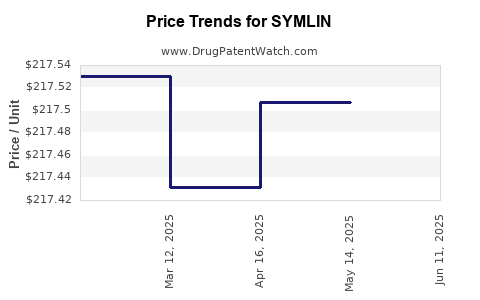
What is the price and reimbursement environment for SYMLIN?
SYMLIN pricing is typically influenced by:
- Branded list price, discounting, and rebates under managed-care contracts
- Payer willingness to cover when step therapy is satisfied
- Competitive class pressure from GLP-1s and dual agonists
From a business perspective, the net price for niche adjuncts often compresses through:
- Formulary placement challenges
- Rebate pressure in preferred categories
- Greater negotiation leverage for larger-volume competitors
Net effect: Even if list price holds, revenue growth is constrained by volume, utilization management, and rebate intensity.
What payer and formulary strategies determine whether SYMLIN stays on the market?
High-impact payer levers:
- Tier placement (preferred vs non-preferred)
- Coverage rules that favor GLP-1 RAs or dual agonists unless contraindicated
- Requirement for documentation of insulin intensification and inadequate control
- Coverage limited to specific patient subtypes (insulin users, inadequate A1c control, and adherence considerations)
Where SYMLIN still has commercial traction
SYMLIN retains pockets of value when:
- Patients are already stabilized on insulin-intensive regimens
- GLP-1s are contraindicated or not tolerated
- Patients need targeted adjunct effects and accept titration complexity
How does SYMLIN compare commercially with GLP-1 RAs and dual agonists?
Demand capture profile
- SYMLIN: adjunct add-on with lower total-addressable volume
- GLP-1 RAs and dual agonists: broader first/early-line and escalation pathways with high patient and payer uptake
Operational adoption friction
- SYMLIN: requires insulin regimen management and patient titration support
- GLP-1 RAs/dual agonists: simpler administration and fewer insulin-alignment steps for most initiation patterns
Efficacy and label breadth (commercially relevant)
Therapeutic franchises with larger A1c reduction, weight loss, CV risk reduction, and obesity label availability have attracted disproportionate coverage and marketing spend, limiting incremental space for adjunct amylin therapy.
What patent and exclusivity events shaped SYMLIN’s commercial outcomes?
SYMLIN’s long-term market dynamics reflect the typical branded-drug pattern:
- Initial brand build with exclusivity protection
- Post-exclusivity competition pressure in the broader diabetes market (even if direct pramlintide competition does not mirror GLP-1 timelines)
- Ongoing payer tightening as multiple high-performing branded alternatives entered the same patient segments
Key commercial implication: once a drug loses the ability to defend category space via exclusivity, it must win on outcomes and ease of use. SYMLIN’s wins are smaller and require heavier clinical management, which limits market share recovery.
What generic entry risks exist for SYMLIN and how could they affect revenue?
For niche injectables like SYMLIN, generic entry risks depend on:
- Manufacturing complexity and stability requirements
- Existing barriers around drug-device compatibility and formulation
- Patent estate specifics around process and formulation (not just active ingredient)
In practical market terms, generic entry would likely:
- Trigger immediate rebate and net-price compression
- Shift payer preference toward lower cost alternatives
- Reduce brand revenue, potentially sharply if interchangeability occurs and prescribers accept switch
However, the commercial record for SYMLIN has been more consistent with “class competition” than a category-wide collapse from widespread generic displacement.
What does FDA regulatory status imply for future SYMLIN demand?
SYMLIN’s demand is shaped less by regulatory risk and more by:
- Label scope
- Ongoing ability to maintain coverage under modern diabetes standards
- Competition for insurer budgets
Absent label expansion that expands patient eligibility, regulatory status supports continuity rather than acceleration.
What is SYMLIN’s competitive landscape in the amylin and adjunct space?
Direct mechanism competitors
Amylin-pathway competition is limited relative to incretin classes. Commercial substitution is therefore cross-class rather than same-mechanism.
Cross-class competitors
The largest impact comes from:
- GLP-1 receptor agonists
- Dual incretin therapies (GLP-1/GIP)
- Insulin intensification strategies and fixed-ratio injectables where payer coverage is favorable
How do distribution and channel dynamics affect SYMLIN revenue?
SYMLIN’s financial trajectory is sensitive to:
- Pharmacy benefit manager formularies and rebate schedules
- Specialty pharmacy vs traditional channel mix
- Inventory management and clinic ordering patterns for insulin adjuncts
Because utilization is episodic and patient-specific (titration and persistence), channel disruptions or payer refusals can swing volumes more than in high-volume chronic therapies.
What financial trajectory metrics should a bidder or investor track for SYMLIN?
To model upside or downside, focus on:
- Script volume trends and persistence (patients remaining on therapy at 3, 6, 12 months)
- Net price and rebate rate changes linked to formulary renegotiations
- Share of insulin-treated adjunct patients (a narrower denominator than total diabetes)
- Prior authorization approval rates and time-to-approval
- PFCR (pharmacy cost) impact versus GLP-1 alternatives under payer step edits
Key Takeaways
- SYMLIN (pramlintide) has operated as a niche adjunct in insulin-treated diabetes populations, not as a category-leading diabetes franchise.
- Market dynamics are driven by payer utilization management, prescriber workflow friction from insulin dose adjustments, and persistence limits tied to nausea.
- Financial trajectory is consistent with stable but constrained branded revenues, capped by strong class competition from GLP-1 and dual incretin therapies.
- Future revenue depends more on formulary strategy, persistence, and patient selection than on regulatory continuity alone.
FAQs
- How do prior authorization requirements typically impact SYMLIN uptake compared with GLP-1 drugs?
- What patient subgroups are most likely to stay on SYMLIN beyond 6 months?
- How does SYMLIN initiation insulin dose adjustment affect real-world adherence and persistence?
- What are the biggest formulary decision factors when payers decide between SYMLIN and incretin therapy?
- If a pramlintide generic entered, how would net pricing and market share likely shift for SYMLIN?
References
- FDA. (n.d.). Drug label and prescribing information for SYMLIN (pramlintide acetate). US Food and Drug Administration.
- DailyMed. (n.d.). SYMLIN (pramlintide acetate) injection prescribing information. National Library of Medicine.
- Orange Book (Hatch-Waxman). (n.d.). Approved Drug Products with Therapeutic Equivalence Evaluations for pramlintide acetate. FDA.