Last updated: July 24, 2026
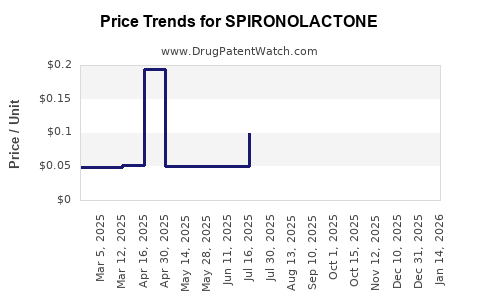
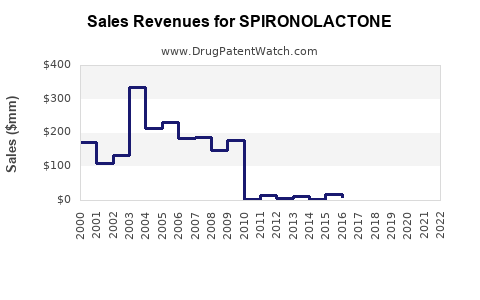
Spironolactone is a mature, off-patent small molecule with broad generic availability in the US and multiple geographies. Financial trajectory is therefore driven less by patent value and more by (1) dose-form and brand-to-generic switching, (2) chronic disease prevalence (heart failure, cirrhosis/ascites, resistant hypertension), (3) reimbursement dynamics, and (4) constrained supply or regulatory actions affecting specific manufacturers. Net pricing typically trends downward, with revenue stability supported by high baseline demand and continued new prescriptions.
How is spironolactone priced and reimbursed in the US retail vs hospital channels?
Spironolactone is widely generic. Pricing is usually “commodity-like,” but channel mix matters. US revenue is typically supported by:
- Retail pharmacy: chronic prescriptions for heart failure and resistant hypertension. Generic fills dominate.
- Hospital and specialty workflows: cirrhosis-related ascites and inpatient heart failure protocols drive consistent volumes, but utilization is sensitive to formulary placement and order sets.
What constrains revenue upside: payer pressure and PBM contract structures that compress net prices once multiple A-rated generics compete on the same strength and dosage form.
What are the main factors that push net price down or up?
- Number of generic competitors at launch and post-launch
Each incremental ANDA reduces allowable net pricing unless there is supply tightness or a formulation-specific differentiation.
- Formulary and interchangeability
If a payer locks in a preferred supplier, competing generics can lose share even when they are interchangeable.
- Supply reliability
Shortages can increase net price temporarily and lift realized revenue for the remaining suppliers.
What drives spironolactone demand growth: heart failure, ascites, or resistant hypertension?
Spironolactone is used across multiple therapeutic indications that have different epidemiology and prescribing patterns:
- Heart failure with reduced ejection fraction (HFrEF)
Spironolactone use remains entrenched due to guideline positioning as an MRA option.
- Cirrhosis with ascites (and edema associated with hepatic disease)
Demand is tied to liver disease prevalence and the rate of decompensation management.
- Resistant hypertension
Increasing hypertension screening and multi-drug intensification can sustain use, though prescribing also follows guideline updates and tolerability.
How does indication mix affect quarterly volatility?
- Heart failure: tends to be stable with fewer abrupt utilization shifts but can show seasonal variation in hospitalizations.
- Ascites: can show more volatility tied to decompensation episodes and hospitalization rates.
- Resistant hypertension: influenced by outpatient prescribing patterns and adherence.
Which dosage strengths and formulations matter most for revenue?
For revenue, the highest-impact levers are commonly:
- Oral solid doses (tablet strengths are the standard commercial basis)
- Dose continuity across chronic therapy
Small price differences across strengths can matter, but volume is often the dominant factor.
Are there economically meaningful differentiation levers?
Yes, but limited:
- Manufacturing scale and supply reliability
- Narrow differences in excipient/formulation that can affect tolerability or prescriber preference
- Packaging and labeling that support adherence
Spironolactone’s core molecule is not patent-protected in practice for most markets; differentiation tends to be operational rather than IP-led.
When do generic entry risks affect spironolactone revenues?
Because spironolactone is largely generics-only, the “entry risk” is less about blocking a first generic and more about subsequent waves of competition and facility-specific supply disruptions.
What typically happens after new generic launches?
- Net price compression is immediate when additional manufacturers gain share.
- Market share redistribution favors the supplier with best PBM placement and reliable supply.
- Revenue total remains stable because demand is inelastic, but margins shrink.
What triggers revenue rebounds?
- Supply constraints from specific manufacturers, sometimes driven by facility issues or regulatory holds.
- Shortage designations or allocation can temporarily move pricing for the constrained products.
How many manufacturers compete for spironolactone and how does that affect margins?
Competition in mature generics markets typically compresses margins to low single digits or sub-single-digit levels at the net-price level, with profitability concentrated in:
- manufacturers with scale
- strong procurement and manufacturing efficiency
- those with preferred payer positioning
What is the economic pattern across generic manufacturers?
- Most firms chase volume at low prices.
- A smaller subset maintains profitability when they avoid stockouts, secure contracting advantages, and run efficient manufacturing.
What is the expected financial trajectory for spironolactone (revenue, margin, and cash flow)?
Given generic maturity, the typical financial shape is:
- Revenue: relatively stable-to-slightly declining, with growth driven by underlying therapeutic demand and utilization shifts that are modest in magnitude.
- Gross margin: under persistent pressure due to price competition.
- Operating leverage: limited by continued administrative and regulatory costs, though scale can sustain profitability for dominant suppliers.
- Cash flow: generally strong in mature generics, assuming stable supply and no major compliance events.
Where does upside come from?
- Volume increases from persistent use in chronic therapy
- Market share gains through contracting and consistent supply
- Short-term pricing lift during supply disruptions
Where does downside come from?
- Additional generic entrants and rebids
- PBM re-contracting that forces down net price
- Regulatory quality issues that remove product from distribution
How does spironolactone compare with other diuretics (furosemide, hydrochlorothiazide) on market dynamics?
Spironolactone competes indirectly for diuretic and MRA-treated populations:
- Hydrochlorothiazide (HCTZ) is widely used and often cheaper, with strong OTC and low-cost generic positioning.
- Furosemide is used heavily inpatient and outpatient but is also commodity-like generics.
- Spironolactone has a distinct role as an MRA. That differentiation supports a steadier demand base tied to guideline-based use in heart failure and ascites rather than broad first-line diuretic substitution.
Does spironolactone lose demand to SGLT2 inhibitors or other heart failure therapies?
Heart failure treatment regimens evolve. However, MRAs remain relevant. Even when other agents expand, MRAs usually do not fully displace spironolactone due to different mechanisms and guideline positioning.
What regulatory and quality events can affect spironolactone supply and revenue?
In mature generics, revenue swings usually come from operational or compliance events:
- FDA warning letters, inspection outcomes, or consent decrees for specific facilities
- product-specific recalls
- manufacturing interruptions leading to shortages
How do supply interruptions translate into financial results?
- constrained supply can produce temporary net-price increases
- revenue can shift toward the least-constrained suppliers
- litigation or corrective action costs can hit operating income for affected manufacturers
What does the competitive landscape look like for spironolactone brands vs generics?
The economic reality is that brand revenue is likely small relative to generic volumes in most markets. Brand competitiveness is limited once multiple generics are available.
Who typically wins share?
- suppliers with preferred formulary positioning
- those with strong distribution relationships
- manufacturers with fewer stockouts and consistent manufacturing throughput
How does spironolactone’s revenue exposure vary by geography and regulatory environment?
Geographic dynamics track local generic penetration:
- US: high generic saturation, frequent contract-driven net price reductions.
- EU/UK: similarly mature generics markets with tender and reimbursement pressures.
- Emerging markets: may show higher pricing variability depending on local manufacturing capacity and import dependence.
Revenue exposure is typically lower where competition is entrenched and stable, and higher where supply constraints or import reliance can cause abrupt price movements.
What is the patent estate impact on spironolactone’s financial trajectory?
Spironolactone is a widely genericized molecule; the “patent estate” impact on pricing is typically already played out. Financial trajectory is therefore dominated by:
- generic competition
- contracting and distribution efficiency
- supply reliability
Key Takeaways
- Spironolactone’s financial trajectory is primarily shaped by mature-generic economics: stable demand offset by persistent net price compression.
- Revenue is supported by chronic indications in heart failure, cirrhosis-related ascites, and resistant hypertension, but upside is limited by PBM and payer contracting dynamics.
- Margin pressure persists with each additional generic entrant, while temporary pricing and revenue lifts can occur during supply constraints affecting specific manufacturers.
- Competitive advantage is operational: manufacturing scale, quality performance, and distribution/formulary positioning.
FAQs
1) Why does spironolactone revenue stay resilient despite generic competition?
Because it is used for chronic conditions with relatively inelastic demand and established guideline-driven use, so volume persists even as net prices decline.
2) What typically causes quarter-to-quarter revenue swings for mature generic spironolactone?
Supply disruptions, formulary rebids, and channel mix changes between inpatient and retail prescribing.
3) How do PBM contracts and formulary placements affect spironolactone net pricing?
They can rapidly shift share among equivalent generics and force net price reductions through rebids and preferred product status.
4) Does spironolactone compete directly with other diuretics like furosemide and thiazides?
Indirectly; it serves distinct clinical roles as an MRA, so it competes by regimen selection rather than by being a full substitute across all indications.
5) What operational factors most influence long-run profitability for spironolactone manufacturers?
Manufacturing efficiency, stable supply, and low compliance-risk exposure, which determine whether a firm can maintain share at contracted net prices.
References (APA)
- FDA Orange Book. U.S. Food and Drug Administration. (Accessed 2026).
- FDA Drug Shortages. U.S. Food and Drug Administration. (Accessed 2026).