Last Updated: August 7, 2026

SPIRIVA RESPIMAT Drug Patent Profile


✉ Email this page to a colleague

« Back to Dashboard


Which patents cover Spiriva Respimat, and what generic alternatives are available?

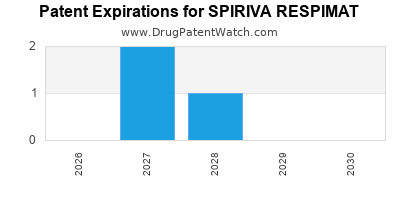
Spiriva Respimat is a drug marketed by Boehringer Ingelheim and is included in one NDA. There are four patents protecting this drug and one Paragraph IV challenge.

This drug has seventy-two patent family members in thirty-five countries.

The generic ingredient in SPIRIVA RESPIMAT is tiotropium bromide. There are eight drug master file entries for this compound. Three suppliers are listed for this compound. Additional details are available on the tiotropium bromide profile page.

DrugPatentWatch® Litigation and Generic Entry Outlook for Spiriva Respimat

A generic version of SPIRIVA RESPIMAT was approved as tiotropium bromide by LUPIN on June 20th, 2023.

  Start Trial

AI Deep Research
Questions you can ask:
  • What is the 5 year forecast for SPIRIVA RESPIMAT?
  • What are the global sales for SPIRIVA RESPIMAT?
  • What is Average Wholesale Price for SPIRIVA RESPIMAT?
Recent Clinical Trials for SPIRIVA RESPIMAT

Identify potential brand extensions & 505(b)(2) entrants

SponsorPhase
University of SaskatchewanPhase 4
Nemours Children's ClinicPhase 2
Rho, Inc.Phase 2

See all SPIRIVA RESPIMAT clinical trials

Pharmacology for SPIRIVA RESPIMAT
Drug ClassAnticholinergic
Mechanism of ActionCholinergic Antagonists
Paragraph IV (Patent) Challenges for SPIRIVA RESPIMAT
Tradename Dosage Ingredient Strength NDA ANDAs Submitted Submissiondate
SPIRIVA RESPIMAT Inhalation Aerosol tiotropium bromide 2.5 mcg per actuation 021936 1 2023-03-07

US Patents and Regulatory Information for SPIRIVA RESPIMAT

SPIRIVA RESPIMAT is protected by four US patents.

Applicant Tradename Generic Name Dosage NDA Approval Date TE Type RLD RS Patent No. Patent Expiration Product Substance Delist Req. Exclusivity Expiration
Boehringer Ingelheim SPIRIVA RESPIMAT tiotropium bromide SPRAY, METERED;INHALATION 021936-002 Sep 15, 2015 RX Yes Yes ⤷  Start Trial ⤷  Start Trial ⤷  Start Trial
Boehringer Ingelheim SPIRIVA RESPIMAT tiotropium bromide SPRAY, METERED;INHALATION 021936-001 Sep 24, 2014 RX Yes Yes 9,027,967*PED ⤷  Start Trial Y ⤷  Start Trial
Boehringer Ingelheim SPIRIVA RESPIMAT tiotropium bromide SPRAY, METERED;INHALATION 021936-001 Sep 24, 2014 RX Yes Yes 7,837,235*PED ⤷  Start Trial Y ⤷  Start Trial
Boehringer Ingelheim SPIRIVA RESPIMAT tiotropium bromide SPRAY, METERED;INHALATION 021936-001 Sep 24, 2014 RX Yes Yes 7,396,341*PED ⤷  Start Trial Y ⤷  Start Trial
Boehringer Ingelheim SPIRIVA RESPIMAT tiotropium bromide SPRAY, METERED;INHALATION 021936-001 Sep 24, 2014 RX Yes Yes 8,733,341*PED ⤷  Start Trial Y ⤷  Start Trial
>Applicant >Tradename >Generic Name >Dosage >NDA >Approval Date >TE >Type >RLD >RS >Patent No. >Patent Expiration >Product >Substance >Delist Req. >Exclusivity Expiration

Expired US Patents for SPIRIVA RESPIMAT

Applicant Tradename Generic Name Dosage NDA Approval Date Patent No. Patent Expiration
Boehringer Ingelheim SPIRIVA RESPIMAT tiotropium bromide SPRAY, METERED;INHALATION 021936-002 Sep 15, 2015 6,176,442 ⤷  Start Trial
Boehringer Ingelheim SPIRIVA RESPIMAT tiotropium bromide SPRAY, METERED;INHALATION 021936-001 Sep 24, 2014 6,176,242 ⤷  Start Trial
Boehringer Ingelheim SPIRIVA RESPIMAT tiotropium bromide SPRAY, METERED;INHALATION 021936-002 Sep 15, 2015 7,246,615 ⤷  Start Trial
>Applicant >Tradename >Generic Name >Dosage >NDA >Approval Date >Patent No. >Patent Expiration

International Patents for SPIRIVA RESPIMAT

See the table below for patents covering SPIRIVA RESPIMAT around the world.

Country Patent Number Title Estimated Expiration
Argentina 003794 DISPOSITIVO MINIATURIZADO PARA PRESURIZAR UN FLUIDO, DISPOSITIVO DE BOMBA ALTERNADORA PARA PRODUCIR ALTA PRESION EN UN FLUIDO Y PULVERIZADOR DE UN FLUIDO ⤷  Start Trial
Austria 248028 ⤷  Start Trial
Austria 352379 ⤷  Start Trial
Australia 7287096 ⤷  Start Trial
Australia 730797 ⤷  Start Trial
Bulgaria 102345 ⤷  Start Trial
>Country >Patent Number >Title >Estimated Expiration

Supplementary Protection Certificates for SPIRIVA RESPIMAT

Patent Number Supplementary Protection Certificate SPC Country SPC Expiration SPC Description
0418716 SPC/GB02/036 United Kingdom ⤷  Start Trial PRODUCT NAME: SCOPINE DI-(2-THIENYL)GLYCOLATE IN THE FORM OF THE QUATERNARY SALTS - ESPECIALLY SALTS OF TIOTROPIUM - PREFERRED TIOTROPIUMBROMIDE AND TIOTROPIUMBROMIDE MONOHYDRATE; REGISTERED: NL RVG26191 20011009; UK PL14598/0062 20020514
0418716 05C0039 France ⤷  Start Trial PRODUCT NAME: TIOTROPIUM MONOHYDRATE DE BROMURE; NAT. REGISTRATION NO/DATE: NL 31393 20050708; FIRST REGISTRATION: RVG 26191 20011009
0418716 C300084 Netherlands ⤷  Start Trial PRODUCT NAME: ZOUTEN VAN TRIOTROPIUM, IN HET BIJZONDER TIOTROPIUM BROMIDE; REGISTRATION NO/DATE: RVG 26191 20011009
0418716 0290010-8 Sweden ⤷  Start Trial PRODUCT NAME: TIOTROPIUM, 3BETA-(DI(2-TIENYL)HYDROXIACETOXI)-6BETA,7BETA-EPO XI-8METYL-1ALFAH,5ALFAH-TROPANIUM, ELLER ETT SALT DAERAV; NAT. REGISRTATION NO/DATE: 18094 20020503; FIRST REGISTRATION: NL RVG 26 191 20011009
0418716 300084 Netherlands ⤷  Start Trial PRODUCT NAME: ZOUTEN VAN TRIOTROPIUM, IN HET BIJZONDER TIOTROPIUM BROMIDE; REGISTRATION NO/DATE: RVG 26191 20011009
>Patent Number >Supplementary Protection Certificate >SPC Country >SPC Expiration >SPC Description

Spiriva Respimat (tiotropium bromide inhalation spray) market dynamics and financial trajectory: sales trend drivers, payer pressure, exclusivity and generic/biosimilar risk, and outlook

Last updated: July 23, 2026

Executive summary

  • Spiriva Respimat (tiotropium bromide inhalation spray) is the branded, inhaler-spray channel of Boehringer Ingelheim’s long-running COPD franchise and remains a high-value respiratory asset in global markets, with financial performance driven by (1) continued COPD/bronchodilator demand, (2) payer contracting and step-therapy pressure, (3) mix shift between Respimat and HandiHaler, and (4) patent life-cycle effects on generic entry in key geographies.
  • The asset’s financial trajectory is constrained by long-term loss of exclusivity across jurisdictions, increasing price pressure as generics and authorized copies expand, and competitive substitution by newer inhaled LAMAs and combinations (notably triple-therapy and LAMA/LABA regimens).
  • Net revenue impact and margin trajectory depend more on market share retention and pricing than on absolute COPD prevalence trends, because the product class is substitutable and payer formularies tighten with each successive contracting cycle.

What drives Spiriva Respimat market dynamics in COPD inhalation therapy?

Spiriva Respimat is a once-daily LAMA therapy for chronic obstructive pulmonary disease (COPD). Market dynamics reflect how COPD patients are managed over time and how payers arbitrate between inhaler devices and molecule classes.

COPD treatment pathway: where Spiriva fits

  • Patients are typically maintained on a long-acting bronchodilator (LAMA or LABA) and escalate based on symptoms and exacerbations.
  • Spiriva is commonly positioned as a foundational LAMA option, then potentially upgraded to dual bronchodilation (LAMA/LABA) or triple therapy (LAMA/LABA/ICS) when exacerbation burden or symptoms persist.

What changes utilization most?

  1. Formulary placement and tiering

    • Payers increasingly steer to lower-cost LAMA/LABA or triple fixed-dose combinations when clinically acceptable.
    • Device-specific preference matters less than net cost after rebates, but it affects patient adherence and persistence.
  2. Adherence and inhaler device preference

    • Respimat and HandiHaler have different patient usability profiles.
    • Real-world persistence tends to favor whichever device a patient can use reliably, which supports mix switching within the same brand portfolio when pricing is favorable.
  3. Therapy substitution by competing LAMAs and combinations

    • COPD inhalation markets are crowded with tiotropium alternatives and LAMA/LABA fixed combinations.
    • Competitive pressure typically shows up first in high-rebate markets and then in broader retail and institutional channels.
  4. Payer step-editing

    • Formularies commonly require prior use of a preferred bronchodilator class before covering more expensive or less preferred options.
    • This reduces “new starts,” even if “existing users” remain on therapy.

How is Spiriva Respimat priced and contracted in major markets?

Pricing dynamics are shaped by payer negotiations, rebate structures, and policy-driven tendering for institutional coverage.

Contracting and rebate mechanics that affect net sales

  • High list prices do not map to net realizations because rebates scale with formulary placement and volume commitments.
  • When generics enter, branded manufacturers typically defend share by:
    • converting to authorized generics/copay support in some markets,
    • increasing rebate intensity,
    • shifting to device or line extensions with separate formulary strategy.

What role does device mix play in net revenue?

  • Shifts from HandiHaler to Respimat can preserve revenue through higher unit costs and stronger perceived usability, even as molecule-level competition builds.
  • When payer substitution accelerates, mix shift can reverse, pulling down net revenue.

When does exclusivity end for Spiriva Respimat, and how does that affect revenue?

Spiriva Respimat’s revenue trajectory is primarily a function of patent and regulatory exclusivity expiration across jurisdictions, which triggers generic entry and channel re-contracting.

Typical exclusivity and lifecycle pressure points

  • Compound and composition-of-matter patents: determine when non-infringing generics can launch in each country.
  • Device and formulation patents: can delay certain switchovers or allow partial brand defense through protected improvements.
  • Regulatory exclusivities and data protection: can extend market protection in select regions but do not usually block subsequent generic supply indefinitely.

Revenue impact pattern after loss of exclusivity

  • Generic entry usually produces a rapid pricing reset on a unit basis.
  • Branded share may fall quickly, but net sales can decline more slowly where:
    • rebates remain strong,
    • payers keep a subset of patients on the branded device due to adherence,
    • wholesalers carry inventory that sustains short-term revenues.

What patents and Orange Book status affect generic entry risk for Spiriva Respimat?

Spiriva Respimat is regulated in the US under an approved NDA, and generic entry risk is tied to Orange Book-listed patents for that application.

What to look for in the Orange Book for a tiotropium inhalation NDA

  • Active patents can include:
    • method-of-use,
    • formulation/device,
    • polymorph/process,
    • and other related proprietary claims.
  • The Orange Book also indicates:
    • patent expiration dates,
    • any delisting events,
    • and whether Paragraph IV certifications have been filed.

Litigation-driven timing risk

  • If there are patent challenges and settlements, generic launch timing may be pushed by:
    • temporary exclusivities in settlement structures,
    • interim agreements,
    • and court-ordered injunctions during litigation.

Which generic and authorized-duplicate products compete with Spiriva Respimat?

Generic entry is the dominant structural risk to branded inhaled LAMA revenues.

Competitive set categories

  • ANDA generics of tiotropium bromide inhalation sprays for Respimat-compatible product claims.
  • Authorized copies in some markets where branding persists under lower-cost authorizations.
  • Competing LAMA/LABA or triple therapies that reduce “new starts” for standalone LAMA.

What matters commercially: share loss vs. class substitution

  • If generics launch, share loss is largely molecule-proportional.
  • If newer combination products gain, the brand can lose not just price share but patient counts due to therapy upgrades.

How strong is the patent estate for Spiriva Respimat versus competitors?

Patent strength is evaluated against three commercial questions: durability, breadth, and ability to block device or formulation design-around.

Estate strength signals that protect revenue

  • Broad composition-of-matter or method-of-use claims that survive challenge.
  • Formulation/device claims that restrict generic replication of the inhaler spray delivery system.
  • A litigation history that results in meaningful launch delays in key jurisdictions.

Estate weakness signals that accelerate erosion

  • Narrow claims vulnerable to design-around.
  • Early delistings or expiration cascades across multiple related patents that reduce remaining coverage density.
  • Settlements that allow generic entry at a specific time, with minimal further delays.

What does Spiriva Respimat financial trajectory look like across the product lifecycle?

Branded inhaled therapies typically follow a lifecycle curve:

  • growth through market expansion and switching,
  • plateau driven by formulary hold and adherence,
  • decline with generics and competitive combinations,
  • then stabilization if the brand retains a loyal user base and device advantage.

Key trajectory components to model

  1. Volume

    • “Existing user” base persistence
    • rate of therapy switching (to combinations or newer devices)
    • new start demand based on formulary rules
  2. Price

    • list price plus net rebate dynamics
    • post-generic pricing reset
    • tender dynamics in public procurement markets
  3. Mix

    • Respimat share vs. other devices in Boehringer’s portfolio
    • COPD segment mix (more severe disease tends to drive treatment intensity and persistence)

Which market forces are most likely to improve or worsen Spiriva Respimat sales?

Likely positive drivers

  • Strong patient persistence in real-world settings where Respimat usage is perceived as easier.
  • Continued COPD prevalence and maintenance therapy adherence.
  • Defensive contracting in high-volume geographies.

Likely negative drivers

  • Generic substitution and broader payer switching to lower net-cost options.
  • Uptake of LAMA/LABA and triple therapy that reduces LAMA monotherapy share.
  • Device substitution where payers and clinicians prefer certain inhaler types, especially in newly treated cohorts.

How does Spiriva Respimat compare with other COPD LAMAs and inhaler brands?

Direct competitive categories

  • Other LAMAs (molecule-level substitutes).
  • LAMA/LABA fixed combinations (dual bronchodilation competitors).
  • Triple therapy regimens (LAMA/LABA/ICS) for patients with exacerbation risk.

Business impact of “class choice” competition

  • When payers prefer combinations, LAMA monotherapy loses share even if the molecule remains on formulary.
  • In many markets, the net effect is a shift from standalone LAMA to combination products, compressing the standalone brand’s addressable market.

What generic entry scenarios exist for Spiriva Respimat, and how do they affect revenue?

Scenario framing for revenue planning

  • Fast generic erosion: multiple ANDA launches lead to immediate pricing reset and steep share loss.
  • Staggered erosion: fewer launches or delayed entry in key countries creates a slower decline.
  • Persistent branded share: despite generic availability, adherence and contracting preserve a meaningful installed base.

Typical timeline pattern (high level)

  • Patent expiration and/or carve-outs trigger initial entry.
  • Payer re-contracting follows, with net sales declines often accelerating in the first 6 to 18 months post-launch.
  • After market stabilization, volume loss often continues at a slower rate due to persistence and churn.

What litigation and settlement activity can change the commercial timeline?

Patent litigation affects launch timing and can materially shift the post-exclusivity curve.

Litigation pathways that matter for launch

  • Court injunctions that block generic launch.
  • Appeals that extend stay periods.
  • Settlements that define a mutually agreed launch date and can include “carve-out” provisions.

Commercial translation

  • Delayed launches sustain branded pricing and prevent immediate net sales collapse.
  • Conversely, early losses of patent coverage can accelerate erosion.

What regulatory milestones and FDA status drive US revenue exposure?

US exposure depends on:

  • the FDA-approved NDA and labeling,
  • the Orange Book patent list,
  • and whether US generics target a shelf-ready or a stay-protected launch window.

FDA pathway and substitution

  • If generic approvals occur while patents are still listed, launch can be stayed.
  • Once stays lift or patents expire, substitution increases rapidly because inhalers for COPD are dispensed broadly at pharmacy channels when covered.

Key Takeaways

  • Spiriva Respimat’s financial trajectory is primarily driven by COPD chronic maintenance demand, but net sales are structurally constrained by generics and payer-driven substitution to lower-cost LAMA options and combinations.
  • The product’s unit revenue can erode quickly after loss of exclusivity, with the steepest decline typically following payer re-contracting and wider channel substitution.
  • Defending mix, persistence, and formulary position can slow decline, but cannot fully offset class-level competitive pressure from dual bronchodilation and triple therapy regimens.
  • Revenue planning hinges on the timing and breadth of patent and Orange Book protections in each major jurisdiction, plus litigation/settlement-defined entry windows.

FAQs

  1. How do authorized generics versus full ANDA launches change Spiriva Respimat branded revenue decline?
  2. What happens to Spiriva Respimat net sales when payers switch from standalone LAMA to LAMA/LABA fixed-dose combinations?
  3. How does device usability (Respimat vs HandiHaler) affect persistence and pricing power over time?
  4. What Paragraph IV or Orange Book patent challenges most commonly determine US generic launch timing for tiotropium inhalation products?
  5. How should investors model post-exclusivity sales for inhaled COPD brands when rebates and formulary tiering shift?

References

  1. FDA Orange Book: Approved Drug Products with Therapeutic Equivalence Evaluations. U.S. Food and Drug Administration.
  2. Boehringer Ingelheim. Annual reports and investor presentations for COPD portfolio and Respiratory business updates.

More… ↓

⤷  Start Trial

Make Better Decisions: Try a trial or see plans & pricing

Drugs may be covered by multiple patents or regulatory protections. All trademarks and applicant names are the property of their respective owners or licensors. Although great care is taken in the proper and correct provision of this service, thinkBiotech LLC does not accept any responsibility for possible consequences of errors or omissions in the provided data. The data presented herein is for information purposes only. There is no warranty that the data contained herein is error free. We do not provide individual investment advice. This service is not registered with any financial regulatory agency. The information we publish is educational only and based on our opinions plus our models. By using DrugPatentWatch you acknowledge that we do not provide personalized recommendations or advice. thinkBiotech performs no independent verification of facts as provided by public sources nor are attempts made to provide legal or investing advice. Any reliance on data provided herein is done solely at the discretion of the user. Users of this service are advised to seek professional advice and independent confirmation before considering acting on any of the provided information. thinkBiotech LLC reserves the right to amend, extend or withdraw any part or all of the offered service without notice.