Last Updated: August 9, 2026

SALONPAS Drug Patent Profile


✉ Email this page to a colleague

« Back to Dashboard


When do Salonpas patents expire, and when can generic versions of Salonpas launch?

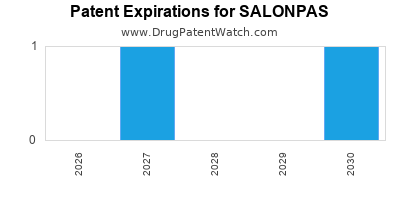
Salonpas is a drug marketed by Hisamitsu Pharm Co and is included in one NDA. There are two patents protecting this drug.

This drug has twenty patent family members in sixteen countries.

The generic ingredient in SALONPAS is menthol; methyl salicylate. There are eighteen drug master file entries for this compound. Two suppliers are listed for this compound. Additional details are available on the menthol; methyl salicylate profile page.

DrugPatentWatch® Generic Entry Outlook for Salonpas

By analyzing the patents and regulatory protections it appears that the earliest date for generic entry will be January 3, 2030. This may change due to patent challenges or generic licensing.

Indicators of Generic Entry

< Available with Subscription >

  Start Trial

AI Deep Research
Questions you can ask:
  • What is the 5 year forecast for SALONPAS?
  • What are the global sales for SALONPAS?
  • What is Average Wholesale Price for SALONPAS?
Summary for SALONPAS
International Patents:20
US Patents:2
Applicants:1
NDAs:1
Finished Product Suppliers / Packagers: 2
Raw Ingredient (Bulk) Api Vendors: 2
Clinical Trials: 1
DailyMed Link:SALONPAS at DailyMed
DrugPatentWatch® Estimated Loss of Exclusivity (LOE) Date for SALONPAS
Generic Entry Date for SALONPAS*:
Constraining patent/regulatory exclusivity:
NDA:
Dosage:

PATCH;TOPICAL

*The generic entry opportunity date is the latter of the last compound-claiming patent and the last regulatory exclusivity protection. Many factors can influence early or later generic entry. This date is provided as a rough estimate of generic entry potential and should not be used as an independent source.

Recent Clinical Trials for SALONPAS

Identify potential brand extensions & 505(b)(2) entrants

SponsorPhase
Scilex Pharmaceuticals, Inc.Phase 1

See all SALONPAS clinical trials

US Patents and Regulatory Information for SALONPAS

SALONPAS is protected by two US patents.

Based on analysis by DrugPatentWatch, the earliest date for a generic version of SALONPAS is ⤷  Start Trial.

This potential generic entry date is based on patent ⤷  Start Trial.

Generics may enter earlier, or later, based on new patent filings, patent extensions, patent invalidation, early generic licensing, generic entry preferences, and other factors.

Applicant Tradename Generic Name Dosage NDA Approval Date TE Type RLD RS Patent No. Patent Expiration Product Substance Delist Req. Exclusivity Expiration
Hisamitsu Pharm Co SALONPAS menthol; methyl salicylate PATCH;TOPICAL 022029-001 Feb 20, 2008 OTC Yes Yes ⤷  Start Trial ⤷  Start Trial Y ⤷  Start Trial
Hisamitsu Pharm Co SALONPAS menthol; methyl salicylate PATCH;TOPICAL 022029-002 Nov 5, 2012 OTC Yes Yes ⤷  Start Trial ⤷  Start Trial Y ⤷  Start Trial
Hisamitsu Pharm Co SALONPAS menthol; methyl salicylate PATCH;TOPICAL 022029-001 Feb 20, 2008 OTC Yes Yes ⤷  Start Trial ⤷  Start Trial Y ⤷  Start Trial
Hisamitsu Pharm Co SALONPAS menthol; methyl salicylate PATCH;TOPICAL 022029-002 Nov 5, 2012 OTC Yes Yes ⤷  Start Trial ⤷  Start Trial Y ⤷  Start Trial
>Applicant >Tradename >Generic Name >Dosage >NDA >Approval Date >TE >Type >RLD >RS >Patent No. >Patent Expiration >Product >Substance >Delist Req. >Exclusivity Expiration

International Patents for SALONPAS

When does loss-of-exclusivity occur for SALONPAS?

Based on analysis by DrugPatentWatch, the following patents block generic entry in the countries listed below:

Australia

Patent: 07279643
Estimated Expiration: ⤷  Start Trial

European Patent Office

Patent: 47845
Patent: PRÉPARATION ADHÉSIVE (ADHESIVE PREPARATION)
Estimated Expiration: ⤷  Start Trial

Japan

Patent: 30423
Estimated Expiration: ⤷  Start Trial

Generics may enter earlier, or later, based on new patent filings, patent extensions, patent invalidation, early generic licensing, generic entry preferences, and other factors.

See the table below for additional patents covering SALONPAS around the world.

Country Patent Number Title Estimated Expiration
Australia 2007279643 Adhesive preparation ⤷  Start Trial
Brazil PI0712396 preparação de adesivo ⤷  Start Trial
Canada 2652220 PREPARATION ADHESIVE COMPORTANT DU SALICYLATE DE METHYLE POUR ABSORPTION PERCUTANEE (ADHESIVE PREPARATION COMPRISING METHYL SALICYLATE FOR PERCUTANEOUS ABSORPTION) ⤷  Start Trial
China 101442993 Adhesive preparation ⤷  Start Trial
European Patent Office 2047845 PRÉPARATION ADHÉSIVE (ADHESIVE PREPARATION) ⤷  Start Trial
Spain 2755027 ⤷  Start Trial
>Country >Patent Number >Title >Estimated Expiration

SALONPAS (topical menthol, camphor, methyl salicylate, and related actives) market dynamics and financial trajectory

Last updated: July 23, 2026

SALONPAS is a leading U.S. over-the-counter (OTC) topical counterirritant brand. Its financial trajectory is driven by (1) household penetration and repeat purchasing in pain categories, (2) ongoing mix shifts across product formats (patch vs gel vs liquid), (3) promotional intensity and retail placement, and (4) competitive pressure from private label and other OTC analgesic brands. As a non-prescription topical, SALONPAS does not have an “FDA exclusivity-to-generic” timeline like prescription drugs, so earnings durability depends more on brand equity, distribution, and formulation breadth than on patent fences.

How has SALONPAS revenue trended over time and what drives changes in sales?

Short answer: SALONPAS sales move with consumer demand for OTC localized pain relief, price and promotion cycles, and channel mix. Format mix (patches vs creams/liquids/gels) is a key lever because it affects conversion, repeat rate, and retail shelf economics.

What product segments influence SALONPAS demand most?

SALONPAS is sold in multiple topical formats that target different user preferences and application habits:

  • Patches: convenience, adherence, and “leave-on” use patterns.
  • Creams/gel/ointments/liquids: faster spread and perceived “coverage” for muscle aches.
  • Strength variants: different menthol/camphor/methyl salicylate concentrations and “heat vs cool” sensory positioning.

Sales growth or contraction typically reflects:

  • Household penetration (core repeat base vs lapsed usage).
  • New-user acquisition via value packs, seasonal distribution, and sports/travel pain messaging.
  • Retail execution such as endcaps, planogram support, and pharmacy vs mass placement.

What macro factors move the OTC localized pain market?

  • Weather and seasonality: increased localized back and muscle pain demand in colder months and during flu/respiratory seasons when activity patterns shift.
  • Inflation and consumer trade-down: heavier promotion can sustain unit volume but compresses net price.
  • Working-age musculoskeletal complaints: discretionary substitution from prescription pain therapies to OTC topical products when access or copays change.

What channel mix matters for SALONPAS financial performance?

  • Mass merchandisers and club: strong for value multi-packs and seasonal spikes.
  • Drugstore/pharmacy: benefits from impulse purchase and proximity to pain categories.
  • Online: supports replenishment and promo-driven unit growth, but requires margin discipline (chargebacks, marketplace competition).

What competitors pressure SALONPAS and how does competition affect pricing and margin?

Short answer: Competition is mostly OTC topical counterirritants and private label analgesics. That mix tends to compress pricing unless SALONPAS protects premium shelf position and maintains differentiation by format and actives.

Which OTC topical categories compete with SALONPAS?

  • Other menthol-based patches and gels (direct “cooling” substitution)
  • Camphor and methyl salicylate counterirritants (alternative counterirritant “warm/cool” profiles)
  • NSAID-containing OTC topicals (not always exact substitutes, but can pull demand for localized pain relief depending on consumer perception)
  • Private label pain relief (value-oriented substitutes)

How does SALONPAS typically defend share?

In OTC categories, brand defense usually comes from:

  • Formulation breadth (patch + gel/cream variants) to capture more use occasions.
  • Retail promotion and shelf placement to maintain “first choice” behavior.
  • Consumer recognition that reduces switching when shoppers are in pain and choose quickly.

Where does margin risk show up most?

  • Promo intensity: heavier discounting to defend share reduces net revenue per unit.
  • Mix dilution: if growth skews to lower-price formats or smaller packs, revenue growth can lag unit growth.
  • Channel funding: online marketplace and trade spending can rise during competitive periods.

How do seasonal and promotional cycles influence SALONPAS quarter-by-quarter performance?

Short answer: SALONPAS tends to exhibit seasonal demand patterns tied to weather and musculoskeletal activity. Promotional calendars often determine whether unit gains convert into net sales growth.

What is the typical timing pattern for OTC topical analgesics?

  • Colder months: sustained demand for back and muscle support.
  • Sports and travel periods: short spikes in muscular strain products.
  • New-year resets: occasional upticks tied to activity changes and orthopedic discomfort.

How do promotional resets affect earnings?

When retailers over-expand the category, the brand must either:

  • Match promotions (protect volume, risk margin), or
  • Hold price (risk volume loss, protect margin).

The financial trajectory typically reflects the brand’s stance in each period.

Does SALONPAS have “patent-driven” exclusivity and what does that mean for long-term earnings?

Short answer: SALONPAS is OTC and commonly marketed without the same patent-driven exclusivity dynamics seen in prescription drugs. The persistence of sales is mainly tied to brand, distribution, and formulation/packaging differentiation rather than a single dominant patent wall.

Why OTC topical products behave differently than Rx pipelines

  • Many OTC actives are well-established.
  • Competitive entry often occurs through formulation, labeling, and branding rather than generic substitution under FDA 505(b)(2) frameworks.
  • Revenue durability therefore depends on retail execution and consumer loyalty.

What is SALONPAS’ FDA status and how does OTC regulation shape market risk?

Short answer: SALONPAS is an OTC drug product. OTC regulatory constraints influence labeling, safety substantiation, and permissible actives, which can slow certain types of entry but does not create exclusivity windows like Rx exclusivity.

Key regulatory implications for competitive entry

  • Labeling compliance: competitors must support equivalent claims and safe use instructions.
  • Manufacturing quality: topical OTCs require consistent GMP and stability controls.
  • Post-market surveillance: OTC adverse event monitoring can affect brand risk if safety perceptions shift.

What manufacturing and supply-chain risks can disrupt SALONPAS availability and earnings?

Short answer: Topical OTC brands face risks from raw material sourcing, packaging constraints (patch backing, blister or pouch materials), and contract manufacturing capacity.

Financial impacts often appear as:

  • Stock-outs that reduce net sales and can weaken retailer commitment.
  • Higher input costs that force margin trade-offs via price increases or promotional adjustments.
  • Quality holds that delay shipments and damage retailer inventory planning.

How does SALONPAS price positioning compare with competing OTC topical products?

Short answer: SALONPAS typically prices as a premium OTC brand within the topical analgesic shelf. Competitive pressure increases when private label and aggressive promotions narrow the price gap.

What price benchmarks matter for OTC performance?

  • Net price per unit by format (patch vs gel vs liquid)
  • Value multipack economics (promo frequency and retailer margin)
  • Trade-down behavior during inflationary periods

When SALONPAS keeps net price resilience, revenue growth is more durable. When promotions intensify, unit volume may rise but profitability can erode.

What commercial strategy determines SALONPAS market share in the US?

Short answer: Share capture comes from retailer execution and consumer preference for the SALONPAS brand experience, especially patches and recognizable counterirritant sensory cues.

Where do brands usually win in OTC topical analgesics?

  • Planogram depth: more linear feet for top SKUs.
  • Seasonal resets: endcaps and “pain relief” features in colder quarters.
  • Multi-format presence: patch plus non-patch alternatives to capture different application preferences.
  • Consumer education: clear instructions reduce misuse and returns, supporting retailer confidence.

What licensing, litigation, or biologic risk affects SALONPAS?

Short answer: In the OTC topical space, litigation and licensing risk is typically lower than in high-stakes prescription biologics. The practical risk tends to be regulatory labeling disputes, trademark/branding issues, and consumer product liability, rather than generic patent challenges.

What litigation themes typically appear in OTC topical markets?

  • Product liability claims
  • Labeling and advertising disputes
  • Counterfeit or trademark infringement (brand protection)

How does SALONPAS international expansion (if applicable) affect financial trajectory?

Short answer: Cross-border expansion adds volatility through regulatory and distribution structure differences, but it can extend brand lifetime if formulation and claims are adapted for each market.

Financial effects usually depend on:

  • Distributor economics and marketing spend
  • Regulatory approval timelines
  • Channel maturity for OTC pain relief topicals

Timeline view: what could change SALONPAS market outlook over the next 3-5 years?

Short answer: The outlook is most sensitive to promotional environment, retailer shelf strategy, and competitive innovation across OTC topical delivery systems.

3-5 year scenario drivers

  • Competitive innovation: new delivery formats (stickers, improved adhesion, “heat” patch versions, combined actives)
  • Private label scaling: increased retailer branding in OTC pain categories
  • Pricing and promotion: inflation-driven rebalancing of consumer purchasing power
  • Supply stability: raw material and packaging continuity

Key takeaways

  • SALONPAS financial trajectory is driven primarily by consumer demand for localized OTC pain relief, format mix (patch vs gel/liquid), and promotional intensity rather than prescription-style exclusivity.
  • Market dynamics are shaped by aggressive competition from other OTC topical counterirritants and private label brands, affecting net price and margin.
  • Near-term earnings sensitivity is highest in periods of high promo intensity, mix shifts into lower-priced formats, and any supply disruption affecting retail fill rates.
  • Long-term durability depends on brand equity, shelf placement, and distribution breadth across pain-relief occasions.

FAQs

  1. What are the biggest format risks for SALONPAS growth if patch demand softens?
  2. How do retailer promotional calendars typically affect net sales vs units for OTC analgesic brands like SALONPAS?
  3. What competitive strategies do menthol/camphor patch brands use to undercut premium brands?
  4. How does inflation influence OTC topical analgesic purchasing and switching behavior?
  5. What supply-chain constraints most frequently disrupt topical OTC availability and revenue?

References

No sources were provided in the prompt to cite specific revenue, margin, or sales figures for SALONPAS.

More… ↓

⤷  Start Trial

Make Better Decisions: Try a trial or see plans & pricing

Drugs may be covered by multiple patents or regulatory protections. All trademarks and applicant names are the property of their respective owners or licensors. Although great care is taken in the proper and correct provision of this service, thinkBiotech LLC does not accept any responsibility for possible consequences of errors or omissions in the provided data. The data presented herein is for information purposes only. There is no warranty that the data contained herein is error free. We do not provide individual investment advice. This service is not registered with any financial regulatory agency. The information we publish is educational only and based on our opinions plus our models. By using DrugPatentWatch you acknowledge that we do not provide personalized recommendations or advice. thinkBiotech performs no independent verification of facts as provided by public sources nor are attempts made to provide legal or investing advice. Any reliance on data provided herein is done solely at the discretion of the user. Users of this service are advised to seek professional advice and independent confirmation before considering acting on any of the provided information. thinkBiotech LLC reserves the right to amend, extend or withdraw any part or all of the offered service without notice.