Last updated: August 4, 2026
Repaglinide is a mature, off-patent oral antidiabetic drug with limited commercial growth potential. The product is a short-acting insulin secretagogue used for type 2 diabetes, sold primarily as a low-cost generic after the loss of U.S. market exclusivity. Its clinical use persists in selected patients who need meal-time dosing or have limitations with longer-acting sulfonylureas, but newer therapies have displaced repaglinide in most growth segments.
The commercial profile is defined by four factors: generic price erosion, a crowded diabetes market, limited differentiation, and low regulatory barriers for conventional tablets. Repaglinide remains commercially viable as a low-cost product, but it is unlikely to generate material branded-drug revenue without a differentiated formulation, combination product, or new geographic strategy.
What is repaglinide and how is it used?
Repaglinide is an oral meglitinide insulin secretagogue. It stimulates pancreatic beta cells to release insulin during and shortly after meals. The FDA approved Novo Nordisk's Prandin tablets in December 1997 for adults with type 2 diabetes as an adjunct to diet and exercise. Repaglinide is generally taken before meals, with the dose adjusted according to meal frequency and glycemic response. [1]
| Attribute |
Repaglinide |
| Active ingredient |
Repaglinide |
| Drug class |
Meglitinide insulin secretagogue |
| Original U.S. brand |
Prandin |
| Original sponsor |
Novo Nordisk |
| U.S. approval |
December 1997 |
| Dosage forms |
Immediate-release tablets |
| Common strengths |
0.5 mg, 1 mg, 2 mg |
| Primary indication |
Type 2 diabetes |
| Administration |
Before meals |
| Generic status |
Established |
| Biosimilar relevance |
None; repaglinide is a small molecule |
| Current market position |
Mature, low-cost generic |
Repaglinide has a shorter duration of action than many sulfonylureas. That pharmacology can benefit patients with irregular meal schedules or patients who skip meals. The same profile limits its use in patients seeking once-daily or outcome-oriented diabetes therapy.
When did repaglinide lose exclusivity?
Repaglinide lost its principal U.S. patent protection in the early 2010s. The original Prandin patent estate was associated with Novo Nordisk and covered the active compound and related pharmaceutical uses and compositions.
What patents protected Prandin and repaglinide?
Public patent records identify several early U.S. patents associated with repaglinide and its pharmaceutical use, including:
| Patent |
General subject matter |
Original assignee or applicant |
Approximate U.S. expiry |
| U.S. Patent No. 5,216,167 |
Repaglinide compound and related pharmaceutical chemistry |
Novo Nordisk-related entities |
2011 |
| U.S. Patent No. 5,312,924 |
Repaglinide compounds and compositions |
Novo Nordisk-related entities |
2011 |
| U.S. Patent No. 6,143,769 |
Pharmaceutical compositions and diabetes treatment applications |
Novo Nordisk-related entities |
Early 2020s, subject to patent-term analysis |
Patent expiration dates can vary based on terminal disclaimers, patent-term adjustment, patent-term extension, prosecution history, and claim scope. The early compound patents no longer provide a blocking barrier to ordinary repaglinide tablets.
Prandin did not develop the type of extended patent runway associated with newer incretin therapies or long-acting insulin products. Its commercial decline began when generic manufacturers entered with tablets containing the same active ingredient.
What is the FDA regulatory status of repaglinide?
Repaglinide is an FDA-approved small-molecule drug available through the abbreviated new drug application pathway. Generic versions do not require new clinical efficacy trials equivalent to the original approval. Applicants generally establish pharmaceutical equivalence, bioequivalence, manufacturing compliance, and labeling conformity.
The regulatory profile is relatively accessible because:
- The dosage form is a conventional immediate-release tablet.
- The active ingredient has extensive clinical history.
- Bioequivalence testing is established.
- The product does not require biologic comparability studies.
- Manufacturing technology is conventional.
- The FDA label is well defined.
The main regulatory risks concern formulation quality, dissolution, impurity control, stability, and manufacturing compliance rather than clinical uncertainty.
What is the Orange Book status of repaglinide?
The FDA Orange Book historically listed Prandin under Novo Nordisk's NDA 020741. The original patents associated with the product are expired or no longer relevant to an ordinary generic repaglinide tablet. Current Orange Book status should be assessed by product and dosage form because listings can change through patent expiry, delisting, manufacturer status, or FDA database updates. [2]
Repaglinide does not have the biologic exclusivity or interchangeable biosimilar framework applicable to insulin analogs and monoclonal antibodies. Generic applicants challenge the product through ANDAs, not biosimilar applications.
How many patents cover repaglinide today?
The active blocking patent estate for standard repaglinide tablets is limited. The principal commercial protection has expired, and generic entry has already occurred. Remaining patents, if any, are more likely to concern:
- Specific fixed-dose combinations
- Modified-release delivery
- Specialized formulations
- Manufacturing processes
- Particular therapeutic uses
- Regional rights outside the United States
A process patent generally has less value than an active-ingredient patent if competitors can manufacture repaglinide through a non-infringing route. A method-of-use patent has limited commercial impact unless the indication is clinically differentiated and the product labeling can support enforcement.
What formulations are protected by repaglinide patents?
The original commercial product is an immediate-release tablet. Formulation differentiation has not produced a major new market category comparable with extended-release metformin, injectable GLP-1 receptor agonists, or long-acting insulin.
Repaglinide formulation and combination products
Novo Nordisk also developed PrandiMet, a fixed-dose combination of repaglinide and metformin. The FDA approved PrandiMet in 2008. The combination was intended to reduce pill burden for patients who required both insulin secretagogue therapy and metformin. [3]
| Product |
Components |
Commercial rationale |
Current competitive position |
| Prandin |
Repaglinide |
Meal-time insulin release |
Generic competition |
| Generic repaglinide |
Repaglinide |
Low-cost therapy |
Mature market |
| PrandiMet |
Repaglinide plus metformin |
Fixed-dose combination |
Limited differentiation |
| Generic combinations |
Repaglinide plus metformin, where approved |
Lower pill burden and lower cost |
Country-specific opportunity |
Combination products can create a separate regulatory and patent analysis, but they do not restore the economics of the original branded product unless the combination has durable market access and meaningful price differentiation.
Are there Paragraph IV challenges to repaglinide?
Paragraph IV litigation was relevant during the original generic-entry period. Generic applicants could certify that listed patents were invalid, unenforceable, or not infringed. The commercial significance of those disputes has largely passed because the main compound patents have expired and multiple generic products are available.
The most important historical patent dispute involved repaglinide and the interaction between generic labeling, use patents, and FDA approval strategy. Novo Nordisk pursued litigation against generic manufacturers in connection with repaglinide patents and labeling issues. The disputes illustrated the limits of method-of-use protection when a generic applicant can pursue a label that omits a patented indication or when the relevant patent expires before litigation produces durable market protection.
Current Paragraph IV risk is low for basic repaglinide tablets. It could re-emerge for a newly patented formulation, combination product, or use-specific product, but that would represent a new product strategy rather than a meaningful barrier around legacy repaglinide.
What is the generic entry risk for repaglinide?
Generic entry risk is already realized rather than prospective. Repaglinide has a high probability of continued price competition because:
- Multiple manufacturers can produce immediate-release tablets.
- The formulation uses established excipients and manufacturing processes.
- The active pharmaceutical ingredient is commercially available from qualified suppliers.
- FDA approval can proceed through the ANDA pathway.
- Prescribers and payers have low switching barriers.
- There is no meaningful exclusivity period remaining for the legacy product.
The principal risks for a generic manufacturer are commercial rather than patent-based. These include low reimbursement, pharmacy concentration, wholesaler fees, manufacturing inspection findings, API supply disruption, and limited volumes.
What generic launch scenarios exist?
| Scenario |
Likely market effect |
| One additional generic entrant |
Moderate price reduction and lower incumbent volume |
| Several generic entrants |
Rapid price compression and low net revenue per tablet |
| Shortage or supplier exit |
Temporary price recovery and higher supply value |
| New fixed-dose combination |
Limited premium if adherence benefit is demonstrated |
| Modified-release formulation |
Potential differentiation, but clinical and reimbursement hurdles |
| Brand relaunch |
Unlikely to succeed without new delivery or clinical positioning |
A new entrant may obtain strong gross margins at launch, but those margins usually decline as additional suppliers enter. The market favors low-cost manufacturers with efficient procurement, reliable quality systems, and established payer or distributor relationships.
How strong is the repaglinide patent estate?
The patent estate is weak for conventional tablets and stronger only in narrow, product-specific areas.
| Patent category |
Current strength |
Commercial assessment |
| Active compound patents |
Expired |
No blocking value |
| Immediate-release tablet patents |
Mostly expired or non-blocking |
Low barrier |
| Method-of-use patents |
Limited |
Enforcement depends on labeling and claim scope |
| Fixed-dose combination patents |
Potentially relevant by jurisdiction |
Product-specific |
| Modified-release patents |
Potential value if valid and commercially differentiated |
Requires new development |
| Manufacturing patents |
Narrow |
Can often be designed around |
| Data exclusivity |
Expired |
No meaningful protection |
| Biosimilar exclusivity |
Not applicable |
Small-molecule generic pathway |
Repaglinide lacks the layered protection seen in newer diabetes drugs, where compound, formulation, device, use, and manufacturing patents can extend commercial exclusivity for many years.
What is the competitive landscape for repaglinide?
Repaglinide competes against drugs with stronger clinical positioning and larger commercial infrastructure.
How does repaglinide compare with competing diabetes drugs?
| Drug class |
Examples |
Main advantage over repaglinide |
Main disadvantage |
| Metformin |
Generic metformin |
Low cost and guideline priority |
Gastrointestinal intolerance |
| Sulfonylureas |
Glimepiride, gliclazide, glipizide |
Familiarity and low cost |
Longer hypoglycemia exposure |
| DPP-4 inhibitors |
Sitagliptin, linagliptin |
Lower hypoglycemia risk and convenient dosing |
Higher cost than basic generics |
| SGLT2 inhibitors |
Empagliflozin, dapagliflozin |
Cardiovascular and renal outcome data |
Cost, adverse-effect profile |
| GLP-1 receptor agonists |
Semaglutide, dulaglutide |
Weight loss and potent glucose lowering |
Injectable or higher-cost oral formats |
| Insulin |
Basal and mealtime insulin |
Potent glucose control |
Hypoglycemia, administration burden |
| Repaglinide |
Repaglinide |
Meal-time flexibility and low generic cost |
Hypoglycemia, weight gain, multiple daily doses |
Repaglinide's main residual niche is price-sensitive treatment where meal-time dosing is useful and newer agents are inaccessible or clinically unsuitable. Its use is less attractive when treatment decisions prioritize cardiovascular, kidney, or weight outcomes.
Drug interaction restrictions also affect the product's utility. Repaglinide should not be used with gemfibrozil, and coadministration with clopidogrel is restricted because of increased repaglinide exposure and hypoglycemia risk. [1]
What is the financial trajectory for repaglinide?
Repaglinide's financial trajectory has moved through three stages:
Branded growth before generic entry
Prandin generated value as an established oral diabetes product during the period when oral secretagogues were widely used. Revenue benefited from brand recognition, physician familiarity, and Novo Nordisk's diabetes commercial platform.
Patent expiry and generic erosion
After compound patent expiry, generic substitution reduced branded volume and net price. Fixed-dose PrandiMet added a product extension but did not create a durable new growth platform.
Mature generic market
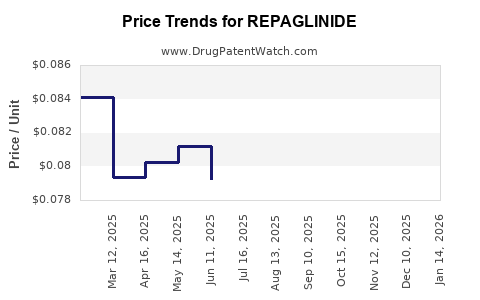
The current market is characterized by low unit prices, fragmented supply, and limited absolute revenue per manufacturer. Public company filings generally do not disclose standalone repaglinide revenue because the product is immaterial within large pharmaceutical portfolios and is often included in broader diabetes or legacy-product categories. [4]
| Financial driver |
Current direction |
Effect |
| Unit volume |
Stable to declining |
Diabetes prevalence supports demand, but newer drugs take share |
| Net price |
Downward |
Generic competition and payer substitution |
| Brand revenue |
Minimal or unavailable as a separate public line |
Loss of exclusivity |
| Generic gross margin |
Compressed over time |
More suppliers and pharmacy bargaining |
| Manufacturing value |
Moderate only at scale |
API and quality execution matter |
| Licensing value |
Low for legacy tablets |
Higher only for differentiated formulations |
| Investment case |
Defensive or niche |
Not a high-growth asset |
No reliable standalone global revenue estimate should be assigned without a defined geography, channel, and product scope. Market-research estimates often combine branded, generic, hospital, retail, and combination-product sales, producing inconsistent totals.
What licensing deals affect repaglinide?
Repaglinide's key commercial history is associated with Novo Nordisk's original development and commercialization. The product does not have the licensing profile of a recently discovered asset with active regional partnering.
Potential transaction value today would be concentrated in:
- Regional generic commercialization rights
- API supply agreements
- Fixed-dose combination rights
- Modified-release technology
- Contract manufacturing
- Portfolio acquisitions involving multiple mature diabetes products
A standalone license for ordinary repaglinide tablets would likely have limited strategic value because the active ingredient is off patent and alternative suppliers are available. The economics improve only where a partner offers market access, regulatory infrastructure, supply reliability, or a differentiated formulation.
What patent litigation affects repaglinide?
The major litigation risk occurred during the generic-entry period and centered on listed patents, infringement theories, and generic labeling. Current litigation exposure for conventional repaglinide is low because the principal patent barriers have expired.
Future litigation could arise from:
- Patent infringement claims involving a new formulation
- ANDA litigation for a new fixed-dose combination
- Trade-secret disputes involving API production
- Manufacturing quality claims
- Trademark disputes involving legacy branding
- Product-liability litigation involving hypoglycemia or drug interactions
Patent litigation is unlikely to support a durable premium for standard repaglinide tablets.
What geographic markets offer repaglinide opportunities?
Repaglinide has greater commercial relevance in markets where low-cost oral diabetes treatment remains the primary access pathway. Opportunities depend on local generic registration requirements, reimbursement, reference pricing, and the availability of competing sulfonylureas.
North America
The United States is a mature generic market with limited brand opportunity. Commercial success depends on efficient supply, retail contracting, and reliable availability. Canadian demand is also largely generic.
Europe
European markets are highly price regulated. National reimbursement systems can support volume but limit pricing. Reference pricing and tendering create pressure on manufacturers.
Asia-Pacific and emerging markets
Repaglinide can retain clinical and commercial relevance in markets where:
- Diabetes prevalence is increasing.
- Generic medicines dominate treatment.
- Newer therapies remain unaffordable.
- Meal-time dosing is clinically useful.
- Local manufacturers have established distribution.
Local competition is strong, and regulatory pathways vary. A regional strategy may be more attractive than a global branded launch.
What manufacturing and intellectual-property barriers exist?
Manufacturing barriers are manageable but not zero. A manufacturer must control:
- API identity, assay, impurities, and particle characteristics
- Tablet content uniformity at low dose strengths
- Dissolution performance
- Stability under local climatic conditions
- Packaging and moisture protection
- Bioequivalence across strengths and dosage conditions
- Supply continuity for API and excipients
The low dose of repaglinide increases the importance of blend uniformity and content uniformity. A company with an established oral-solid-dose plant can usually enter more efficiently than a company building a new facility.
The main IP barrier is no longer the active compound. Manufacturing patents may create narrow process constraints, but alternative synthesis routes can reduce their effect. Freedom-to-operate analysis remains necessary in each country because patent status and claim scope differ by jurisdiction.
When does repaglinide lose commercial exclusivity in major markets?
| Market |
Commercial status |
| United States |
Generic entry established; principal protection expired |
| European Union |
Generic and off-patent market |
| Japan |
Mature market with local regulatory and reimbursement considerations |
| China |
Generic competition and local registration requirements |
| India |
Generic market with multiple manufacturers |
| Latin America |
Predominantly price-sensitive, country-specific generic markets |
The relevant commercial question is no longer the date of initial patent expiry. It is whether a manufacturer can achieve sufficient volume and margin after generic substitution, tendering, and payer pressure.
Key Takeaways
- Repaglinide is a mature, off-patent small-molecule diabetes drug.
- Prandin received FDA approval in 1997 and lost principal U.S. patent protection in the early 2010s.
- Standard immediate-release tablets face low patent and regulatory barriers.
- Paragraph IV litigation is primarily historical; current generic-entry risk is already realized.
- Biosimilar risk does not apply because repaglinide is a conventional small molecule.
- PrandiMet provided a combination-product extension but did not create durable brand growth.
- Newer GLP-1, SGLT2, DPP-4, insulin, and metformin products constrain demand.
- Standalone current revenue is generally not disclosed by major pharmaceutical companies.
- Commercial value is concentrated in efficient generic manufacturing, regional distribution, API supply, and differentiated formulations.
- The strongest opportunity is a low-cost or formulation-specific strategy in price-sensitive markets, not a conventional branded relaunch.
FAQs About Repaglinide Market and Patent Strategy
Is repaglinide still profitable for generic manufacturers?
It can be profitable at scale, but margins are generally compressed. Profitability depends on manufacturing cost, supply reliability, market concentration, reimbursement, and the number of competing suppliers.
Can a company obtain new exclusivity for a repaglinide formulation?
Potentially. A genuinely novel modified-release system, fixed-dose combination, or clinically differentiated delivery technology could receive patent protection. Regulatory exclusivity would depend on the product and approval pathway, but a new patent would need meaningful technical and commercial differentiation.
Does repaglinide have biosimilar competition?
No. Repaglinide is a small-molecule drug, so competitors enter through generic drug applications rather than biosimilar applications.
Is repaglinide preferred over sulfonylureas for patients with irregular meals?
Its short pre-meal dosing profile can provide flexibility, but clinical selection depends on hypoglycemia risk, kidney function, drug interactions, cost, and the availability of therapies with cardiovascular, renal, or weight benefits.
Could repaglinide revenue increase if newer diabetes drugs become unaffordable?
Yes, volume can remain resilient or rise in price-sensitive markets if access to GLP-1 receptor agonists, SGLT2 inhibitors, and DPP-4 inhibitors is restricted. Higher volume would not necessarily produce higher manufacturer revenue because generic pricing would continue to limit value per unit.
References
- U.S. Food and Drug Administration. (2023). Prandin (repaglinide) prescribing information. FDA.
- U.S. Food and Drug Administration. (2024). Approved drug products with therapeutic equivalence evaluations: Orange Book. FDA.
- U.S. Food and Drug Administration. (2008). PrandiMet approval letter and prescribing information. FDA.
- Novo Nordisk A/S. (1998-2024). Annual reports and financial statements. Novo Nordisk.
- U.S. Patent and Trademark Office. (2024). Patent Center and Patent Examination Data System records for U.S. Patent Nos. 5,216,167 and 5,312,924. USPTO.