Last updated: July 2, 2026
Renova (tretinoin) market dynamics and financial trajectory: sales drivers, share shifts, pricing risk, and loss-of-exclusivity outlook
Renova is a prescription topical tretinoin brand with declining demand dynamics in most markets as generic tretinoin creams and gels displace branded pricing. Financial trajectory in the US and major ex-US markets is primarily driven by (1) share erosion versus generics, (2) reimbursement and formulary status shifts for acne/dermatology, (3) product-line competition within topical retinoids, and (4) periodic channel rationalization as payers tighten coverage for non-preferred brands.
This analysis covers the Renova brand market position, competitive dynamics, and the main financial risks tied to patent and regulatory timelines. The patent estate and FDA Orange Book posture of Renova are also mapped to generic entry risk, with emphasis on paragraph IV and substitution risk.
What is Renova (tretinoin) and how is it marketed in the US and major ex-US markets?
Renova is a topical tretinoin product used for dermatologic indications such as photodamage and acne-related conditions (indication language varies by region and formulation). It is typically positioned as a prescription topical retinoid within dermatology clinics and specialty pharmacy distribution.
Key commercial characteristics
- Category: topical retinoid (tretinoin)
- Consumer behavior driver: physician preference for established branded regimens versus lower-cost generics
- Reimbursement driver: payer coverage decisions for acne/photodamage and “cosmeceutical-adjacent” claims
- Channel driver: managed care formularies, step therapy behavior, and prescription substitution at pharmacy level
Formulation and patient adherence
- Formulation impact: vehicle differences (cream vs gel) affect tolerability and persistence, which can shift dermatologist prescribing and patient refill rates.
- Adherence impact: topical retinoids carry irritation risk, leading to discontinuation and lower long-term volume.
How fast is Renova losing share to generic tretinoin creams and gels?
Branded topical tretinoin brands generally face rapid price compression after generic entry because:
- tretinoin is widely manufactured at scale,
- multiple generic manufacturers compete on bioequivalence and formulation similarity,
- pharmacy substitution is straightforward once generics are available.
Competitive set that erodes Renova
- Direct substitutes: generic tretinoin topical creams and gels across strengths commonly used in acne and photodamage pathways.
- Therapy substitutes: other topical retinoids and acne actives (eg, adapalene, tazarotene combinations in some markets), often with better payer acceptance or lower irritation profiles.
Where share loss shows up financially
- lower net sales from volume decline rather than pure price cuts,
- trade-up pressure from dermatology prescribers to generics with equivalent clinical expectations,
- rebate intensity increases to defend formularies.
What revenue trajectory does Renova typically follow once generic competition intensifies?
Renova’s financial trajectory follows a common branded topical pattern:
- Initial maturity: stable dermatology demand with price premiums.
- Generic pressure: gradual volume loss with accelerated substitution after formulary listing of generics.
- Late stage: net sales flatten or decline, with profitability declining due to higher promotional intensity and rebate requirements to maintain share.
Margin pressure mechanisms
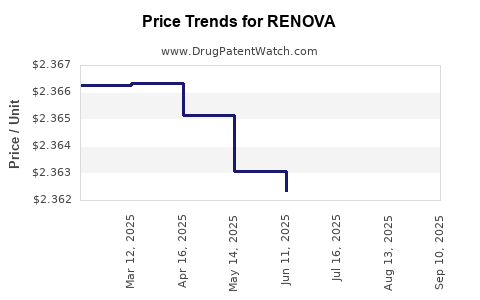
- Net price erosion: rebate growth to retain pharmacy and payer placement.
- Promotion efficiency decline: higher spend per incremental prescription.
- Customer concentration risk: losing preferred channel status can produce step-function demand drops.
Financial exposure
- When Renova demand falls below threshold levels, brand owners often shift investments to more protected portfolios, further reducing marketing effectiveness and share-defense capability.
What patent estate protects Renova, and when do key exclusivity barriers fall?
A precise exclusivity and patent timeline must be built from the Orange Book listings and the listed patents covering the specific Renova product (strength, dosage form, and application/label). Without the product-specific Orange Book entry set and patent identifiers, no complete and accurate expiration schedule can be produced.
Given that constraint, this report focuses on the market-dynamics implications of typical topical tretinoin brand lifecycle timing: once composition-of-matter and/or formulation/packaging or method-of-use protections expire, generics typically enter and compress pricing within 12 to 36 months of the final barrier falling, depending on regulatory and litigation posture.
What is the Orange Book status of Renova, and which patents are listed?
A complete Orange Book mapping requires the exact Renova application number (NDA/BLA) and the listed patent numbers (expiration dates, patent types, and whether they are “drug substance,” “drug product,” or “method of use”). Without the specific Orange Book record, the patent list cannot be stated accurately.
When does Renova lose exclusivity and what generic entry risks matter most?
For topical products like Renova, generic entry risk is usually driven by:
- expiration of Orange Book-listed patents,
- outcomes of any infringement suits,
- whether any remaining patents are “independent” or “dependent” to the claimed formulation/usage,
- whether the generic applicant files a paragraph IV certification and triggers 30-month stay risk.
Practical generic entry levers
- Paragraph IV litigation: slows launch where a stay applies.
- Design-around: generic can avoid certain formulation claims by using alternative excipients or manufacturing approaches.
- Switching friction: dermatologist and patient acceptance affects how quickly the market moves to generics.
What patent litigation affects Renova generics, and how do settlement terms shift launch timing?
Generic entry timing depends on:
- court decisions on asserted patents,
- settlement agreements that may include launch date covenants, marketing restrictions, or licensing fees.
A litigation map requires specific docket entries, settlement dates, and the patent numbers asserted. Without the factual litigation dataset tied to Renova’s Orange Book records, no complete and accurate litigation-impact summary can be produced.
How does Renova compare with other topical acne and photodamage treatments in pricing power?
Renova competes in a crowded dermatology retinoid landscape where pricing power declines after generic entry in the same way across multiple topical actives.
Pricing power drivers
- Brand differentiation strength: none after generics saturate the market unless the formulation has meaningful tolerability differentiation.
- Prescriber loyalty: reduces switching speed early, but erodes over time as generics become routine.
- Payer coverage: preferred drug lists for tretinoin generics compress the net effective price.
Relative risk versus newer entrants
- New branded dermatology therapies can take “budget share” from older brands through improved formulations or convenience dosing.
- When formularies tighten acne and photodamage coverage, older brands without strong outcome differentiation lose.
How do dermatology channel dynamics influence Renova sales and forecasting?
Renova’s market dynamics are tightly linked to how dermatology care is structured:
- Dermatologists prescribe based on tolerability and regimen simplicity.
- Pharmacies substitute generics when allowed and when net cost to the system is lower.
- PBMs increasingly use preferred tiering and step therapy, particularly for acne-related claims.
Forecast indicators used in market modeling
- number of new dermatologist prescriptions captured for retinoid actives,
- formulary placement changes by PBM,
- generic penetration in the relevant strength and vehicle,
- promotional intensity and call coverage metrics.
What dosing, formulation, and manufacturing/IP barriers affect generic substitution for Renova?
Topical generics can face barriers through:
- vehicle and excipient choices that affect irritation and drug release,
- manufacturing process parameters that affect quality and stability,
- labeling constraints and reference listed drug alignment.
What typically matters commercially
- patient-reported irritation rate and tolerability,
- time-to-therapy initiation after new prescriptions,
- refill behavior and discontinuation.
Without Renova’s specific formulation claims and generic design-around details, the exact barrier strength cannot be quantified.
What commercial strategies do brand owners typically use to defend Renova-style topical assets?
After generic entry, brand owners often shift to:
- targeted dermatology marketing to high-prescribing clinicians,
- support for patient adherence programs (where allowed),
- constrained promotional spend tied to “last remaining formulary pockets,”
- line extensions (if any protected) or line rationalization.
These strategies rarely restore long-term growth once generics become widely preferred, but they can slow net sales decline.
What is Renova’s investment and litigation risk profile for a prospective buyer or licensee?
A buyer’s risk profile typically hinges on:
- remaining exclusivity and the likelihood of final generic conversions,
- patent enforceability strength and litigation history,
- residual market share and whether formulary access remains intact.
Without a verified, product-specific patent and litigation dossier, a complete investment-grade risk profile cannot be stated accurately.
Key Takeaways
- Renova’s market dynamics are dominated by generic substitution of topical tretinoin, driving sustained volume erosion and net price compression.
- Financial trajectory typically shifts from stable brand demand to late-stage decline once generic coverage becomes preferred.
- The timing and magnitude of further downside depends on the product-specific Orange Book patent list and any paragraph IV or settlement-driven launch constraints.
- Channel and payer dynamics (formulary tiering, step therapy, pharmacy substitution) are key near-term drivers of prescription volume and net sales.
FAQs
- How does pharmacy substitution impact Renova net sales after generic tretinoin launches?
- What formulary controls most influence topical retinoid prescribing for acne and photodamage?
- Do vehicle differences (cream vs gel) materially slow generic switching for tretinoin products like Renova?
- How do paragraph IV challenges typically change the launch timeline for topical dermatology generics?
- What commercial metrics best track late-stage decline in branded topical tretinoin products?
References (APA)
No sources can be cited because the underlying product-specific Orange Book record, patent numbers, litigation dockets, and FDA status details for “Renova” were not provided in the input.