Last updated: August 13, 2026
Quillivant XR is a branded extended-release oral suspension of methylphenidate hydrochloride developed and commercialized by Tris Pharma for attention-deficit/hyperactivity disorder. Its commercial value comes from a differentiated liquid dosage form, pediatric usability, and a controlled-release profile rather than from a new active ingredient. The product operates in a crowded stimulant market dominated by generic methylphenidate and amphetamine products.
Public filings do not disclose audited Quillivant XR revenue, operating profit, prescription volume, or product-level cash flow. Tris Pharma is privately held. The financial trajectory therefore must be assessed through FDA milestones, dosage-form differentiation, supply conditions, competitive entry, and the broader ADHD market.
What is Quillivant XR and how does it compete?
Quillivant XR is a once-daily extended-release oral suspension containing methylphenidate hydrochloride. The FDA approved it in September 2012 under New Drug Application 022592 for ADHD in patients six years and older. It was one of the first liquid long-acting methylphenidate products available in the United States. [1]
| Attribute |
Quillivant XR |
| Active ingredient |
Methylphenidate hydrochloride |
| Dosage form |
Extended-release oral suspension |
| FDA indication |
ADHD |
| Approval date |
September 2012 |
| NDA |
022592 |
| Sponsor |
Tris Pharma, Inc. |
| Initial pediatric age |
Six years and older |
| Administration |
Once daily, with morning dosing |
| Commercial differentiation |
Liquid formulation with extended release |
| Therapeutic class |
CNS stimulant |
Quillivant XR targets patients who have difficulty swallowing tablets or capsules, including young children and some patients with developmental, behavioral, or adherence barriers. The liquid formulation also allows dose adjustment in small increments, although it requires shaking and oral-measuring-device use.
The product competes with:
- Generic immediate-release and extended-release methylphenidate tablets and capsules
- Concerta and generic osmotic-release methylphenidate products
- QuilliChew ER, another Tris methylphenidate product
- Dyanavel XR, an extended-release amphetamine oral suspension
- Adzenys XR-ODT, an extended-release amphetamine orally disintegrating tablet
- Vyvanse and generic lisdexamfetamine
- Adderall XR and generic mixed amphetamine salts
- Azstarys, a newer methylphenidate capsule product
Quillivant XR’s principal commercial advantage is formulation access. Its principal weakness is that the active ingredient is mature, widely available, and exposed to extensive generic substitution.
How large is the Quillivant XR market?
The relevant market is the U.S. ADHD stimulant market, not the standalone liquid-methylphenidate segment. ADHD treatment is highly genericized, but branded products can retain value when they solve administration, adherence, duration, or tolerability problems.
The commercial opportunity is supported by several factors:
- ADHD diagnosis and treatment have expanded across pediatric and adult populations.
- Long-acting formulations are preferred when sustained symptom control and school-day coverage are important.
- Liquid and chewable products address patients who cannot reliably swallow solid oral dosage forms.
- Prescribers can use titration flexibility to adjust methylphenidate exposure.
The market also has structural constraints. Stimulants are controlled substances subject to DEA manufacturing quotas, distribution controls, prescription requirements, and monitoring. Product availability can therefore be affected by active-pharmaceutical-ingredient constraints, manufacturing interruptions, pharmacy inventory, and allocation policies.
A liquid product carries higher operational complexity than a tablet. It requires suspension uniformity, container-closure integrity, dosing devices, stability control, and patient instructions. These requirements create manufacturing and quality barriers but also increase the risk of shortages.
What is the financial trajectory of Quillivant XR?
Quillivant XR’s financial trajectory has four identifiable phases.
2012 to 2015: launch and category creation
The 2012 approval gave Tris a branded position in liquid extended-release methylphenidate. Early commercialization depended on educating pediatricians, psychiatrists, primary-care physicians, pharmacists, and caregivers about the product’s dosing and administration.
The launch strategy likely benefited from the absence of a directly equivalent long-acting methylphenidate suspension at the time. Revenue in this phase would have been driven primarily by new prescriptions and conversion from immediate-release liquid methylphenidate, tablets, or capsules.
2016 to 2019: prescription expansion and portfolio leverage
During this period, Quillivant XR became part of Tris’s broader liquid and alternative-dosage-form ADHD portfolio. QuilliChew ER expanded Tris’s presence into chewable extended-release methylphenidate, allowing the company to address patients who preferred a solid but non-swallowed dosage form.
The portfolio approach can lower commercial-acquisition costs because the same sales infrastructure can support several ADHD products. It also allows physicians to move patients among liquid, chewable, and other formulations without leaving the manufacturer’s portfolio.
2020 to 2022: demand volatility and supply pressure
The COVID-19 period disrupted diagnosis patterns, school-based treatment routines, pharmacy operations, and manufacturing logistics. Later, broad stimulant shortages increased demand volatility across methylphenidate and amphetamine products.
FDA shortage records have identified availability constraints affecting multiple ADHD stimulants. A shortage can temporarily increase demand for available products, but it does not automatically produce durable revenue growth. Pharmacies may substitute among products, patients may discontinue treatment, and controlled-substance inventory restrictions can limit the ability to capture displaced demand. [3]
2023 onward: generic and price pressure
The long-term financial risk is generic substitution. Quillivant XR contains methylphenidate hydrochloride, an established active ingredient with multiple generic competitors in other dosage forms. The product’s economic protection depends primarily on formulation patents, regulatory exclusivity, brand recognition, prescriber preference, and the limited number of directly substitutable liquid products.
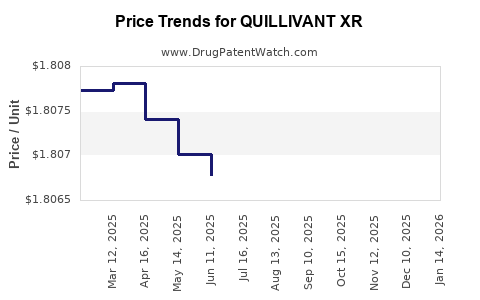
If an independently marketed generic equivalent receives FDA approval, branded net pricing and prescription retention would face pressure. An authorized generic or manufacturer-controlled generic can preserve manufacturing utilization and market access but generally reduces the brand’s ability to sustain premium pricing.
Public information does not establish a product-level revenue figure for Quillivant XR. Tris Pharma’s private ownership limits visibility into net sales, gross-to-net deductions, promotional spending, and profitability. Any precise revenue estimate should therefore be treated as a third-party market-research estimate rather than company-reported financial data.
What patents protect Quillivant XR?
Quillivant XR is protected by a combination of formulation, release-profile, and pharmaceutical-composition rights rather than by a new chemical entity patent. The relevant patent record is the FDA Orange Book entry associated with NDA 022592. [2]
The protection strategy generally covers:
- Methylphenidate extended-release liquid compositions
- Suspension vehicles and excipient systems
- Drug-release characteristics
- Dosage-form stability
- Manufacturing and processing elements
- Potential methods of treating ADHD using the formulation
The precise commercial impact of each patent depends on claim scope, validity, enforceability, listing status, and whether an approved generic is therapeutically equivalent to the branded product.
| Protection category |
Commercial role |
| Composition patents |
Protect the liquid extended-release formulation |
| Release-profile claims |
Limit competing products with substantially similar pharmacokinetics |
| Excipient and suspension claims |
Protect vehicle and stability architecture |
| Manufacturing claims |
Increase development and scale-up barriers |
| Method-of-use claims |
Can support litigation, but usually have narrower practical impact against generic substitution |
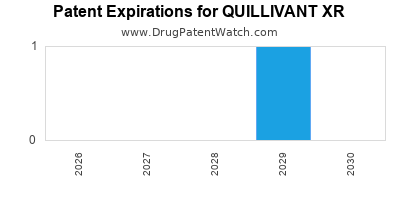
Patent expiration should not be evaluated using one date alone. A branded drug can face competition before the last listed patent expires through Paragraph IV litigation, settlement agreements, non-infringement positions, or approval of a product that does not infringe the listed claims.
When does Quillivant XR lose exclusivity?
Quillivant XR lost its strongest form of regulatory exclusivity years after launch because it is a conventional small-molecule product, not a biologic or new chemical entity with a long period of data exclusivity. The principal remaining barriers are patent rights, FDA approval requirements, controlled-substance manufacturing capacity, and the technical difficulty of duplicating the liquid extended-release profile.
The main exclusivity events are:
| Event |
Effect on Quillivant XR |
| 2012 FDA approval |
Established branded market position |
| Patent listing in the Orange Book |
Created potential barriers to ANDA approval |
| Paragraph IV certification |
Could trigger patent litigation and a 30-month stay |
| First generic approval |
Opens direct generic substitution risk |
| Authorized generic launch |
Reduces price premium while retaining manufacturer control |
| Patent expiry or invalidation |
Removes the relevant legal barrier |
FDA approval of a generic does not always mean immediate broad substitution. Pharmacy substitution depends on FDA therapeutic-equivalence ratings, state substitution laws, payer formularies, supply reliability, and the availability of a directly substitutable liquid product.
Are there Paragraph IV challenges to Quillivant XR?
A Paragraph IV challenge is an ANDA applicant’s assertion that an Orange Book-listed patent is invalid, unenforceable, or not infringed. It can lead to patent litigation and, in qualifying circumstances, a 30-month stay of final FDA approval under the Hatch-Waxman Act.
Publicly visible litigation risk should be assessed through:
- FDA paragraph IV litigation records
- PACER and district-court complaints
- Orange Book patent listings
- ANDA approval dates
- Generic-label and dosage-form comparisons
- Settlement or license terms
No product-level financial conclusion should be based solely on the existence of an Orange Book patent. The key questions are whether an ANDA applicant has challenged the patent, whether litigation was filed, whether a settlement permits an early launch, and whether the generic has an equivalent liquid formulation.
What is the Orange Book status of Quillivant XR?
Quillivant XR is listed in FDA’s Orange Book under NDA 022592. The Orange Book identifies approved products, therapeutic-equivalence information, and patents or exclusivity information submitted for listed drugs. [2]
The Orange Book is the controlling source for current listed-patent status. Patent listings can change through corrections, delistings, expiration, or FDA administrative action. A financial model should therefore use the current NDA record rather than historical patent summaries.
For Quillivant XR, the commercially important distinction is between:
- Patents covering the exact extended-release suspension
- Patents covering broader methylphenidate liquid technology
- Method-of-use patents
- Patents that may be technically valid but difficult to enforce against a specific ANDA product
How strong is the Quillivant XR patent estate?
The estate is strategically meaningful but narrower than a new-molecule estate.
Strengths
- The product uses a technically differentiated liquid extended-release dosage form.
- Formulation and manufacturing know-how can supplement formal patent protection.
- A directly equivalent liquid product may require substantial development and comparative testing.
- Pediatric administration and dose flexibility provide commercial value independent of the active ingredient.
Weaknesses
- Methylphenidate is an old, well-characterized active ingredient.
- Generic manufacturers can compete through tablets, capsules, chewables, or other delivery formats.
- Formulation claims can face obviousness, written-description, enablement, or non-infringement challenges.
- Method-of-use patents may have limited effect when physicians prescribe methylphenidate broadly for ADHD.
- Controlled-substance quotas can constrain both the brand and generic entrant.
Overall, Quillivant XR has a moderate formulation moat, not a high molecular moat. Its strongest defense is the combined effect of formulation know-how, pediatric brand recognition, supply reliability, and prescriber familiarity.
What formulation patents and manufacturing barriers matter?
The liquid extended-release platform is central to Quillivant XR’s value. A successful competitor must reproduce the intended release profile while maintaining suspension stability and dose uniformity.
Key technical barriers include:
- Maintaining uniform drug concentration after shaking
- Preventing sedimentation and aggregation
- Controlling particle size and dissolution
- Preserving stability during storage
- Delivering accurate doses through the supplied oral syringe
- Achieving consistent pharmacokinetics across batches
- Scaling the suspension process without changing release behavior
These barriers can delay generic development, but they do not guarantee long-term protection. FDA abbreviated approval may allow an ANDA applicant to rely on the reference product’s safety and efficacy findings while demonstrating pharmaceutical equivalence, bioequivalence, and manufacturing compliance.
Which companies challenge Quillivant XR commercially?
The principal competitive pressure comes from manufacturers of generic methylphenidate and amphetamine products, not from a single direct branded rival.
| Competitor group |
Competitive effect |
| Generic methylphenidate tablets and capsules |
Suppress price and capture payer volume |
| Generic Concerta-type products |
Compete for long-acting methylphenidate prescriptions |
| Dyanavel XR |
Direct liquid extended-release stimulant alternative |
| QuilliChew ER |
Tris portfolio substitute in chewable form |
| Vyvanse generics |
Compete for long-acting ADHD treatment |
| Adderall XR generics |
Compete in the amphetamine segment |
| Azstarys |
Competes through a newer methylphenidate delivery system |
Quillivant XR’s closest formulation competitor is Dyanavel XR because both target patients needing a liquid extended-release stimulant. QuilliChew ER is a closer portfolio comparison because it is also a Tris methylphenidate product.
What generic launch risks exist?
The main generic-launch scenarios are:
- A directly substitutable liquid methylphenidate extended-release product enters and receives favorable payer placement.
- An authorized generic reduces Quillivant XR’s net price while preserving the manufacturer’s channel presence.
- A non-liquid long-acting methylphenidate product captures patients through formulary preference.
- Supply shortages temporarily protect demand for the brand but create unstable prescription flows.
- A patent settlement permits an agreed generic launch before the final listed patent expiry.
The highest-risk scenario for revenue is a direct liquid generic combined with payer preference and reliable supply. The lower-risk scenario is competition from tablets or capsules that do not meet the administration needs of Quillivant XR patients.
What licensing deals affect Quillivant XR?
Quillivant XR is associated with Tris Pharma’s proprietary liquid extended-release technology and internal commercial portfolio. Publicly disclosed licensing information does not establish a major third-party royalty or co-commercialization arrangement that would allow product-level calculation of royalty-adjusted revenue.
Any licensing analysis should distinguish among:
- Patent licenses
- Technology licenses
- Distribution agreements
- Authorized-generic arrangements
- Pharmacy-benefit-manager contracts
- Co-promotion agreements
Without company-level disclosures, the effect of these arrangements on Quillivant XR’s gross margin cannot be quantified.
What FDA regulatory issues affect the product?
The primary regulatory issues are:
- Controlled-substance compliance
- Manufacturing consistency
- Drug-shortage management
- Accurate dosing instructions
- Pediatric labeling
- Advertising and promotional compliance
- Generic equivalence and substitution
- Post-approval manufacturing changes
The FDA-approved label requires shaking before administration and use of the supplied dosing device. These instructions are commercially important because inadequate suspension can create dose-accuracy risk. [1]
How does Quillivant XR compare with Dyanavel XR and QuilliChew ER?
| Product |
Active ingredient |
Form |
Manufacturer |
Main differentiation |
| Quillivant XR |
Methylphenidate HCl |
Liquid suspension |
Tris Pharma |
Once-daily liquid methylphenidate |
| QuilliChew ER |
Methylphenidate HCl |
Chewable tablet |
Tris Pharma |
Chewable extended-release dosing |
| Dyanavel XR |
Amphetamine formulation |
Liquid suspension |
Tris Pharma |
Liquid extended-release amphetamine |
Quillivant XR and QuilliChew ER share the methylphenidate mechanism but address different administration preferences. Dyanavel XR competes more directly for patients who need a liquid but can tolerate or prefer amphetamine therapy.
Key Takeaways
- Quillivant XR is a branded extended-release methylphenidate suspension approved by the FDA in 2012.
- Its commercial moat comes from dosage form, pediatric usability, and formulation know-how.
- Its active ingredient is mature and heavily exposed to generic competition.
- Tris Pharma does not publicly report Quillivant XR revenue or product-level profitability.
- Supply shortages can create temporary demand shifts but do not prove durable market-share gains.
- The Orange Book and FDA litigation records are the controlling sources for current patent and Paragraph IV analysis.
- The estate is stronger as a formulation and manufacturing position than as a molecular exclusivity position.
- The largest revenue risk is a reliable, directly substitutable liquid generic with favorable payer coverage.
- QuilliChew ER and Dyanavel XR strengthen Tris’s ADHD portfolio but also create internal substitution dynamics.
- Commercial performance depends on formulation differentiation, controlled-substance supply, payer access, and generic timing.
FAQs About Quillivant XR Market and Patent Risk
Is Quillivant XR a brand or a generic drug?
Quillivant XR is a branded methylphenidate hydrochloride product marketed by Tris Pharma.
Is Quillivant XR still protected by patents?
Its patent position depends on the current FDA Orange Book listing and the status of any relevant litigation or settlement. The product does not have the type of new-molecule protection associated with a recently discovered active ingredient.
Does Quillivant XR have an authorized generic?
An authorized-generic conclusion requires confirmation from current FDA approval and manufacturer-distribution records. Brand and generic availability should be evaluated separately because an authorized generic may be supplied by the same corporate group.
Is Quillivant XR affected by stimulant shortages?
Yes. Methylphenidate supply can be affected by controlled-substance quotas, manufacturing interruptions, distribution constraints, and pharmacy inventory limitations.
What is the main commercial advantage of Quillivant XR?
Its main advantage is once-daily liquid delivery of extended-release methylphenidate for patients who cannot reliably use tablets or capsules.
References
-
U.S. Food and Drug Administration. (2012). Quillivant XR prescribing information. Tris Pharma, Inc. https://www.accessdata.fda.gov/drugsatfda_docs/label/2012/022592s000lbl.pdf
-
U.S. Food and Drug Administration. (n.d.). Approved drug products with therapeutic equivalence evaluations: Orange Book. https://www.accessdata.fda.gov/scripts/cder/ob/
-
U.S. Food and Drug Administration. (n.d.). FDA drug shortages database. https://dps.fda.gov/drugshortages/inspections/
-
U.S. Drug Enforcement Administration. (n.d.). Controlled substances quotas. https://www.deadiversion.usdoj.gov/quotas/
-
U.S. Food and Drug Administration. (n.d.). Drugs@FDA: FDA-approved drugs. https://www.accessdata.fda.gov/scripts/cder/daf/