Share This Page
PYRAZINAMIDE Drug Patent Profile
✉ Email this page to a colleague
When do Pyrazinamide patents expire, and when can generic versions of Pyrazinamide launch?
Pyrazinamide is a drug marketed by Hikma, Macleods Pharms, and Novitium Pharma. and is included in three NDAs.
The generic ingredient in PYRAZINAMIDE is pyrazinamide. There is one drug master file entry for this compound. Five suppliers are listed for this compound. Additional details are available on the pyrazinamide profile page.
DrugPatentWatch® Litigation and Generic Entry Outlook for Pyrazinamide
A generic version of PYRAZINAMIDE was approved as pyrazinamide by NOVITIUM PHARMA on December 31st, 1969.
AI Deep Research
Questions you can ask:
- What is the 5 year forecast for PYRAZINAMIDE?
- What are the global sales for PYRAZINAMIDE?
- What is Average Wholesale Price for PYRAZINAMIDE?
Summary for PYRAZINAMIDE
| US Patents: | 0 |
| Applicants: | 3 |
| NDAs: | 3 |
| Finished Product Suppliers / Packagers: | 5 |
| Raw Ingredient (Bulk) Api Vendors: | 1 |
| Clinical Trials: | 136 |
| Patent Applications: | 4,429 |
| Drug Prices: | Drug price information for PYRAZINAMIDE |
| DailyMed Link: | PYRAZINAMIDE at DailyMed |
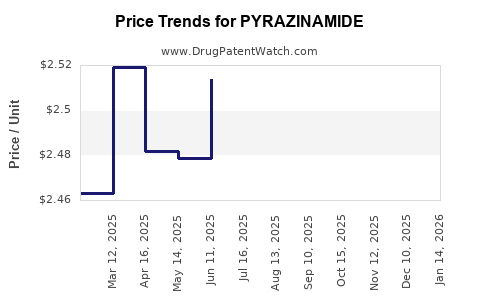
Recent Clinical Trials for PYRAZINAMIDE
Identify potential brand extensions & 505(b)(2) entrants
| Sponsor | Phase |
|---|---|
| University of Minnesota | PHASE2 |
| Infectious Diseases Institute | PHASE2 |
| Huashan Hospital | PHASE3 |
Pharmacology for PYRAZINAMIDE
| Drug Class | Antimycobacterial |
Medical Subject Heading (MeSH) Categories for PYRAZINAMIDE
Anatomical Therapeutic Chemical (ATC) Classes for PYRAZINAMIDE
US Patents and Regulatory Information for PYRAZINAMIDE
| Applicant | Tradename | Generic Name | Dosage | NDA | Approval Date | TE | Type | RLD | RS | Patent No. | Patent Expiration | Product | Substance | Delist Req. | Exclusivity Expiration |
|---|---|---|---|---|---|---|---|---|---|---|---|---|---|---|---|
| Hikma | PYRAZINAMIDE | pyrazinamide | TABLET;ORAL | 081319-001 | Jun 30, 1992 | AB | RX | No | Yes | ⤷ Start Trial | ⤷ Start Trial | ⤷ Start Trial | |||
| Macleods Pharms | PYRAZINAMIDE | pyrazinamide | TABLET;ORAL | 212541-001 | Jul 27, 2020 | AB | RX | No | No | ⤷ Start Trial | ⤷ Start Trial | ⤷ Start Trial | |||
| Novitium Pharma | PYRAZINAMIDE | pyrazinamide | TABLET;ORAL | 080157-001 | Approved Prior to Jan 1, 1982 | AB | RX | Yes | No | ⤷ Start Trial | ⤷ Start Trial | ⤷ Start Trial | |||
| >Applicant | >Tradename | >Generic Name | >Dosage | >NDA | >Approval Date | >TE | >Type | >RLD | >RS | >Patent No. | >Patent Expiration | >Product | >Substance | >Delist Req. | >Exclusivity Expiration |
Pyrazinamide Market Dynamics, Patent Status, and Financial Trajectory
Pyrazinamide is an established, low-cost tuberculosis medicine with no meaningful branded pricing power, no material active composition-patent barrier, and limited standalone financial disclosure. Its commercial value is driven by public-health procurement, fixed-dose combination demand, country tenders, and global tuberculosis incidence rather than by private retail growth. The drug remains clinically important because it is part of the standard six-month treatment regimen for drug-susceptible tuberculosis, but its revenue trajectory is structurally flat to modestly growing.
What is the current market position of pyrazinamide?
Pyrazinamide is a first-line antituberculosis active ingredient used with rifampicin, isoniazid, and ethambutol during the intensive phase of treatment. The standard adult regimen for drug-susceptible pulmonary tuberculosis is generally two months of rifampicin, isoniazid, pyrazinamide, and ethambutol, followed by four months of rifampicin and isoniazid. Treatment varies by patient group, resistance profile, and national guidance.
The drug is commercially mature:
| Market attribute | Pyrazinamide position |
|---|---|
| Therapeutic class | Antituberculosis agent |
| Primary use | Drug-susceptible tuberculosis |
| Common strengths | 500 mg and 750 mg tablets; country-specific availability |
| Dosage forms | Immediate-release tablets; oral fixed-dose combinations |
| FDA status | Prescription drug; approved generic products |
| Innovation status | Mature small molecule |
| Patent barrier | No meaningful current composition-patent barrier |
| Main buyers | Ministries of health, global procurement agencies, hospitals, wholesalers |
| Pricing model | Generic, tender-driven, volume-based |
| Standalone revenue disclosure | Generally unavailable |
| Main commercial growth driver | Tuberculosis treatment volume and procurement coverage |
The World Health Organization estimated 10.8 million people developed tuberculosis in 2023, including approximately 1.25 million deaths among HIV-negative people and 161,000 deaths among people with HIV. Tuberculosis therefore creates a large treatment requirement, but pyrazinamide captures only a small portion of regimen spending because the active ingredient is inexpensive and usually purchased as part of a combination regimen. [1]
What patents protect pyrazinamide?
No active composition-of-matter patent is expected to protect pyrazinamide in the major commercial markets. Pyrazinamide was identified and developed many decades ago, placing any original compound protection well outside the ordinary patent term.
Are there active pyrazinamide patents in the United States?
The commercial risk from U.S. patent protection is low. Pyrazinamide is an old, conventional small molecule, and generic products have long been available. Any historical compound patent would have expired decades ago.
Potentially relevant rights could still arise around:
- Fixed-dose combinations containing pyrazinamide
- Modified-release or specialty delivery systems
- Manufacturing and purification processes
- Pediatric formulations
- Specific treatment regimens
- Combination products for drug-resistant tuberculosis
Those rights would not normally prevent sale of a conventional immediate-release pyrazinamide tablet unless the product practices the claimed formulation, process, or method.
What is the Orange Book status of pyrazinamide?
Pyrazinamide does not have the commercial profile of a single-source Orange Book product. FDA-approved pyrazinamide products are generic prescription medicines, and the principal competitive issue is abbreviated new drug application approval rather than branded patent litigation.
The FDA Orange Book identifies approved drug products and, where applicable, listed patents and exclusivity. For mature pyrazinamide products, there is no widely recognized active patent estate equivalent to the estates associated with newer branded drugs. [2]
When does pyrazinamide lose exclusivity?
Pyrazinamide lost meaningful market exclusivity decades ago. The relevant distinction is between historical product exclusivity and current regulatory market access.
| Exclusivity category | Status |
|---|---|
| Original chemical patent | Expired decades ago |
| Regulatory exclusivity | No commercially meaningful current exclusivity |
| Generic approval pathway | ANDA or equivalent national generic pathway |
| Orphan exclusivity | Not applicable to the established tuberculosis indication |
| Pediatric exclusivity | No known market-defining exclusivity |
| Biosimilar exclusivity | Not applicable; pyrazinamide is a small molecule |
| Formulation exclusivity | Could apply only to a specifically protected product |
| Method-of-use exclusivity | Could apply to a narrow patented regimen, but not the base drug |
Pyrazinamide is therefore exposed to ordinary generic competition. Entry does not depend on challenging a valuable active ingredient patent.
Which companies manufacture or supply pyrazinamide?
The supplier base is fragmented and country-specific. Generic manufacturers, regional pharmaceutical companies, and public-health suppliers produce pyrazinamide as a standalone tablet or in fixed-dose combinations.
Commercial supply can involve:
- Indian generic manufacturers
- Chinese pharmaceutical manufacturers
- European and U.S. generic companies
- Regional suppliers in Africa, Latin America, and Southeast Asia
- WHO-prequalified manufacturers supplying public tenders
- Contract manufacturers producing tablets for government programs
Supplier identity varies by market and procurement cycle. Public tenders often change winning vendors based on price, quality documentation, delivery performance, regulatory status, and available manufacturing capacity.
What formulations are protected by pyrazinamide patents?
The most commercially relevant formulation opportunity is not conventional pyrazinamide itself. It is the delivery and packaging of multi-drug tuberculosis therapy.
Potential protected technologies include:
- Fixed-dose combinations containing rifampicin, isoniazid, pyrazinamide, and ethambutol.
- Pediatric dispersible tablets.
- Taste-masked formulations.
- Modified-release tablets.
- Coated tablets designed to improve stability or reduce gastrointestinal effects.
- Combination products intended to simplify adherence.
- Manufacturing processes that improve content uniformity or stability.
These technologies can create product-level differentiation, but their commercial value is constrained by low procurement prices and the need to satisfy national tuberculosis-program specifications.
How large is the pyrazinamide market?
A reliable global standalone market value is not publicly disclosed. Public-company filings generally report broader segments such as anti-infectives, generics, or emerging markets rather than pyrazinamide revenue.
The market can be assessed through demand rather than reported sales:
- Global tuberculosis incidence is above 10 million cases annually. [1]
- Pyrazinamide is used in the initial phase of standard drug-susceptible treatment.
- A treatment course generally requires approximately 50 to 60 daily doses, subject to regimen and patient weight.
- Drug procurement is concentrated among national tuberculosis programs and international financing mechanisms.
- Fixed-dose combinations account for a substantial portion of programmatic demand.
- Unit prices are low, limiting revenue even when treatment volumes are high.
Assuming roughly 10 million annual incident tuberculosis cases, the addressable need for treatment courses is large. The actual pyrazinamide volume is lower because of underdiagnosis, incomplete treatment initiation, drug resistance, contraindications, treatment substitution, and supply interruptions.
A simplified demand framework is:
| Variable | Commercial effect |
|---|---|
| Tuberculosis incidence | Increases treatment-course demand |
| Diagnosis rate | Converts epidemiological need into purchases |
| Treatment initiation | Determines actual drug volume |
| Use of fixed-dose combinations | Shifts revenue from standalone tablets to combination suppliers |
| Drug-resistant tuberculosis | Can reduce or alter pyrazinamide use |
| Pediatric treatment | Creates demand for dispersible formulations |
| Tender competition | Compresses price per dose |
| Procurement funding | Determines purchasing continuity |
What is the financial trajectory for pyrazinamide?
The financial trajectory is best characterized as stable volume with persistent price pressure.
Revenue outlook
Pyrazinamide is unlikely to generate meaningful standalone growth for a diversified pharmaceutical company. Its financial performance typically follows five conditions:
- Stable or rising tuberculosis treatment volumes
- Continued use in first-line regimens
- Expansion of diagnosis and treatment coverage
- Increased use of fixed-dose combinations
- Competitive tender pricing
Revenue can rise in nominal terms if more patients are diagnosed or if procurement programs expand. Margin expansion is unlikely because the product is readily substitutable and buyers have substantial negotiating power.
Profitability profile
The product has a low-to-moderate manufacturing cost but low selling prices. Profitability depends on scale, plant utilization, formulation complexity, and access to regulated or public-sector markets.
Standalone conventional tablets generally have limited gross-margin potential. Better economics may be available in:
- High-volume government contracts
- WHO-prequalified products
- Pediatric dispersible tablets
- Integrated fixed-dose combinations
- Markets with limited local competition
- Contract manufacturing agreements
The product is less attractive when sold through fragmented private channels because distribution costs can be high relative to the tablet price.
Financial trajectory by time horizon
| Period | Expected trajectory |
|---|---|
| 2020-2023 | Demand affected by COVID-19 disruption to tuberculosis diagnosis and treatment |
| 2023-2025 | Recovery in tuberculosis services and procurement volumes |
| 2025-2030 | Low-single-digit nominal growth is plausible if treatment coverage expands, but pricing remains pressured |
| Long term | Stable public-health demand; limited innovation-driven expansion |
The 2020-2022 period disrupted tuberculosis case finding and treatment initiation. WHO reported that tuberculosis remained a major global health burden and that service disruptions caused a decline in reported diagnosis during the pandemic period. [1] Recovery in case detection supports demand, but the effect is more likely to restore prior volumes than create sustained pricing power.
What competitive forces affect pyrazinamide pricing?
Pyrazinamide operates in a buyer-controlled market.
Procurement concentration
National tuberculosis programs and international procurement agencies can purchase large volumes through competitive tenders. This structure favors suppliers with:
- Low cost of goods
- Reliable active pharmaceutical ingredient access
- Validated manufacturing processes
- Regulatory approvals
- WHO prequalification where required
- Strong supply-chain performance
- Capacity to meet large, recurring orders
Product substitutability
For conventional immediate-release tablets, substitution is high. Buyers can switch suppliers if the product meets quality and regulatory requirements. The strongest differentiation is therefore operational rather than scientific.
Fixed-dose combination pressure
Fixed-dose combinations can reduce the role of standalone pyrazinamide tablets. They improve pill burden and may support adherence, but they also concentrate purchasing with manufacturers able to produce and register multiple active ingredients in one product.
A supplier that sells only pyrazinamide tablets may lose share to a company offering the complete four-drug combination.
What regulatory status does pyrazinamide have?
Pyrazinamide is an established prescription medicine approved in multiple jurisdictions. In the United States, generic products are approved through the abbreviated pathway when they meet requirements for pharmaceutical equivalence, bioequivalence, manufacturing quality, and labeling.
Key regulatory issues include:
- Hepatotoxicity monitoring as part of tuberculosis treatment
- Dose adjustment or clinical caution in hepatic disease
- Renal dosing considerations
- Hyperuricemia and gout-related adverse effects
- Product quality and assay uniformity
- Stability in fixed-dose combinations
- Pediatric dispersibility and dose accuracy
- Compliance with national tuberculosis-program guidance
FDA labeling identifies pyrazinamide as part of combination therapy for active tuberculosis and warns about hepatic toxicity and other adverse reactions. [3]
Are there Paragraph IV challenges involving pyrazinamide?
Paragraph IV litigation is not a material current risk for conventional pyrazinamide. A Paragraph IV certification is relevant when an ANDA applicant seeks approval for a product listed against patents in the FDA Orange Book and asserts that the patents are invalid, unenforceable, or will not be infringed.
For pyrazinamide:
- The original compound protection has expired.
- The product is generic and mature.
- There is no widely recognized patent barrier controlling ordinary tablet entry.
- Litigation risk would be more likely for a novel fixed-dose combination or specialty formulation.
- Any dispute would need to focus on a specific listed patent, not pyrazinamide as an old active ingredient.
The absence of a major Paragraph IV dispute reduces launch uncertainty for standard products but also limits the ability of a supplier to preserve market share through intellectual property.
What patent litigation affects pyrazinamide?
No major ongoing patent litigation is broadly associated with conventional pyrazinamide tablets. Litigation exposure is more likely to arise indirectly through:
- Combination products containing other protected ingredients
- Device or packaging rights
- Manufacturing patents
- Procurement or regulatory disputes
- Trademark or labeling disputes
- Contract disputes between suppliers and public purchasers
The patent estate for pyrazinamide itself is weak because the active ingredient is old and widely available. A new formulation would require claim scope that is technically specific, commercially relevant, and enforceable in the target jurisdictions.
How strong is the pyrazinamide patent estate?
The base-drug patent estate is weak. The commercial defensibility of a pyrazinamide product depends more on regulatory status, manufacturing scale, procurement relationships, and quality records than on patent ownership.
| Patent factor | Assessment |
|---|---|
| Composition-of-matter protection | Effectively absent |
| New chemical entity exclusivity | Expired |
| Conventional tablet protection | Weak or absent |
| Fixed-dose combination protection | Product-specific |
| Pediatric formulation protection | Potentially stronger if technically differentiated |
| Manufacturing patents | Narrow and process-dependent |
| Method-of-use patents | Limited practical value for standard tuberculosis treatment |
| Freedom-to-operate risk | Low for ordinary tablets; higher for novel combinations |
| Litigation leverage | Low |
| Licensing value | Limited unless tied to a differentiated formulation or procurement platform |
What licensing deals involve pyrazinamide?
Pyrazinamide has limited standalone licensing value. Licensing is more likely to involve a broader tuberculosis product portfolio, a fixed-dose combination, a pediatric formulation, or a public-health manufacturing arrangement.
Potential transaction structures include:
- Technology licensing for dispersible tablets
- Contract manufacturing and supply agreements
- Regional commercialization rights
- Government procurement framework agreements
- Technology transfer for fixed-dose combinations
- Voluntary licensing linked to access programs
There is no widely reported blockbuster-style licensing transaction centered on pyrazinamide as a standalone active ingredient. Its commercial value is usually embedded in a multi-drug tuberculosis portfolio.
What generic entry risks exist for pyrazinamide?
Generic entry risk is already realized rather than prospective. The market has long been genericized.
The principal risks to an incumbent supplier are:
- Price erosion from new tender participants.
- Loss of contracts after a procurement-cycle change.
- Replacement of standalone tablets by fixed-dose combinations.
- Manufacturing interruptions or active pharmaceutical ingredient shortages.
- Quality findings or regulatory observations.
- Reduced tuberculosis diagnosis and treatment initiation.
- Shift toward alternative regimens for resistant disease.
- Failure to meet pediatric or WHO procurement specifications.
For a new entrant, the principal barrier is not patents. It is the ability to secure approvals, validate quality, qualify for tenders, and operate profitably at low prices.
How does pyrazinamide compare with other tuberculosis drugs?
| Drug | Role in standard therapy | Patent strength | Commercial profile |
|---|---|---|---|
| Pyrazinamide | Intensive-phase component | Very weak | Low-cost, high-volume generic |
| Isoniazid | Core first-line agent | Very weak | Mature generic |
| Rifampicin | Core first-line agent | Very weak for original compound; formulation-specific rights possible | Higher technical complexity and combination importance |
| Ethambutol | Core first-line agent | Very weak | Mature generic |
| Bedaquiline | Drug-resistant tuberculosis | Historically stronger, with recent patent and access issues | Higher-value branded and generic competition |
| Pretomanid | Drug-resistant tuberculosis regimens | Newer product-specific rights | Smaller, higher-value market |
| Linezolid | Drug-resistant tuberculosis use | Original compound protection expired; formulation and use rights may vary | Broad anti-infective market |
Pyrazinamide has a larger public-health role than its price would suggest. Its financial value is lower than that of newer drug-resistant tuberculosis medicines because it lacks exclusivity and is used in low-cost regimens.
What is the geographic coverage of pyrazinamide demand?
Demand is concentrated in countries with high tuberculosis incidence, including India, Indonesia, China, the Philippines, Pakistan, Nigeria, Bangladesh, and the Democratic Republic of the Congo. [1]
Commercially important regions include:
- South and Southeast Asia
- Sub-Saharan Africa
- Eastern Europe and Central Asia
- Latin America
- Public-health systems in high-income countries treating tuberculosis cases and latent infection-related disease where applicable
The strongest growth opportunity is in countries expanding diagnosis, treatment coverage, pediatric access, and directly observed or digitally supported treatment programs. High-income markets provide regulated sales but generally have smaller patient volumes.
What manufacturing and intellectual-property barriers exist?
Manufacturing barriers are moderate operationally and low from an intellectual-property perspective.
A supplier must manage:
- Consistent active pharmaceutical ingredient quality
- Tablet compression and content uniformity
- Stability under heat and humidity
- Compatibility with other active ingredients
- Bioequivalence requirements
- Pediatric formulation performance
- Good manufacturing practice compliance
- Country-specific registration
- Tender documentation and delivery obligations
For fixed-dose combinations, the technical burden increases. Rifampicin can create formulation and stability challenges, and combination products require evidence that each active ingredient remains appropriately controlled throughout shelf life.
Key Takeaways
- Pyrazinamide is a mature, essential tuberculosis medicine with no meaningful current composition-patent barrier.
- The market is generic, tender-driven, and highly price competitive.
- Standalone global revenue is not publicly reported with sufficient consistency to support a reliable market-size figure.
- Demand is linked to global tuberculosis incidence, diagnosis, treatment initiation, and public-health funding.
- Fixed-dose combinations and pediatric dispersible formulations offer the main areas for product differentiation.
- Paragraph IV and patent litigation risks are low for conventional tablets.
- Manufacturing reliability, WHO or national procurement eligibility, and cost control matter more than patent ownership.
- Revenue is likely to remain stable or grow modestly in nominal terms, while margins remain constrained.
- New entrants face regulatory, quality, and procurement barriers rather than meaningful patent barriers.
- The strongest commercial position belongs to suppliers with broad tuberculosis portfolios rather than pyrazinamide-only products.
FAQs About Pyrazinamide Market and Exclusivity
Is pyrazinamide still commercially important?
Yes. It remains a core component of standard drug-susceptible tuberculosis therapy, even though its unit price and standalone revenue are low.
Does pyrazinamide have a current U.S. patent?
No meaningful active composition patent is expected to control ordinary pyrazinamide tablets in the United States. Product-specific formulation or combination patents must be assessed separately.
Can generic companies launch pyrazinamide without a Paragraph IV challenge?
Generally, yes, if the product meets FDA approval requirements and does not infringe any relevant product-specific patent. A Paragraph IV certification is not normally the central launch issue for this mature active ingredient.
Is pyrazinamide included in fixed-dose tuberculosis combinations?
Yes. It is commonly included in combinations with rifampicin, isoniazid, and ethambutol, particularly for the intensive phase of treatment.
What is the largest financial risk for pyrazinamide manufacturers?
The largest risk is tender-driven price erosion combined with loss of procurement contracts. Patent expiry is not the key risk because generic competition has existed for decades.
References
-
World Health Organization. (2024). Global tuberculosis report 2024. World Health Organization. https://www.who.int/teams/global-tuberculosis-programme/tb-reports/global-tuberculosis-report-2024
-
U.S. Food and Drug Administration. (2024). Approved drug products with therapeutic equivalence evaluations: Orange Book. https://www.accessdata.fda.gov/scripts/cder/ob/
-
U.S. Food and Drug Administration. (2023). Pyrazinamide tablets: Prescribing information. DailyMed. https://dailymed.nlm.nih.gov/dailymed/
More… ↓
