Last updated: July 30, 2026
Executive summary: Prednisone is a long-established, small-molecule corticosteroid with a mature U.S. generic ecosystem and minimal remaining brand-style exclusivity. Financial trajectory is driven by steady demand from chronic and acute inflammatory indications, high pricing pressure from multisource generics, and periodic supply or formulation shifts that affect net price and gross margin. For investors and planners, the key variables are (1) payer reimbursement and ingredient cost inflation versus generic base erosion, (2) channel inventory and manufacturing reliability, (3) disputes and court outcomes tied to limited remaining brand or abbreviated-new-drug exclusivity niches, and (4) relative substitution dynamics between prednisone and alternative steroid regimens (including other oral corticosteroids and targeted biologics).
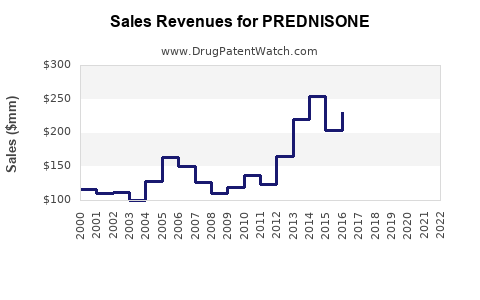
How big is the prednisone market in the US and what is the spending trajectory?
Prednisone’s financial profile is defined by persistent utilization rather than blockbuster-like growth. U.S. spend trends are typically characterized by:
- Volume durability: Chronic autoimmune, asthma/COPD exacerbation management, dermatologic and rheumatologic inflammation, and antiemetic/adjunct regimens in oncology create baseline demand.
- Price erosion: Long-standing generic availability drives net price downward over time, leaving revenue growth dependent on utilization, pack size mix, and periodic supply disruptions.
- Low innovation intensity: Market share is less about formulation breakthroughs and more about procurement contracts, AB-rated competition, and supply continuity.
What determines near-term revenue movement?
- Net pricing vs list price: Generic discounts and rebates dominate net revenue.
- Product mix: Prednisone strength mix (e.g., 1 mg, 5 mg, 10 mg, 20 mg) and dosage form mix (tablet vs liquid) shifts gross margin.
- Channel inventory: Wholesaler inventory corrections can create quarter-to-quarter volatility in shipments and revenue recognition.
Which indications drive consistent demand for prednisone?
Prednisone is used across multiple therapy areas. Demand is typically supported by:
- Asthma and COPD exacerbations (short courses, taper-based)
- Rheumatologic and autoimmune disease flares
- Dermatology (e.g., severe inflammatory dermatoses)
- Hematology/oncology adjuncts (anti-inflammatory and symptom control in regimens)
- Pulmonary, GI inflammatory conditions where oral corticosteroid bridging is used
What pricing and margin dynamics shape prednisone’s financial trajectory?
Prednisone’s economics are typical of mature oral generics: stable volume, compressed margins, and episodic supply or regulatory events.
How do generic competitors affect prednisone net price?
- Multisource competition pushes net prices toward marginal cost plus distribution.
- Contracting cycles (state and federal procurement, GPO influence) can cause share swings without meaningful clinical differentiation.
- Interchangeability and substitution keep demand elastic to price.
What margin levers exist for prednisone manufacturers?
- Manufacturing cost and yield: Bulk steroid synthesis and downstream processing cost structure.
- Packaging and compliance costs: Strength-specific SKUs, stability programs, and labeling complexity.
- Working capital: Working capital tied to inventory turns and lead times for API and packaging components.
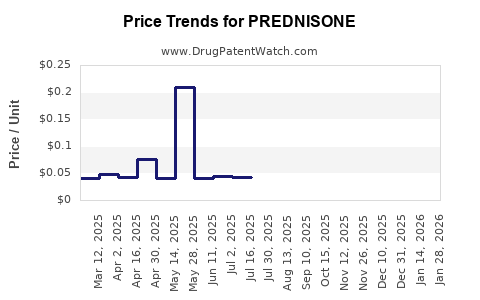
- Supply reliability: Production downtime shifts supply to fewer producers, temporarily supporting price and margin.
When does prednisone lose exclusivity and what does that mean for revenue?
Prednisone is not dependent on modern patent exclusivity the way newer drugs are. The commercial endpoint for brand-style economics occurred long before current planning horizons for most market participants.
Is prednisone still protected by meaningful U.S. patent exclusivity?
For a mature molecule like prednisone, market dynamics generally reflect:
- Expired composition-of-matter and key use or process patents across the primary U.S. entrant era.
- Remaining IP, if any, tends to be narrow and product-specific (certain dosage-form variants, specific manufacturing processes, or method-of-use claims tied to labeled populations).
How do generic entry risks materialize for prednisone now?
- For most buyers, incremental generic entry is less about “opening a new class” and more about predictable multi-entrant competition.
- The main risks are supply-side constraints (plant capacity, sterility/quality events, API availability) and regulatory compliance that can limit the effective supply of certain strengths.
What is the Orange Book status of prednisone and what products are listed?
Prednisone is a widely available generic, so the Orange Book is expected to show multiple AB-rated listings across strengths and dosage forms. The financial implication is that:
- No single sponsor holds pricing power at scale.
- Formulation or manufacturer-specific listings are often the only differentiators.
Commercial impact of Orange Book structure
- If multiple firms share Orange Book entries for the same strength and dosage form, then contract pricing and availability determine share.
- If any limited listings with unexpired patents exist, they typically create small pockets of constrained supply rather than brand-grade exclusivity.
How do Paragraph IV and patent litigation events affect prednisone revenue?
For mature generics, litigation is usually not a major driver unless it affects:
- A concentrated set of strengths (where only a few suppliers exist)
- A specific manufacturer’s ability to supply (leading to temporary shortages and price rebounds)
What is the typical litigation pathway for mature prednisone generics?
- Multiple ANDA filings are common.
- Court outcomes usually lead to routine generic launches unless a firm is enjoined.
- Even when litigation occurs, market economics typically revert quickly as other entrants maintain supply.
What is the biosimilar risk for prednisone?
Prednisone is a small-molecule chemical drug, so it does not have a biosimilar analogue. Competitive risk is instead generic-driven, not biosimilar-driven.
How do formulations and manufacturing method patents affect prednisone competition?
For prednisone tablets and common strengths, differentiation usually comes from:
- Bioavailability equivalence (ANDA bioequivalence waivers or studies)
- Stability and shelf-life performance
- Tablet hardness, disintegration, dissolution specs
- Manufacturing process controls
Financial effect
- Even when multiple generics meet specs, the winners are those who can sell at contracted net prices without supply interruption.
- Manufacturing disruptions are a bigger source of short-term price and margin movement than incremental formulation differentiation.
What generic launch scenarios exist for prednisone and what is the revenue upside/downside?
Generic launches for prednisone are generally “steady state” rather than discontinuous. Revenue upside is mostly supply-related.
Launch scenario A: New ANDA entrant increases competition
- Revenue downside for existing suppliers due to price compression.
- Margin pressure rises unless cost position improves.
Launch scenario B: Entrant launch is blocked or delayed
- Existing suppliers can protect pricing for longer.
- Shortages can create transient premium pricing.
Launch scenario C: Supply disruption constrains effective competition
- Net prices and margins can improve even without IP changes.
- Revenue volatility increases and inventory management becomes critical.
How does prednisone compare with other corticosteroids in market dynamics?
Prednisone’s economics should be compared against other oral corticosteroids and steroid alternatives.
Key substitution competitors
- Prednisolone (different steroid but same class economics)
- Methylprednisolone (dose-form and regimen differences)
- Dexamethasone (longer duration regimens, distinct clinical use patterns)
Commercial implication
- Substitution depends on clinician preference, formulary placement, dosing equivalence practices, and payer policies.
- Because all are generic, price competition is broad and switching often follows contracting and availability.
What regulatory factors influence prednisone’s financial trajectory (FDA pathways and labeling)?
Prednisone is typically served through ANDAs and generic labeling within established standards. Regulatory factors that affect supply and cost include:
- Manufacturing site approvals and inspection outcomes
- Stability data maintenance and shelf-life extensions
- Labeling changes that affect bid specifications or tender language
Which business factors most influence prednisone revenue forecasts?
For planning, the highest-signal drivers are operational and commercial rather than innovation-driven.
Demand drivers
- Baseline prevalence and escalation of inflammatory and autoimmune conditions
- Seasonality in respiratory exacerbations
- Utilization patterns for short-course steroids in outpatient and emergency settings
Supply drivers
- API availability and quality release times
- Finished dosage manufacturing capacity for specific strengths
- Batch failures or recall risk affecting near-term availability
Pricing drivers
- GPO and PBM contract resets
- State Medicaid and federal procurement changes
- Competitive intensity by strength and package size
Financial trajectory by firm archetype: what to expect
Without assigning specific quarter-by-quarter financial numbers to individual companies, the market structure supports three archetypes:
- Large diversified generics suppliers
- More stable supply chains and contract coverage.
- Lower sensitivity to single strength disruptions due to portfolio breadth.
- Niche generics or single-product-focused firms
- Higher margin volatility.
- Higher risk from plant downtime or batch failures.
- Distributor private label / contract manufacturers
- Revenue tied to procurement award cycles.
- Strong link between operational reliability and volume capture.
Key risks to the prednisone financial outlook
- Continued price erosion: Multi-entrant competition remains the baseline.
- Supply concentration risk: If production is concentrated among fewer suppliers, supply events create volatility.
- Regulatory action risk: Warning letters or import holds can abruptly reduce effective supply.
- Formulary and contract shifts: PBM and wholesaler contract changes can re-rank suppliers quickly.
- Clinical substitution: Even though corticosteroids are interchangeable in practice, payer preferences and formulary positioning influence utilization.
Key Takeaways
- Prednisone’s financial trajectory is dominated by mature generic pricing dynamics, not by remaining drug-specific exclusivity.
- Revenue is supported by persistent utilization across multiple inflammatory and autoimmune indications, but net prices trend down with each effective competitor and contract reset.
- Margin upside is episodic and usually follows supply constraints or manufacturing reliability rather than product innovation.
- The primary planning variables are effective supply by strength, contracting cycles, and regulatory/manufacturing reliability.
FAQs
- What factors drive quarter-to-quarter revenue volatility for generic prednisone tablets?
- How do GPO and PBM contracting decisions affect prednisone market share across strengths?
- What supply-chain events most commonly cause prednisone pricing spikes in the U.S.?
- How does switching between prednisone and prednisolone influence payer utilization and spend?
- What regulatory milestones (ANDAs, inspections, labeling updates) most impact prednisone availability?
References
- U.S. Food and Drug Administration. Orange Book: Approved Drug Products with Therapeutic Equivalence Evaluations. (Accessed 2026-07-30).