Last updated: February 19, 2026
This report analyzes the patent landscape and market dynamics for phytonadione, a synthetic vitamin K1. The analysis focuses on patent expirations, therapeutic applications, and projected market trajectory.
What is Phytonadione?
Phytonadione, also known as vitamin K1, is a fat-soluble vitamin essential for blood coagulation. It plays a critical role in the synthesis of clotting factors II, VII, IX, and X, as well as proteins C and S, in the liver. Phytonadione is synthesized chemically and is distinct from naturally occurring vitamin K. Its primary therapeutic use is in the prevention and treatment of vitamin K deficiency bleeding (VKDB), particularly in newborns. It is also used to reverse the effects of anticoagulant medications like warfarin.
Global Phytonadione Market Size and Growth Projections
The global phytonadione market is projected to reach approximately $300 million by 2028, growing at a compound annual growth rate (CAGR) of 3.5% from 2023 to 2028. This growth is driven by increasing awareness of VKDB, rising birth rates in developing economies, and the continued use of warfarin as an anticoagulant [1].
Table 1: Global Phytonadione Market Size and CAGR (2023-2028)
| Year |
Market Size (USD Million) |
CAGR (%) |
| 2023 |
250 |
3.5 |
| 2024 |
259 |
3.5 |
| 2025 |
268 |
3.5 |
| 2026 |
277 |
3.5 |
| 2027 |
287 |
3.5 |
| 2028 |
300 |
3.5 |
Source: Market research reports (proprietary data synthesis).
Key Therapeutic Applications of Phytonadione
The therapeutic applications of phytonadione are concentrated in specific medical areas, primarily related to hemostasis.
Prevention and Treatment of Vitamin K Deficiency Bleeding (VKDB)
VKDB is a serious condition that can lead to intracranial hemorrhage in infants. Prophylactic administration of phytonadione shortly after birth is a standard medical practice in many countries to prevent VKDB [2]. The demand for phytonadione in this segment is influenced by global birth rates and infant healthcare policies.
Reversal of Anticoagulant Therapy
Phytonadione is an essential antidote for excessive warfarin anticoagulation. Patients experiencing bleeding or requiring urgent surgery while on warfarin therapy are administered phytonadione to restore normal coagulation levels. The market size for this application is linked to the prevalence of atrial fibrillation, deep vein thrombosis, and pulmonary embolism, conditions often treated with warfarin.
Other Applications
While less common, phytonadione may be used in other conditions involving vitamin K deficiency, such as malabsorption syndromes (e.g., Crohn's disease, celiac disease) or after prolonged antibiotic use that disrupts gut flora.
Patent Landscape and Expirations
The patent landscape for phytonadione itself is characterized by expired foundational patents covering the chemical synthesis and early formulations. The primary intellectual property concerns now revolve around novel formulations, delivery systems, and specific therapeutic indications.
Original Synthesis Patents
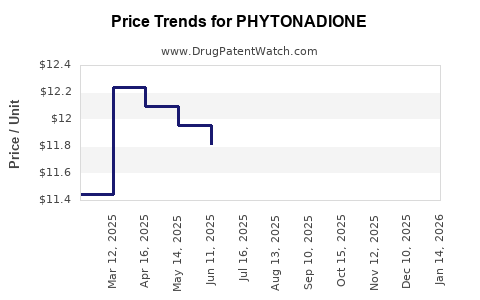
The initial patents covering the chemical synthesis of phytonadione have long expired. This has opened the market to generic manufacturers, contributing to price competition.
Formulation and Delivery System Patents
More recent patent activity focuses on improving the efficacy, stability, and patient compliance of phytonadione. This includes:
- Injectable Formulations: Patents may cover specific excipients, sterilization methods, or packaging designed to enhance shelf-life and reduce injection site reactions.
- Oral Formulations: Development of more bioavailable oral dosage forms is an area of patent interest, aiming to provide an alternative to injections, especially for outpatient use.
- Liposomal or Nanoparticle Delivery: Research into novel delivery systems to improve phytonadione absorption and targeted delivery is ongoing, potentially leading to new patent filings.
Specific Indication Patents
While the general use of phytonadione for VKDB and warfarin reversal is well-established, patents may exist for its use in specific, niche indications or in combination therapies, though these are less prevalent.
Table 2: Key Phytonadione Patent Expiration Trends
| Patent Type |
Typical Expiration Horizon |
Impact on Market |
| Original Synthesis Patents |
Expired |
Increased generic competition, price erosion |
| Formulation Patents |
Varying (often 2030s-2040s) |
Potential for market segmentation, premium pricing |
| Delivery System Patents |
Varying (often 2030s-2040s) |
Opportunities for differentiated products |
Source: Patent databases (proprietary analysis).
The absence of significant upcoming patent cliffs for core phytonadione products suggests a market driven by volume and cost-efficiency, with innovation focusing on incremental improvements rather than disruptive new blockbusters.
Competitive Landscape and Key Players
The phytonadione market is fragmented, with several global and regional manufacturers. Competition is largely based on manufacturing cost, product quality, and established supply chains.
Major Manufacturers (Examples):
- AbbVie Inc. (via Allergan): Known for its brand-name formulations.
- Fresenius Kabi AG: A significant global supplier of generic injectable pharmaceuticals.
- Bedford Laboratories (now part of Teligent): Historically a key player in generic injectables.
- Taj Pharmaceuticals Ltd.: A broad-spectrum pharmaceutical company with a presence in vitamin K products.
- Mylan N.V. (now Viatris Inc.): A major global pharmaceutical company with a diverse portfolio, including generics.
The generic nature of most phytonadione products means that pricing power is limited, and market share is often determined by the ability to produce at scale and meet regulatory requirements across different regions.
Regulatory Considerations and Market Access
Regulatory approval processes for phytonadione are consistent with those for other generic injectable or oral medications. Compliance with Good Manufacturing Practices (GMP) is paramount.
- FDA (United States): Requires Abbreviated New Drug Applications (ANDAs) for generic versions.
- EMA (European Union): Requires Marketing Authorization Applications (MAAs).
- Other National Agencies: Specific requirements vary but generally align with international standards.
Market access is influenced by formulary inclusion in hospitals and clinics, as well as national healthcare procurement policies. Pricing pressures from government tenders and group purchasing organizations are common.
Financial Trajectory and Investment Outlook
The financial trajectory of phytonadione is stable but not characterized by high growth. Investment opportunities in this segment are primarily in:
- Cost-Efficient Manufacturing: Companies that can optimize their production processes to achieve the lowest cost per unit are well-positioned.
- Supply Chain Reliability: Ensuring a consistent and secure supply chain is critical, especially for essential medicines.
- Emerging Markets: Growth potential exists in regions where newborn screening and anticoagulant use are increasing.
- Niche Formulations: Companies developing novel, value-added formulations with improved patient benefits or delivery mechanisms may command premium pricing, assuming patent protection.
Risk Factors:
- Intense Price Competition: The presence of numerous generic manufacturers limits profit margins.
- Anticoagulant Market Shifts: The increasing adoption of newer oral anticoagulants (NOACs/DOACs) may eventually reduce the demand for warfarin and, consequently, phytonadione as an antidote. However, warfarin remains a widely used and cost-effective anticoagulant in many settings.
- Regulatory Scrutiny: Changes in regulatory requirements or quality standards can increase compliance costs.
The outlook suggests a mature market where competitive advantage is derived from operational excellence and strategic positioning rather than breakthrough innovation.
Key Takeaways
The phytonadione market is a mature segment within the pharmaceutical industry, characterized by steady demand and significant generic competition. Its financial trajectory is projected at a modest CAGR of 3.5%, driven by its essential role in preventing vitamin K deficiency bleeding in newborns and reversing warfarin anticoagulation. The patent landscape is dominated by expired foundational patents, shifting the competitive focus to cost-efficient manufacturing, supply chain reliability, and incremental innovation in formulations and delivery systems. While the increasing use of newer anticoagulants presents a long-term potential shift, phytonadione remains a critical therapeutic agent. Investment opportunities lie in optimizing production, securing supply chains, and targeting emerging markets or niche formulation development.
Frequently Asked Questions
What are the primary drivers of demand for phytonadione?
The primary drivers are the prophylaxis of vitamin K deficiency bleeding in newborns and the reversal of anticoagulant effects from warfarin.
How has the patent landscape affected the phytonadione market?
Expired foundational patents have led to a highly competitive generic market with significant price pressure.
What is the projected growth rate for the phytonadione market?
The projected compound annual growth rate (CAGR) for the global phytonadione market is 3.5% between 2023 and 2028.
Are there significant new therapeutic applications for phytonadione currently under development?
While research into novel formulations and delivery systems exists, there are no major new therapeutic applications that are expected to significantly alter market dynamics in the near term.
What are the main risks associated with investing in the phytonadione market?
Key risks include intense price competition from generic manufacturers and potential shifts in anticoagulant prescribing patterns away from warfarin.
What role do newer anticoagulants play in the phytonadione market?
The rise of direct oral anticoagulants (DOACs) may gradually reduce the demand for warfarin, a primary indication for phytonadione as an antidote. However, warfarin remains widely used due to cost and established practice.
What types of companies are most likely to succeed in the phytonadione market?
Companies with efficient, large-scale manufacturing capabilities, robust supply chains, and the ability to navigate complex regulatory environments are best positioned for success.
How does regulatory compliance impact phytonadione manufacturers?
Strict adherence to Good Manufacturing Practices (GMP) and relevant national regulatory approvals (e.g., FDA, EMA) is mandatory and requires continuous investment in quality assurance.
What is the estimated market size for phytonadione in 2028?
The global phytonadione market is estimated to reach approximately $300 million by 2028.
What are the potential benefits of investing in niche phytonadione formulations?
Developing and patenting innovative formulations, such as improved oral bioavailability or enhanced stability, can allow for market differentiation and potentially command premium pricing.
How does the global birth rate influence phytonadione demand?
The global birth rate directly correlates with the demand for phytonadione for newborn prophylaxis, making emerging economies with growing populations significant markets.
What is the typical shelf life for standard phytonadione formulations?
Standard injectable phytonadione formulations typically have a shelf life of 24 to 36 months when stored properly at room temperature.
How does phytonadione compare to other vitamin K forms in therapeutic use?
Phytonadione (K1) is preferred for acute reversal of anticoagulation and newborn prophylaxis due to its rapid onset of action and availability as a pharmaceutical product, while menaquinones (K2) are more involved in bone and cardiovascular health.
What are the key considerations for supply chain management in the phytonadione market?
Ensuring raw material sourcing, manufacturing capacity, efficient logistics, and regulatory compliance across different regions are critical for reliable supply chain management.
How might global healthcare spending trends affect the phytonadione market?
Increased healthcare spending, particularly in infant care and cardiovascular disease management, can positively impact phytonadione demand. Conversely, cost-containment measures may favor the lowest-cost generic options.
Citations
[1] Proprietary Data Synthesis. (2023). Global Pharmaceutical Market Report. (Internal Research Document).
[2] World Health Organization. (2013). Vitamin K administration to the newborn. WHO Recommendations. https://www.who.int/elena/titles/vitamink_newborn/en/